Moscow answered Friedrich Merz’s show of solidarity with a show of force — and the target may not have been the bridge at all.
Russia’s drone strike on Kyiv’s Northern Bridge, landing within hours of the German chancellor’s unannounced Sunday arrival, read as a message aimed less at the span itself than at the man who had just stepped off his train. The Kremlin has been warning European capitals — Berlin above all — to cut off military aid to Ukraine. Striking while Merz was on the ground was Moscow’s way of demonstrating what that aid is being used against, and what it costs to keep sending it.
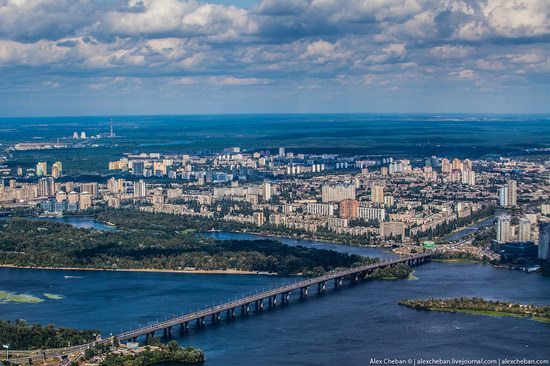
The morning strike sent a Russian drone into the roadway of the Pivnichnyi Bridge over the Dnipro River, igniting a fireball that engulfed one side of the span. Traffic was still flowing when it hit; drivers were filmed forcing their way through the flames to reach the far bank. Kyiv Mayor Vitaliy Klitschko said two people were injured. It was the second hit on the Northern Bridge in two days. Two days earlier, the city’s Southern Bridge — which carries both road traffic and the subway — had been struck five times in under 24 hours.
Russia’s defense ministry said the Sunday attack targeted a route used to move troops and military equipment. It also claimed to have hit two cargo vessels carrying military hardware at the port of Odesa, and said that on Saturday it had struck a logistics center in the Kyiv region. Moscow warned that the assault on Kyiv would only intensify in the coming days.
The logic of the bridge campaign is straightforward geography. The Dnipro cuts Kyiv in half: the western bank holds the bulk of the government offices, businesses and employment centers, while the eastern bank is mostly residential. Take the crossings out and the capital of nearly three million people stops functioning. Authorities have already restricted or suspended traffic on several crossings, bringing gridlock across the city. Kyiv’s infrastructure minister said Sunday the city plans to build additional bridges over the Dnipro if the attacks continue. Klitschko — who has watched his city largely spared the worst of the front-line destruction — said Kyiv must now shift onto a war footing.
The bombardment reaches beyond the bridges. President Volodymyr Zelensky said Russian drones had also hit a pharmaceutical warehouse in Sumy, killing one person, and a communications facility in Dnipro. “Terrible nights and days,” he said of what Kyiv’s residents are enduring, calling the attackers “absolute barbarians.”
Merz had come to say Europe’s largest economy is not looking away. Standing with Zelensky at the National Academy of Sciences — a building itself damaged by a Russian drone strike last week — he announced further German military and energy assistance, including funding for the production of interceptor drones built to hunt Russia’s new jet-powered attack drones. “Ukraine needs all our support in the coming weeks,” he said. “If Russia is not stopped, sooner or later its war machine will turn against us.” He did not soften what he had witnessed: “We can see the entire pointlessness of this war at this place. These barbarous attacks on the civilian population of Ukraine must stop. These are war crimes that are being committed daily here.” Zelensky said “important agreements” were discussed on Sunday, though no details were released.
For now the Dnipro campaign is doing exactly what it was designed to do: choking the movement of a major European capital, day by day, crossing by crossing. The open question — the one Merz’s visit was meant to answer — is whether the bridges and the Western aid flowing beneath them can outlast Moscow’s resolve to bring them down.