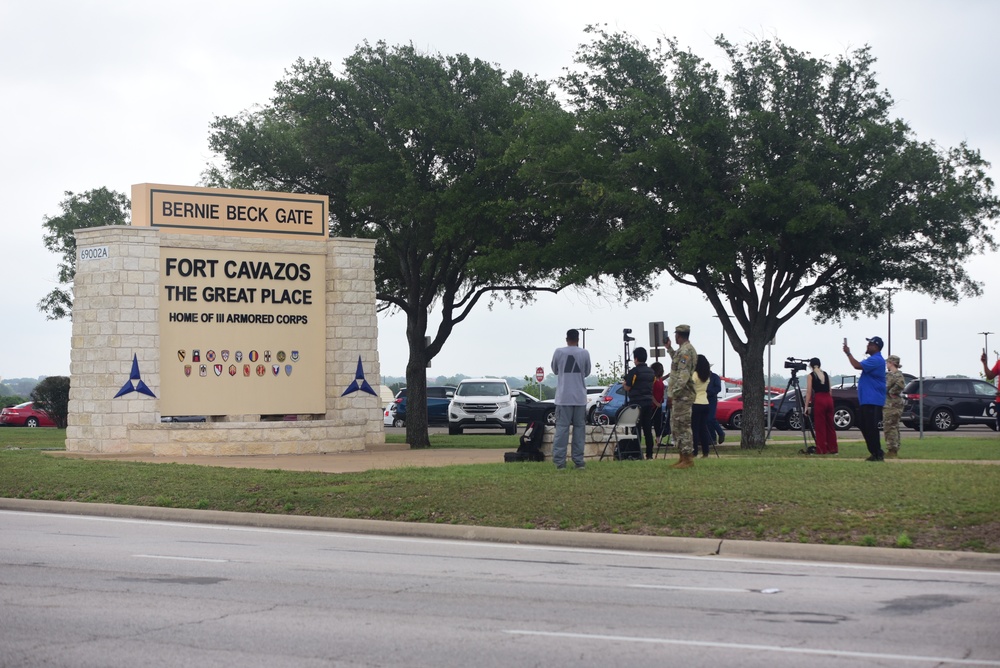
President Donald Trump has approved the execution by military firing squad of Nidal Hasan, the former Army psychiatrist convicted of killing 13 people at Fort Hood, Texas, in 2009. The Pentagon announced the decision on Monday, setting up what would be the first execution carried out by the United States military since 1961.
“Secretary of War Pete Hegseth has recommended — and President Donald J. Trump has approved — death by U.S. Army firing squad for convicted terrorist Nidal Malik Hasan,” Pentagon spokesman Sean Parnell wrote on X. “The Secretary of the Army will set the time and place of the execution. Judgement day for Hasan has finally come.”
Hegseth himself marked the announcement with a single word on X: “Justice.”
The deadliest attack on a U.S. military base in decades
On November 5, 2009, Hasan — then an Army major and psychiatrist — opened fire at the Soldier Readiness Processing Center at Fort Hood, where troops were being prepared for deployment to Iraq and Afghanistan. He killed 13 people, 12 of them unarmed active-duty soldiers, and wounded 32 others. Parnell noted that Hasan shouted “Allahu Akbar” during the attack. A civilian police officer shot Hasan to stop the rampage; he has been partially paralyzed ever since.
Hasan later described the shooting as retaliation for American wars in the Muslim world. Investigators found he had exchanged messages with Anwar al-Awlaki, the American-born al-Qaeda cleric later killed in a U.S. drone strike in Yemen.
A 17-year legal road
Hasan was court-martialed in 2013, where he represented himself and mounted almost no defense — calling no witnesses and making no effort to deny the charges. A military jury convicted him of 13 counts of premeditated murder and 32 counts of attempted premeditated murder, and sentenced him to death. He has been on military death row at the U.S. Disciplinary Barracks at Fort Leavenworth, Kansas, ever since, and was stripped of his rank and dismissed from the Army.
He is one of only four inmates on the military’s death row. According to reports, he completed his final legal appeals in early 2025, leaving only executive approval before an execution could be scheduled. Under Army policy, the execution must take place within 150 days of the president’s approval — but not sooner than 60 days.
Why a firing squad, and why now
The last time the U.S. armed forces put anyone to death was 1961, when Army Private John Bennett was hanged at a Kansas prison for the rape and attempted murder of an 11-year-old girl. The firing squad is even rarer in military history; a military firing-squad execution hasn’t happened in more than 60 years.
The method is part of a broader revival. The Trump administration recently added the firing squad, electrocution and gas asphyxiation to the permissible methods of execution for the gravest federal crimes — in part because lethal injections have become harder to carry out. Last week, Tennessee’s attempt to execute Christa Pike by lethal injection went wrong: two doses of pentobarbital failed to kill her on September 30, leaving her hospitalized in critical condition and reigniting the national debate over execution methods.
According to earlier reporting, the Army has been preparing for this moment for months. Officials circulated a plan — dubbed “Operation Resolute Justice” — to coordinate with the Federal Bureau of Prisons on the executions of Hasan and the military’s three other death-row inmates, potentially transferring them to a facility in Indiana.
Why this matters
This is not really a story about one inmate. The Hasan execution order is the sharpest edge of a deliberate federal turn toward harsher, more visible capital punishment — and toward methods that carry a particular theatrical weight. The firing squad is designed to be seen and felt differently from a needle behind a curtain; choosing it for the first military execution in 65 years is a statement, not just a procedure.
It also closes one of the longest-running sagas in American military justice. Seventeen years after the worst mass killing at a U.S. military base, the man who did it has exhausted his appeals, lost his uniform, and is about to lose his life on a schedule set by presidential approval. For the families of the dead — and for an Army that still remembers the shock of soldiers being gunned down on their own base — the announcement is both an ending and a reopening. Judgment day, as the Pentagon put it, has finally come. But the arguments about how America executes people, and whether it should, are only getting louder.