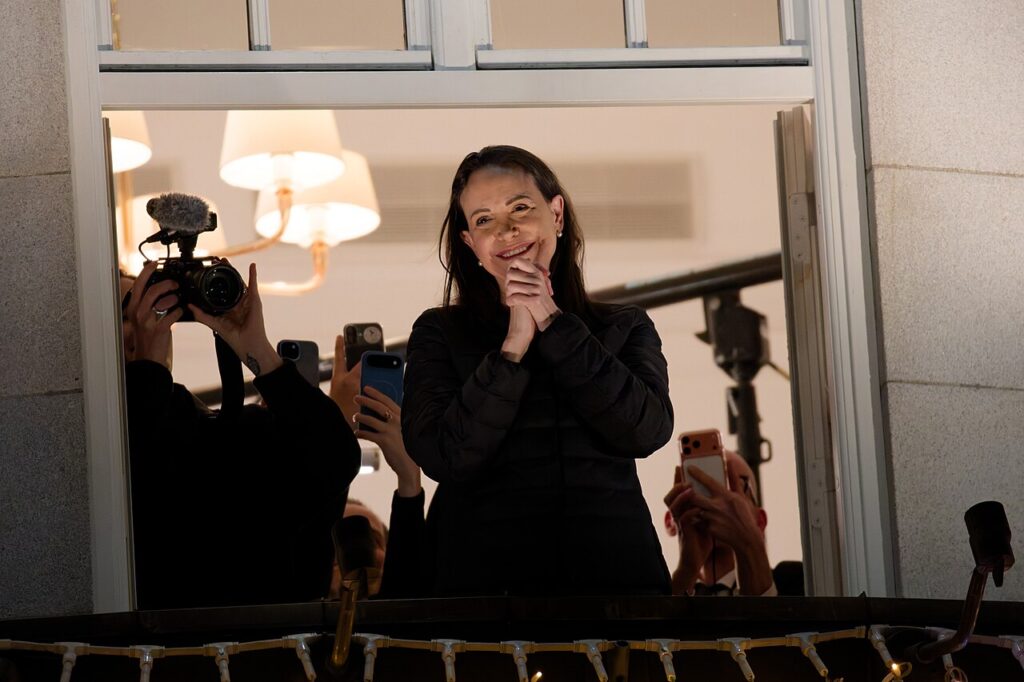
María Corina Machado is home. After nearly a year in exile, Venezuela’s opposition leader and Nobel Peace Prize laureate announced her return on Sunday morning with a short post on X: “I am here. With you.”
Within hours, her team shared images of her first public appearance: Machado among worshippers at the Church of Santa Rosa in Barquisimeto, in the western state of Lara, surrounded by an ecstatic congregation. The opposition later circulated video of her being welcomed by a crowd of supporters at the Sanctuary of the Divine Shepherdess in the same city.
For readers outside Venezuela, Machado’s name carries unusual weight. She is the opposition leader who spent years challenging the authoritarian rule of Nicolás Maduro, went into hiding in January 2025 after being briefly detained following a protest, then slipped out of the country in a clandestine escape and reappeared in December 2025 in Norway, where she received the Nobel Peace Prize for her peaceful defiance of the Maduro government.
Everything changed while she was away. In January 2026, a United States military operation removed Maduro from power; he and his wife, Cilia Flores, were taken to the United States to face federal charges including narco-terrorism conspiracy, and have pleaded not guilty. Maduro’s former deputy, Delcy Rodríguez, took over as interim president, and Washington has thrown its weight behind her government — including the $76 billion oil partnership struck with the interim government — while saying democratic elections must wait until the country stabilises. In September, President Donald Trump said it was “too soon” to consider holding elections.
That transition, brokered by Washington, proceeded without Machado. The Wall Street Journal reports that the talks were channelled through another opposition figure, Dinorah Figuera, and that Machado has said she was shut out of the negotiations. A third round of those talks concluded this week with agreements on incremental reforms — but no timetable for a presidential election. The Journal also reports that Machado made at least seven failed attempts to return through Curaçao and Panama, some of them thwarted amid opposition from US officials.
Her closest ally welcomed the return immediately. Edmundo González Urrutia, the opposition candidate in Venezuela’s disputed 2024 presidential election, who is himself in exile in Spain, wrote on X: “Our sovereign voice returns with her to lead and guide this process!” He added that he would soon join her in Venezuela “so that our country truly advances towards freedom.”
Trump, asked about the return as he left the White House on Sunday, said he had not known about it. “She’s a very nice woman,” he said. “She gave me her Nobel Prize, so how can I say anything else? And I hope she’s safe.” In a separate Fox News interview on Sunday, he said the United States had “total control of Venezuela” and was “taking out millions of barrels of oil a week.” Neither the White House nor the State Department immediately commented further, and Venezuela’s communications ministry did not immediately respond to requests for comment, according to Reuters.
What Machado does next is now the question hanging over the transition. Her senior foreign-policy adviser, David Smolansky, told Reuters she plans to meet victims of the deadly earthquakes that struck Venezuela in June, as well as the families of political prisoners, the international community and leaders of the democratic movement. “She will work proactively for a date for free and fair elections,” he said.
Why this matters beyond Venezuela: a political transition managed from abroad has just collided with the one figure it could not absorb. Machado brings something neither Washington nor the interim government can manufacture — the moral authority of a Nobel laureate who refused to leave until she was forced out, and who chose to come back when staying abroad would have been safer. She holds no formal office, and the interim government has given no sign it will offer her one. But every step of the US-backed plan — stabilisation first, elections at some unspecified later date — now has to be argued in a country where its most popular opposition voice is standing on home soil demanding a date. If González follows her back, as he says he will, the exiled leadership that challenged Maduro will be reunited inside Venezuela for the first time since his fall. How Rodríguez’s government and Washington respond to that — embrace, ignore, or confront — will define whether Venezuela’s transition is a genuine opening or a managed arrangement that only looked like one.
One detail remains undisclosed: how Machado got in. Her team has shared images and video of her arrival but not the route she took, and neither Caracas nor Washington has said whether her entry was facilitated, tolerated, or simply undetected until she announced it herself.