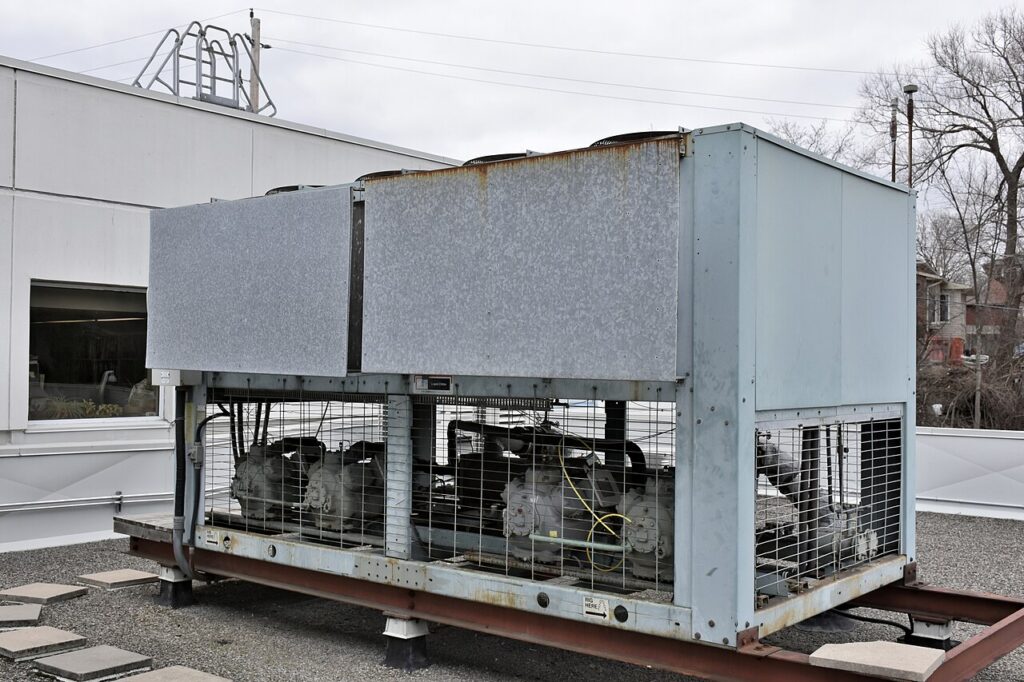
Informopedia Explains: there is a chemical inside your air conditioner that, molecule for molecule, warms the planet more than a thousand times as powerfully as carbon dioxide. It leaks a little every year. And humanity is now racing — through treaties, labs and factory floors — to replace it before the world buys billions more air conditioners.
Start with an uncomfortable number. The refrigerants humming inside most of the world’s air conditioners and refrigerators belong to a family called HFCs — hydrofluorocarbons. The most common, HFC-134a, has a global warming potential of roughly 1,300 to 1,430: one kilogram of it traps as much heat as 1.3 tonnes of CO₂. It lingers in the atmosphere for 13 to 14 years. Every cooling device on Earth holds kilograms of the stuff, and every one of them leaks — a little during normal use, a lot when it is serviced badly or dumped at the end of its life.
Now multiply by the future. The International Energy Agency counts 1.6 billion air conditioners in use today and projects 5.6 billion by 2050, as rising incomes and rising temperatures collide across Asia and Africa. Cooling already consumes about 10 percent of the world’s electricity. In India alone, air conditioning could account for 45 percent of peak electricity demand by 2050. Every one of those new machines needs a refrigerant. The question of which chemical goes inside them is one of the quietest, most consequential climate decisions of the next two decades.
How we got the wrong chemical — twice
This is actually the second time humanity has had to fix its refrigerants. The original coolants, CFCs — chlorofluorocarbons — were brilliant at their job and catastrophic for the ozone layer: a single chlorine atom from a CFC could destroy 100,000 ozone molecules. The world responded with the Montreal Protocol of 1987, the most successful environmental treaty ever written, and the ozone hole began its slow recovery.
But the replacement chemicals, HFCs, solved the ozone problem by creating a climate problem. They contain no chlorine, so the ozone layer is safe — yet their molecular structure makes them ferociously effective greenhouse gases, thousands of times more potent than CO₂. We traded a hole in the sky for a blanket around the planet.
The fix to the fix came in 2016: the Kigali Amendment to the Montreal Protocol, which commits the world to cutting HFC production and consumption by 80 to 85 percent by 2047. If fully implemented, it would prevent up to 0.5°C of warming by 2100 — a staggering return for a treaty most people have never heard of. More than 170 countries have ratified it. India, whose cooling demand is growing faster than almost anywhere on Earth, ratified in 2021, with a freeze year of 2028: from then on, its HFC consumption cannot grow, and must fall 10 percent by 2032, 20 percent by 2037, 30 percent by 2042, and 85 percent by 2047.
The molecule that disappears in 11 days
The leading replacement is a chemical with an unlovely name: HFO-1234yf, a hydrofluoro-olefin. Its trick is structural — a carbon double bond that makes the molecule fall apart in the atmosphere within about 11 days, versus 13-plus years for HFC-134a. The result: a global warming potential of roughly 1 to 4, over 99 percent lower, with zero ozone depletion. It is a near drop-in replacement for HFC-134a, which is why carmakers worldwide have already adopted it for vehicle air conditioning; it is now expanding into commercial refrigeration, cold chains and chillers. Its one drawback: it is mildly flammable, classified A2L, which demands careful handling in manufacturing and servicing.
And this is where a laboratory in Hyderabad enters the story. Around October 10, scientists at India’s Council of Scientific and Industrial Research – Indian Institute of Chemical Technology (CSIR-IICT) announced they had developed the country’s first indigenous bench-scale process for producing HFO-1234yf at a national laboratory — work underway since 2018, now ready for industry collaboration toward commercialization. “We did not have our own process technology for manufacturing HFO-1234yf. CSIR-IICT has developed India’s first bench-scale process for producing HFO-1234yf,” the institute’s director, Dr. D. Srinivasa Reddy, told the Deccan Herald.
Why does “indigenous process” matter? Because manufacturing HFO-1234yf is genuinely hard — it involves handling hydrogen fluoride, one of industry’s nastiest chemicals — and until now India has depended on imports for the next-generation refrigerant. With the 2028 freeze year approaching, domestic manufacturing capacity is the difference between a managed transition and a supply crunch. The institute is now talking to industry about scaling up; the realistic horizon for the chemical reaching consumers is two to three years.
The part most people get wrong
Here is the honest accounting, and it complicates the story: most of cooling’s climate damage does not come from leaking refrigerants at all. It comes from the electricity that powers the machines. The UN Environment Programme’s analysis is blunt — the energy consumed by air conditioners dwarfs the warming caused by their refrigerant leaks over a unit’s lifetime, especially in countries whose grids still run on coal.
That does not make the refrigerant transition pointless; it makes it half the job. The other half is efficiency: the average air conditioner sold today is far less efficient than the best available models, and minimum efficiency standards in many countries are weak. The IEA’s prescription is to do both at once — efficient machines running on low-GWP refrigerants, powered increasingly by clean electricity. Fix only the chemical and you leave most of the emissions in place. Fix only efficiency and the leaks keep warming the planet for centuries.
Why this matters
Cooling sits at the exact intersection of climate cause and climate consequence. As the planet warms — driven in part by records like the super El Niño now breaking temperature records — demand for cooling explodes, and the way we meet that demand determines how much worse the warming gets. It is a feedback loop with a thermostat, and the refrigerant inside the machine is one of the levers.
The Kigali Amendment is proof that the world can, occasionally, coordinate on invisible chemistry: the ozone hole is healing because of one such decision. The HFC phase-down is the sequel, harder because the stakes are diffuse and the chemistry is buried inside appliances nobody thinks about. India’s bench-scale process is a small, technical milestone — a few scientists in Hyderabad coaxing a fragile molecule into existence. But multiply it by 5.6 billion air conditioners, and small technical milestones are what the future is made of.
What happens next
Watch three clocks. The first is India’s 2028 freeze year — the moment its HFC consumption must stop growing, which will test whether domestic HFO-1234yf production scales in time. The second is the global phase-down schedule: 80–85 percent cuts by 2047, with each step requiring the chemical industry to retool. The third is the efficiency standards most governments have been slow to tighten, even though they are the bigger lever.
The molecule in your air conditioner will probably be different in 2035 than it is today. Whether the electricity running it is different too — that is the part still up for negotiation.
Sources: UNEP — Kigali Amendment overview; IEA — The Future of Cooling.