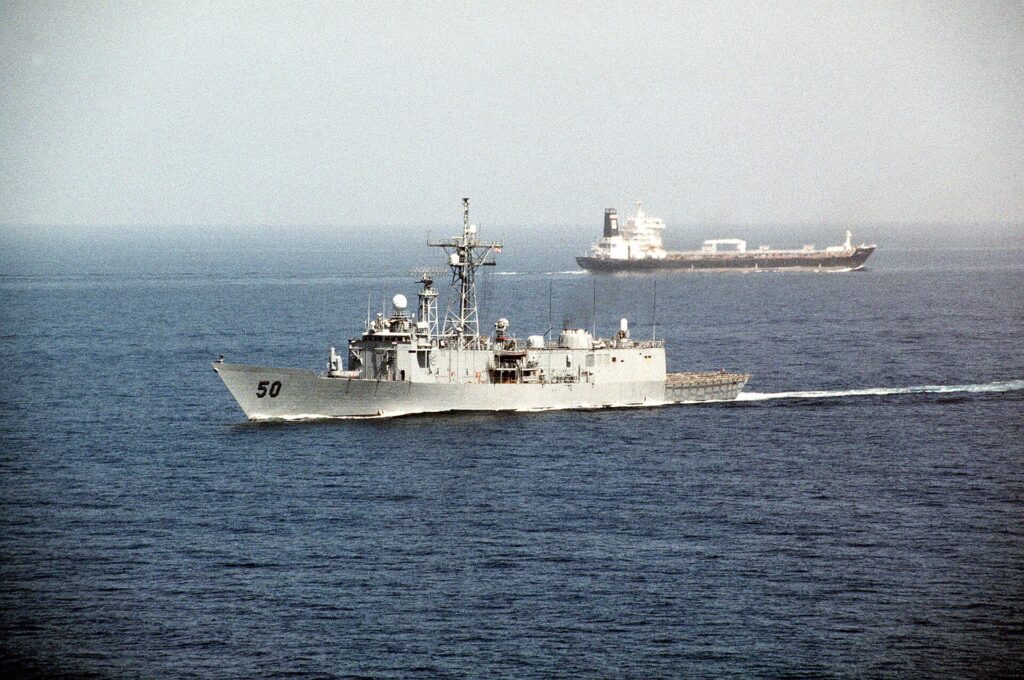
Informopedia Explains: two numbers should not coexist — 21 miles wide, and 20 million barrels of oil a day. This is the waterway the whole world economy balances on.
Stand on the coast of Oman at the right spot and you can see Iran across the water. That is how narrow the Strait of Hormuz is: 21 nautical miles — about 39 kilometers — at its narrowest point. A fast boat crosses it in under an hour.
Through that gap flows one-fifth of all the oil the world consumes. Every single day.
The numbers that make planners lose sleep
According to the U.S. Energy Information Administration, roughly 20 million barrels of oil and petroleum liquids pass through the Strait of Hormuz daily. That is about 20 percent of global consumption and more than a quarter of the world’s seaborne oil trade. Some estimates put it at 21 million barrels a day.
Most of those barrels sail east. China, India, Japan and South Korea together take well over half of the crude passing through the strait, which is why any sustained disruption hits Asian economies first and hardest.
And it is not just oil. Roughly a quarter of the world’s liquefied natural gas transits Hormuz — nearly all of Qatar’s LNG exports, which heat homes and power factories from Europe to East Asia, squeeze through the same gap.
Why nobody can just go around it
The obvious question: if one strait is this dangerous, why not use another route? The honest answer is that there isn’t one — not one that matters.
Saudi Arabia has its East-West Pipeline, which can move about 5 million barrels a day to the Red Sea. The UAE’s Habshan-Fujairah pipeline bypasses the strait with about 1.5 million barrels a day. Combined, every bypass route on Earth covers less than 40 percent of the strait’s traffic. A full closure would leave more than 10 million barrels a day with nowhere to go.
Rerouting tankers around Africa adds two to three weeks and enormous shipping costs. Strategic reserves — about 1.5 billion barrels globally, roughly 75 days’ worth of strait-equivalent supply — buy time, not solutions. Ramping up production elsewhere, from U.S. shale to Guyana, takes six months to a year at minimum.
Why it keeps getting closed — or threatened to
Hormuz has been a lever in every serious Gulf confrontation for four decades. Iran borders the strait’s northern shore and has repeatedly threatened to close it in response to sanctions, military action or diplomatic pressure. During the Iran-Iraq War in the 1980s, the so-called Tanker War turned these waters into a battlefield. In 2019, tanker seizures spiked insurance rates tenfold.
Then came 2026. With the U.S.-Iran war shutting the strait, the world is living through the largest oil supply shock in history by raw volume: nearly 20 million barrels a day at risk, against about 4–5.5 million removed by the 1973 embargo, roughly 5–6 million during the Iranian Revolution, and about 4 million at the start of the Iran-Iraq War.
Yet the catastrophe that was forecast didn’t fully materialize — at least not yet. The IMF estimates the closure would have cut 0.9 percentage points off 2026 global growth without mitigation. Instead, redirected Gulf supplies, increased production elsewhere, withdrawals from inventories and the fact that the world simply uses oil less intensively than it did in the 1970s have limited the damage to about 0.3 percentage points.
What it costs you
Even a partial disruption reaches your wallet fast. Refined petroleum product prices are running 70 to 95 percent above pre-war levels. The IMF projects the average petroleum spot price at $96 a barrel for 2026 — 16 percent above what it assumed in April — and natural gas at $20 per million British thermal units, about 36 percent higher.
That shows up in diesel prices, freight rates, fertilizer, food transport — the entire chain of things that move things. This is also why diesel costs more than petrol — and it is the economic pressure behind the Trump-Putin diesel deal that has torn open the Western alliance.
What happens next
The baseline in the IMF’s October World Economic Outlook assumes the Strait of Hormuz reopens in March 2027, with broadly pre-war conditions by October 2027 — “a gradual restoration of production, shipping, insurance and payment arrangements rather than immediate normalisation.” That is an assumption, not a promise. Iran’s seven conditions for reopening it remain on the table.
History suggests the strait will reopen, as it always has. It also suggests someone will threaten to close it again within a decade. The strait’s real lesson is not about any one war. It is that the modern world built an energy system in which a waterway narrower than the English Channel can decide whether factories in Osaka run, trucks in Karachi move, or lights stay on in Seoul.
Until that changes, every map of the global economy has one small, unmissable dot on it — and every crisis in the Gulf sends a bill to everyone, everywhere.



4 Comments