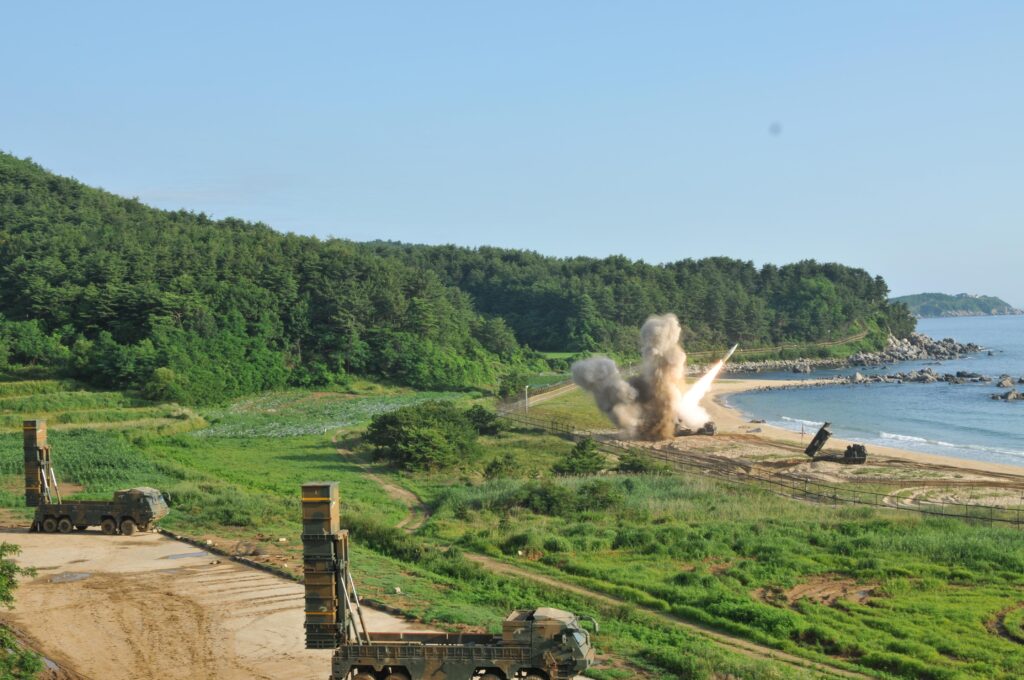
South Korea flight-tested its first domestically developed hypersonic weapon on Thursday, a milestone its president called a major step toward defending the country “through our own strength.” The test comes days after North Korea launched its own hypersonic missile — and the two launches, taken together, say something bleak about where the peninsula is heading.
What was tested
The weapon is a hypersonic glide vehicle: a warhead boosted into the upper atmosphere by a rocket, then released to glide toward its target at five times the speed of sound or more, maneuvering unpredictably along the way. That combination — extreme speed plus an irregular flight path — is what makes hypersonics so prized and so feared: they are designed to slip past missile defenses that can track ordinary ballistic missiles.
According to the presidential Blue House, the vehicle separated from its booster at the planned altitude, then descended while maneuvering both vertically and horizontally before striking a test target. The test was meant to verify the core technologies: ultra-high-temperature heat-resistant materials, guidance and control, and the ability to fly an irregular course at low altitude under hypersonic conditions.
President Lee Jae Myung attended the test in person, then inspected the country’s most powerful conventional weapon, the Hyunmoo-5 ballistic missile, at the Agency for Defense Development site. His office did not say where the test took place.
Why now
Timing is everything here. Less than a week earlier, North Korea tested its own intermediate-range hypersonic missile, which landed in waters near Japan. Pyongyang claimed the launch used artificial intelligence and boasted of a “wave-like trajectory” that left South Korea and Japan unable to track it.
The two Koreas are technically still at war, and the temperature has been rising for weeks. Last month, three South Korean soldiers were wounded by landmine explosions near the border; Seoul and the US-led United Nations Command concluded the devices were planted by the North, which denied responsibility and mocked the demand for an apology. Kim Jong Un, meanwhile, keeps expanding his nuclear program while taking an ever harder line toward the South — with what analysts describe as growing technological help from Russia, which has been using hypersonic missiles in combat since around 2024.
“South Korea has also been devoting considerable effort to developing the technology — and can be said to have achieved a successful test this time,” said Hong Sung-pyo, a senior researcher at the Korea Institute for Military Affairs.
The logic — and the trap
Seoul’s argument is straightforward deterrence: a weapon that can strike key targets by surprise, anywhere on the peninsula, makes Pyongyang think twice. The Blue House called the glide vehicle a “key strategic asset capable of changing the course of the battlefield,” and Lee’s line — “must secure our security through our own strength” — is aimed as much at Washington as at Pyongyang, a declaration that South Korea will not outsource its defense forever.
The trap is equally straightforward. Every advance on one side of the DMZ becomes the justification for the next advance on the other. North Korea’s test prompted the South’s; the South’s success will be cited in Pyongyang when the next northern test is announced. Hypersonics compress decision times from minutes to seconds, which is precisely why strategists worry about them: in a crisis, there is less room for a phone call, a pause, a second thought.
What happens next
The weapon is still under development — Thursday’s flight verified technologies, not a deployable system. But the direction of travel is unmistakable. Both Koreas now claim working hypersonic programs. Russia is sharing what it knows with the North. And South Korea, having proven it can build the thing, will now work on building it in numbers.
The peninsula’s arms race used to be measured in artillery and rhetoric. Now it is measured in Mach numbers.



One Comment