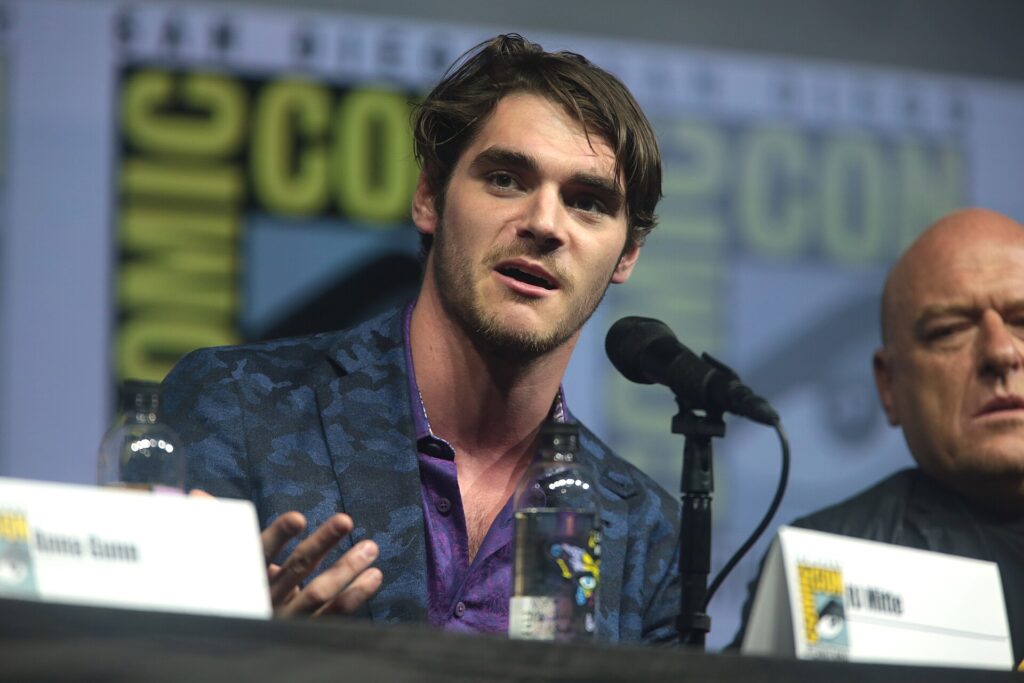
RJ Mitte, the actor who played Walter White Jr. across all five seasons of Breaking Bad and spent the decade after the show fighting for disability representation in Hollywood, has died. He was 34.
A representative for the actor, Sean Reilly, confirmed his death to multiple outlets on Monday. Mitte was declared dead at 1:32 p.m. local time at his home in Brownsville, Texas, on October 12, according to Cameron County Justice of the Peace Judge Cyndi Hinojosa.
“It is with profound sadness that we share the tragic passing of beloved actor, philanthropist, and passionate disability rights advocate RJ Mitte,” Reilly said in the statement. “At this time, we ask people to respect the privacy of RJ Mitte’s family and close ones.”
No official cause of death has been announced. TMZ, citing a county official, reported that Mitte died by suicide and that the death investigation is ongoing; his representatives have not confirmed those details. If you or someone you know is struggling, the 988 Suicide and Crisis Lifeline is available 24/7 in the United States.
Walt Jr., the son nobody wanted to be but everyone watched
Born Roy Frank Mitte III in Jackson, Mississippi, on August 21, 1992, Mitte was diagnosed with cerebral palsy at age three. He moved to Los Angeles in 2006 with dreams of acting, picking up small parts on sitcoms like Everybody Hates Chris and Hannah Montana before landing the role that would define him.
When Breaking Bad premiered in 2008, Mitte was cast as Walter “Flynn” White Jr., the son of Bryan Cranston’s chemistry-teacher-turned-kingpin Walter White and Anna Gunn’s Skyler. It was not a small part: Mitte appeared in 56 episodes, and Walt Jr. became the show’s moral anchor — the kid who adored his father even as he unknowingly financed that adoration with drug money, and whose final-season confrontation with Walt delivered one of the series’ most devastating scenes.
The ensemble cast was nominated for three consecutive Screen Actors Guild Awards for outstanding performance by an ensemble in a drama series, winning in 2014. In 2013, Mitte received the SAG-AFTRA Harold Russell Award, given to a performer with a disability who has substantially advanced awareness of the disability experience through media.
A platform, not just a role
What separated Mitte from most child-actor success stories is what he did after the cameras stopped. Drawing on his own life with cerebral palsy — the same condition his character had on screen — he became a Screen Actors Guild spokesman for actors with disabilities, an ambassador for United Cerebral Palsy and Shriners Children’s, and the president of his own philanthropic organization, The Mitte Foundation.
He kept working, too: a recurring role on Switched at Birth, the lead in Netflix’s The Guardians of Justice, and a string of indie films including Who’s Driving Doug, Standing Up for Sunny, The Oak Room, and Triumph, the last of which he also executive produced.
His death comes two days after that of Mike Ditka, the Chicago Bears legend, and it caps a year in which Breaking Bad itself was named the greatest television show of the 21st century by The New York Times — a reminder that the show’s legacy is carried by its people, and its people are mortal.
Why this matters
Mitte belonged to a small, stubborn lineage of actors who refused to let disability be a casting gimmick. On Breaking Bad, his character’s cerebral palsy was never the point of the story and never a punchline; it was simply part of a complicated kid trying to survive a complicated family. Off screen, Mitte weaponized that authenticity, spending his adult career arguing — in speeches, on panels, and in industry rooms — that disabled characters should be played by disabled actors, and that disability stories belong in the writers’ room, not just in the dialogue.
Fifteen years ago, that argument was a fringe plea. Today, after productions across the industry have changed how they cast and write disabled roles, it is standard professional wisdom. That shift does not carry his name alone, but he was one of the people who carried it. He was engaged to Kennedy Suarez, stayed active in advocacy until the end, and died far too young to finish the work he had claimed as his own.