SINGAPORE — A week apart, the two most influential voices in global economic policy landed on the same warning: the age of energy-driven inflation is back, and central banks may have to answer it with higher interest rates.
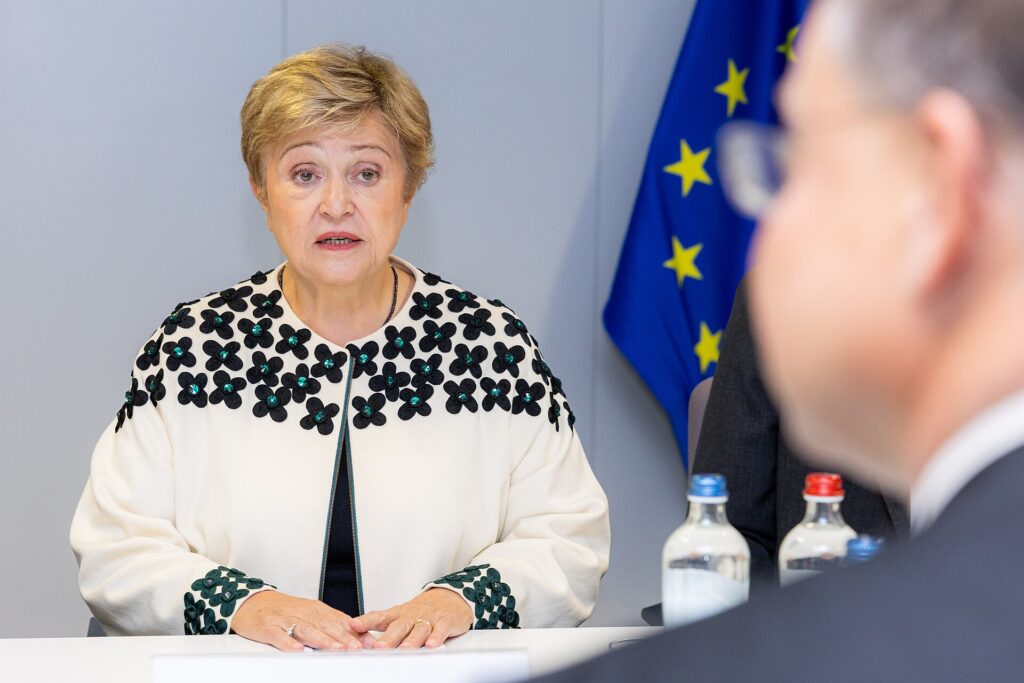
The first warning came on October 7 from Kristalina Georgieva, the managing director of the International Monetary Fund — the Washington-based lender that advises 190 member countries. Speaking at the Lee Kuan Yew School of Public Policy in Singapore, in her curtain-raiser address ahead of the IMF–World Bank Annual Meetings in Bangkok, Georgieva said an energy shock was colliding with the investment boom in artificial intelligence, and the crash site was the world economy.
“Higher energy prices are pushing up inflation, policy rates, and benchmark yield curves,” Georgieva said.
Crude oil is holding around $100 a barrel. But Georgieva’s real concern was not the crude price — it was what happens after crude leaves the ground. A global shortage of refining capacity is adding roughly another $100 a barrel in “crack-spread” margins for key products, diesel chief among them. Natural gas supplies from the Gulf remain severely impaired, and threats to shipping through the Strait of Hormuz have squeezed the options for moving liquefied natural gas. Asia and Europe, Georgieva said, are particularly exposed.
The pressure does not stop at fuel. Expensive energy pushes up the cost of fertilizers and other farm inputs, while a looming super El Niño adds a separate threat to food security. Georgieva warned the squeeze could intensify as countries rebuild depleted fuel reserves and demand rises heading into the Northern Hemisphere’s winter.
What makes this shock unusual, she argued, is the force running in the opposite direction. The AI investment boom is a positive demand shock — AI hardware and related products now account for more than 10 percent of global goods trade. But that boom is bypassing most countries entirely. “The combined impact of these two forces is highly uneven across the world,” Georgieva said.
Ottawa’s version of the same problem
Ten days later came the second warning — this time from a central banker facing the problem in real time. On October 17, Tiff Macklem, the governor of the Bank of Canada (the country’s central bank), told journalists on a conference call from Bangkok that the bank expects to raise its quarterly inflation forecast “significantly” this month, because of persistently high crude oil and petroleum-product prices.
“With the (Middle East) conflict ongoing, shipments still curtailed and refinery capacity damage, the risk that inflation broadens and becomes more persistent has gone up,” Macklem said.
The bank’s new forecasts will feed directly into its rate decision on October 28. Macklem framed the choice the way only a central banker can: “Is inflation likely to come back down towards our target on its own, or are we going to have to raise interest rates to influence the path, nudge the path for inflation back towards the target?”
Markets, at least, have made their bet. Traders are not pricing in a rate change on October 28, or even at the bank’s final meeting of the year in December — but they are pricing in a full 100 basis points of rate increases over the course of next year.
Why this matters far beyond Singapore and Ottawa
When Georgieva and Macklem talk about energy prices, they are talking about everyone’s bills. Diesel is the clearest example: it costs more than petrol for structural reasons — it moves the trucks, tractors, ships and trains that move everything else, and its buyers cannot easily cut back when prices rise. A dollar added to diesel is a tax on movement itself, paid by everyone who eats food that rode a truck. Which is everyone.
There is a second channel that runs through borrowing costs. Higher energy prices push up government bond yields — Georgieva noted 10-year yields in the United States, Germany and Japan have hit levels not seen in decades — raising the cost of mortgages, business loans and government debt everywhere. That squeeze lands hardest on countries that import their fuel and borrow in foreign currencies.
Days earlier in Bangkok, the Fund’s October World Economic Outlook had put 2026 growth at 3.1 percent — an upgrade the Fund said rested on buffers now largely spent. The Georgieva and Macklem warnings are the other side of that coin: the cushion is gone, and the next shock passes straight to prices.
A familiar dilemma, with a new twist
There is a 1970s echo here that central bankers would rather not hear: inflation driven by energy they cannot control, while growth stays fragile. But this time the economy is being pulled in two directions at once — an energy supply shock on one side, an AI demand shock on the other — with global public debt near its highest level since World War II, leaving governments little room to cushion the blow.
Her advice to central banks was blunt: keep “a prudent hawkish bias” on interest rates, and do not count on the AI boom to rescue public finances. “Some very tough political choices stare us in the face,” she said.
The next test of how seriously policymakers are taking her comes on October 28, when the Bank of Canada decides whether the inflation forecast Macklem is about to raise is a forecast — or a promise.