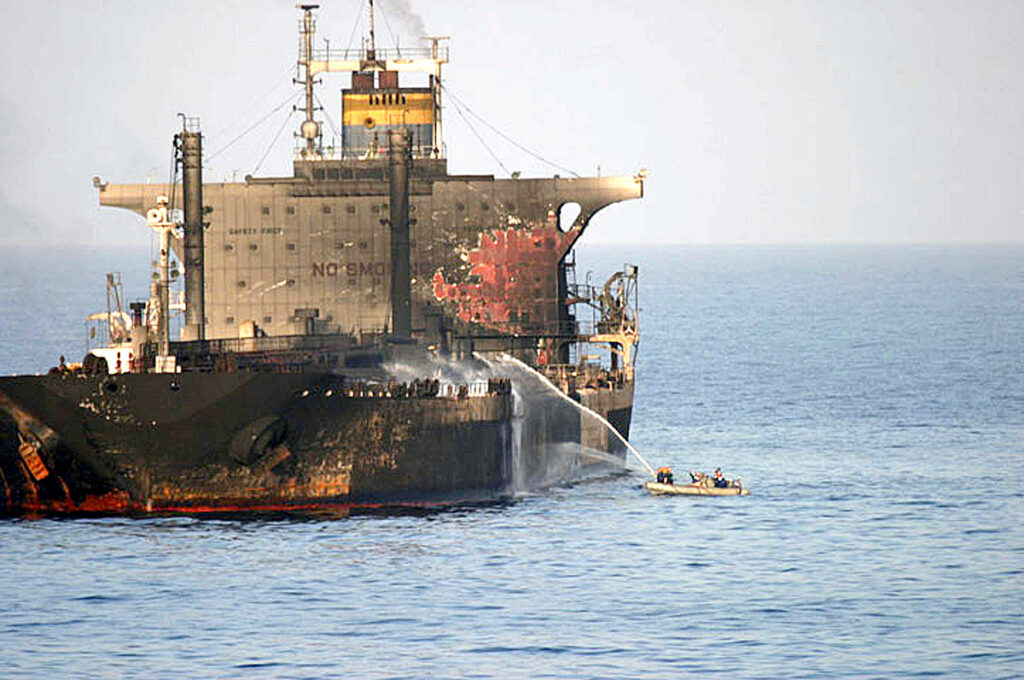
The Strait of Hormuz has added another burning tanker to its ledger — at least according to Iran.
Iran’s Revolutionary Guards said on Saturday that an oil supertanker exploded and caught fire after striking a naval mine while transiting the narrow waterway between Iran and Oman, the channel that carries roughly a fifth of the world’s seaborne oil. The Guards said the vessel was carrying more than two million barrels of crude, and accused it of attempting an “unauthorized” transit thro
It is not an isolated incident — it is the latest in a cascade. In the past week alone, Iran’s navy has reported a liquefied petroleum gas carrier catching fire, another supertanker striking a mine, a third tanker fire, and the sinking of the Singapore-flagg
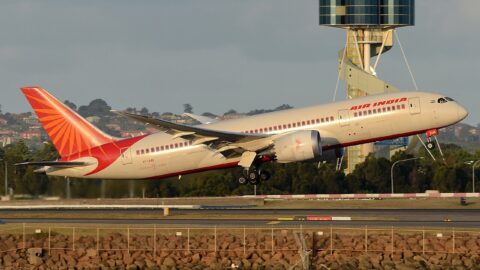
The mine claim landed the morning after a wider escalation. On Friday, two missiles landed on the grounds of Aden International Airport in Yemen, just as a Yemenia Airways flight bound for Cairo was preparing for takeoff. No casualties were reported, but it was the second attack on the airport in less than a week. The Saudi-led coalition said it intercepted a ballistic missile headed for Yanbu — the Red Sea oil hub that lets Saudi Arabia bypass Hormuz entirely — and destroyed two cruise missiles over the Red Sea and three drones over Saudi territory.
Markets are already moving. Brent crude briefly touched $110 a barrel on Friday, its first trip above that mark since May, as traders priced the risk that Hormuz traffic — roughly 20 million barrels a day — could be interrupted or become too dangerous to insure. Insurance premiums for the strait have soared in recent weeks, which is itself part of the spiral: shipowners facing soaring premiums and Iranian warnings are the ones trying the routes Tehran calls illegal.
Iran’s acting oil minister, Hamid Bovard, said this week that Tehran would respond “at the right time” to threats against its energy sites. It was the closest thing to a timetable Iran’s oil establishment has given — and it landed just as the waterway it sits on added another fire to the count.
A supertanker fire in Hormuz is not a regional story; it is a global inflation story. Two million barrels sitting in a burning hull barely dents world supply — what moves prices is the risk that the next ship never sails. If insurers withdraw coverage or owners refuse the route, refiners across Asia, the biggest buyers of Gulf crude, will bid up replacement barrels from every other source, and the cost will fold into everything from jet fuel to plastic packaging. The last time tankers burned in this waterway, in 2019, it took coordinated naval patrols to settle the markets. This time there is no coordination — there is a shooting war, a naval blockade, and two sides mining the same sea lanes while each accuses the other of doing it.
ed container ship GFS Pride with more than 2,500 containers aboard. Every Iranian account carries the same refrain: the vessels were using “unauthorized” routes and had switched off their tracking systems.
That refrain is a policy, stated openly. On October 12, IRGC Navy commander Ali Ozmaei warned that any ship in the strait that switched off its identification and navigation systems would be classified as hostile and face “decisive action.” Tehran’s stated position is that all vessels must coordinate passage with the Iranian armed forces. Washington rejects that entirely: the United States treats the strait as international waters and has been escorting tankers through it for weeks — a deployment that included the destruction of a blockade runner earlier this month.
The “dark ships” themselves are part of the war’s logic. Vessels switch off their transponders to avoid being targeted — by either side. Iran reads dark ships as proof of US-orchestrated “unauthorized” transit; Washington and its allies read the mines and missiles appearing in the strait as proof of Iranian coercion. Pinning down the truth of any single incident in real time is hard, because both sides have every reason to shape the story.
ugh waters Iran claims to control.
The report, carried by Iranian state media, named no vessel, gave no flag, and stated no destination — and there was no independent verification of the mine strike as of early Saturday. But the scale of the claim is what matters for markets: two million barrels is roughly the full cargo of a very large crude carrier, and a prolonged fire aboard such a ship in the world’s most critical energy chokepoint moves oil prices whether or not every detail checks out.


4 Comments