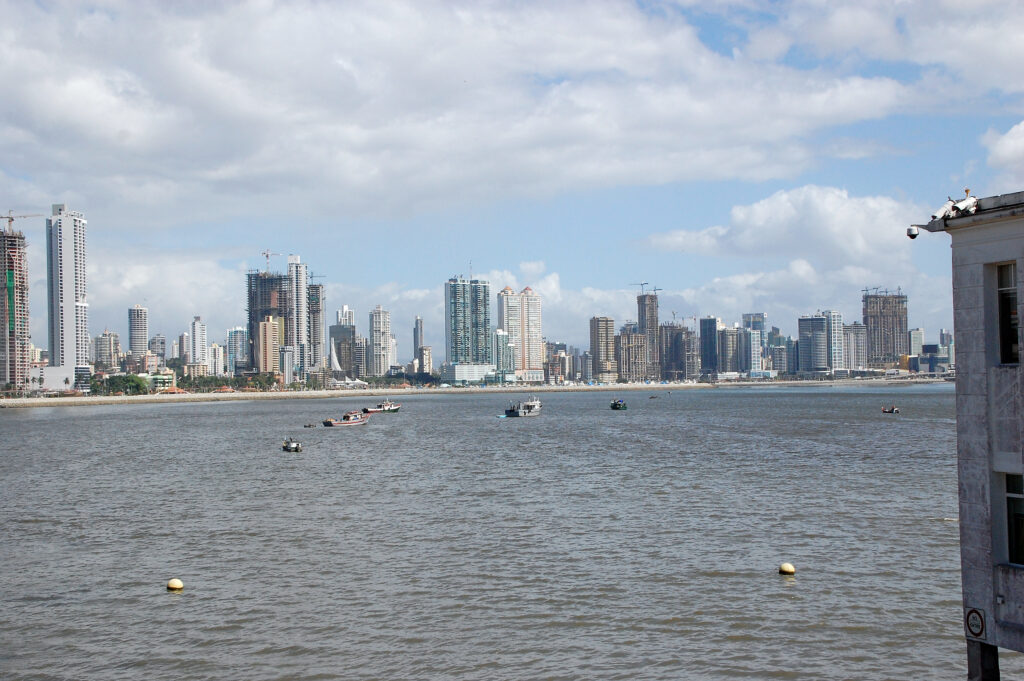
PANAMA CITY — The quake hit at 17:56 GMT on Friday, and Panama had never felt anything like it.
A magnitude 7.7 earthquake struck near the remote town of Pitaloza Arriba in Panama’s Herrera province, about 10 kilometers (6 miles) from the Pacific coastline and roughly 200 kilometers southwest of the capital. The shaking lasted about a minute — a full minute at a shallow depth of around 10 kilometers, which is exactly what turns a distant rumble into a local disaster.
In Penonome, a city roughly halfway between the epicenter and Panama City, television footage showed the tower of a historic building collapsing and balconies shearing off a residential block. In Panama City itself, office towers emptied into the streets as people fled high-rises they could feel swaying. Tremors were felt as far away as San José, the capital of neighboring Costa Rica.
“We felt it very strongly. It knocked things over in the kitchen, but we’re okay, though we’re very scared,” Rosendo Dominguez, 60, told the Associated Press by phone from Herrera province. “Everyone is outside, scared.”
Ricardo Brown, 74, spoke from Las Minas, also in Herrera: “We’re scared. It’s just the two of us old folks here. The house has cracked, and we’re afraid it could fall on us.”
Within minutes, the Pacific Tsunami Warning Center issued alerts for ten countries: Panama, Colombia, Costa Rica, Ecuador, Peru, Nicaragua, Guatemala, El Salvador and Mexico. Its forecast warned of possible waves of one to three meters along some Panamanian coasts and smaller but dangerous waves elsewhere. The US National Weather Service followed with its own warnings for Panama, Colombia, Ecuador, Nicaragua and Guatemala. Later on Friday, the US Tsunami Warning System updated its guidance: no tsunami warning, advisory, watch or threat was in effect — though monitoring of coastal areas continued.
Panama’s response moved fast. The education ministry ordered schools closed. Omar Smith, who heads the national civil protection agency, said the city of Chitré and the coast of Los Santos province had reported impacts. Tocumen airport suspended operations as a precaution, and the Naturgy power company reported electricity disruptions across six provinces. President José Raúl Mulino appealed for calm on X: “What happened should not be used to cause alarm or disorder.”
By Friday night there were no confirmed casualties — a mercy, given the force of the quake — though authorities warned that damage assessments in the sparsely populated epicenter region were still underway. Critically, the Panama Canal, the waterway through which roughly 40 percent of US container traffic passes, remained fully operational.
The USGS had initially estimated the quake at magnitude 8.0 before revising it to 7.7. Earthquakes of this size are rare in Panama, which sits outside the region’s most violent seismic zones, and that rarity made the fear worse: elderly residents were seen in tears in the streets as aftershocks rattled the country through the evening.
Why this matters
Latin America has had a brutal year underground. In June, twin earthquakes devastated northern Venezuela, killing at least 6,500 people. In August, a magnitude 7.4 quake struck Colombia, killing at least 289. Friday’s Panama quake makes three major seismic events in four months — and the scientists who track these things will tell you they are not connected. The plates move where they move; the Caribbean and Nazca plates have been grinding for millions of years and will keep grinding regardless of the calendar.
But the pattern that matters here is not geological, it is human. Each of these quakes hit countries with different levels of preparedness, and the difference shows in the casualty figures. Panama’s building stock, its alert systems and its response machinery will now be judged in real time. A minute of shaking at shallow depth near a sparsely populated area could have been far worse had the epicenter landed under Panama City’s dense towers. The tsunami warning machinery — ten countries alerted within minutes — did its job, and the absence of a major wave is the best kind of false alarm. The real test is what Panama builds next: whether the cracked houses in Herrera get rebuilt to a standard that would survive the next one, because the geology guarantees there will be a next one.


2 Comments