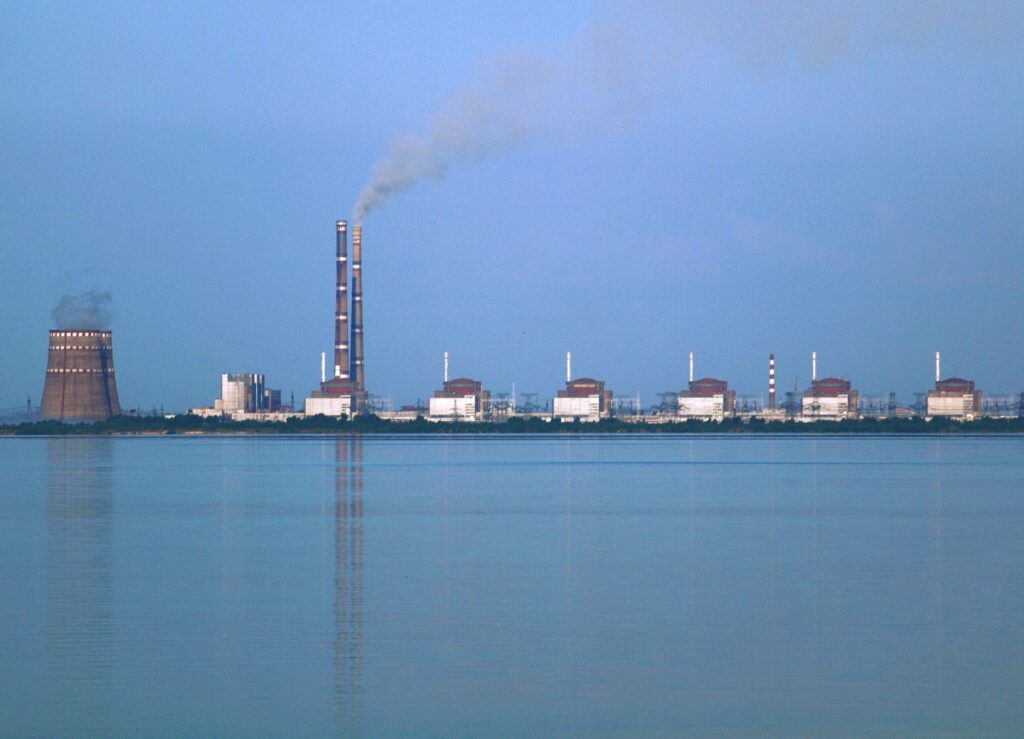
MOSCOW — Ukrainian drones struck two facilities at the Russian-held Zaporizhzhia nuclear power plant overnight into Monday, killing a driver who was delivering food supplies for plant employees, the head of Russia’s state nuclear corporation said. The attack marks another sharp turn in the escalating battle around Europe’s largest nuclear installation, which is currently running on emergency diesel generators after weeks of shelling knocked out its external power lines.
Alexei Likhachev, director general of Rosatom, said the drones hit a laboratory building and a radioactive waste processing plant on the site in southeastern Ukraine. A driver bringing in food for the plant’s staff was killed in the attack, he said. Plant authorities later reported that the strikes damaged the roof of a service and laboratory building adjacent to reactors 4 and 5, as well as the roofs of the area where radioactive waste is stored and processed.
There is no threat to nuclear safety and radiation levels have not changed, according to Likhachev and the plant’s administration. Ukraine has not commented on the incident.
A plant under constant pressure
The Zaporizhzhia plant, with its six VVER reactors, has not produced electricity for years. It still needs a steady supply of external power to keep its nuclear fuel cool. That lifeline has been hanging by a thread.
On Saturday, the plant’s management said shelling over the previous weeks had damaged external power supply equipment, forcing the facility to rely on emergency diesel generators. The plant sits on the front line of the war that began with Russia’s full-scale invasion in February 2022; Moscow seized the complex in the invasion’s first weeks, and the two sides have blamed each other ever since for every shell and drone that lands near it.
The International Atomic Energy Agency has been tracking the deterioration closely. On October 3, the agency said a series of drone attacks in recent weeks had targeted the neighboring Zaporizhzhia Thermal Power Plant, whose switchyard helps feed electricity to the nuclear site. The strikes, on September 19, 20 and 27, damaged transformers considered vital for keeping the plant connected to the grid. A separate attack on September 22 knocked out an off-site radiation monitoring station, reducing the plant’s ability to track radiation levels nearby. The agency did not say who carried out those strikes.
IAEA Director General Rafael Grossi is now negotiating a localized ceasefire between Ukraine and Russia to allow repair crews to reach the damaged equipment. It would be the eighth such IAEA-brokered pause in fighting aimed at securing the plant’s off-site power. Back in May, the agency had already warned that increased drone activity near the complex was intensifying the risk of a nuclear accident.
Accusations fly alongside the drones
Moscow was quick to frame the overnight strikes as part of a deliberate campaign. Russian Foreign Ministry spokeswoman Maria Zakharova accused Western governments of effectively enabling the attacks by refusing to condemn them publicly.
“Kyiv’s intensification of shelling the Zaporizhzhia plant has been made possible by the lack of an appropriate response to such actions from Western countries, which are effectively facilitating new attacks,” Zakharova wrote on the ministry’s website.
The claim lands at a moment of heightened diplomacy around the war. The United States has been pressing both sides toward a negotiated settlement, with US-mediated talks involving Ukraine and Russia continuing in recent weeks and Washington pushing Kyiv to move quickly on a deal.
Why this matters
Strikes on a nuclear plant are in a different category from the daily drumbeat of drone warfare. The reactors at Zaporizhzhia are shut down, but spent fuel still needs constant cooling — and the cooling now depends on diesel generators, a finite backstop. Every damaged transformer, every severed line, every disabled monitoring station narrows the margin between a functioning safety regime and an improvisation. The plant survived four years of occupation without a radiological release. What the latest attacks show is that the safety buffer the IAEA has spent years negotiating — ceasefire by ceasefire, repair by repair — is being worn down faster than it can be rebuilt. UN monitors remain stationed at the plant, but they can only observe. Whether the reactors stay safe depends on both armies treating the plant’s invisible lifelines — its power lines and its cooling systems — as off-limits. This week, those lines came under attack again, and a man delivering food to the people who keep the plant running did not survive the night.