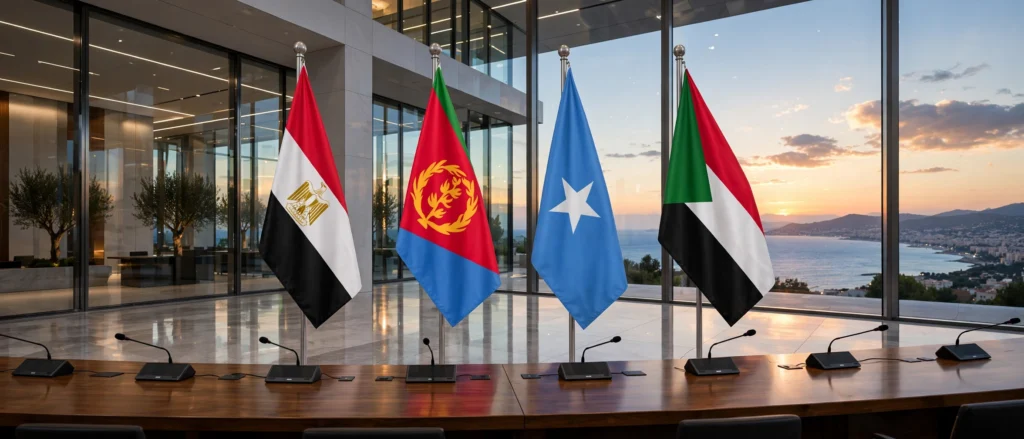
NEW ALAMEIN CITY — Four of the Red Sea region’s most powerful leaders sat down together on Sunday and walked out with a document that was really a coordinated warning to Ethiopia: resolve this through dialogue, not confrontation — and take no unilateral steps on the Nile, the Red Sea, or your neighbors’ borders.
Egyptian President Abdel Fattah el-Sisi hosted the leaders of Eritrea, Somalia and Sudan at New Alamein City, the Mediterranean resort town that has become Cairo’s preferred stage for high-stakes diplomacy. After the quadrilateral summit, the four issued the El Alamein Joint Declaration, a sweeping statement covering the wars in Sudan and Ethiopia, control of the Red Sea, Nile water rights, and the sovereignty of Somalia.
The timing was no accident. Fighting in Ethiopia has intensified in recent days, and Cairo is openly alarmed at the direction the region is moving.
Ethiopia has accused Egypt, Eritrea and Sudan of backing the armed alliance fighting its government — a charge all three deny. On the battlefield, Addis Ababa says its forces have retaken the airport in Mekelle from Tigray rebels, a measure of how sharply the conflict has escalated. Sudan, meanwhile, has been at war since April 2023, when the army and the paramilitary Rapid Support Forces turned their guns on each other. Khartoum and Addis Ababa have traded accusations of meddling in each other’s conflicts, folding two wars into one tangled crisis. Earlier on Sunday, el-Sisi put it plainly, saying the cross-border challenges facing the region demanded “a dialogue, not confrontation.”
The declaration itself read as a point-by-point answer to Ethiopia’s most contested ambitions. It rejected interference in the internal affairs of regional states “under any pretext.”
On the Red Sea, the four leaders declared that governing the waterway is the exclusive responsibility of its coastal states — a direct pushback against landlocked Ethiopia’s pursuit of sovereign sea access and a naval presence. They stressed the need to protect freedom and safety of navigation through the Gulf of Aden and the Bab-el-Mandeb strait, one of the world’s busiest shipping chokepoints.
On the Nile, Egypt and Sudan warned against “unilateral measures” that damage downstream water rights — the long-running fight over Ethiopia’s Grand Ethiopian Renaissance Dam. The declaration called for adherence to international law and the principle of doing no harm, demanding prior notification, consultation and consensus on shared rivers.
On Sudan, the leaders backed the country’s unity, sovereignty and territorial integrity and its national institutions, rejecting the creation of any parallel entities. They called for a Sudanese-owned and Sudanese-led political process and rejected support for mercenaries.
On Somalia, the declaration underscored the country’s unity and sovereignty, rejecting any recognition of or support for what it called “so-called Somaliland” — a pointed line as talk of separatist recognition resurfaces.
The four also agreed to set up a periodic joint mechanism to coordinate on regional security, a sign that the summit was meant to launch a standing coalition rather than produce a one-off statement.
The declaration’s breadth points to something larger than a routine communiqué: Cairo is assembling a durable regional bloc. Every flashpoint it names — the Red Sea, the Nile, Somaliland, Sudan’s war — sits on a fault line with Addis Ababa.
There was, however, one olive branch. Somali President Hassan Sheikh Mohamud said Mogadishu does not object to Ethiopia securing commercial access through Somali ports, as long as the arrangement is agreed with Somalia — a distinction between trade access, which he called acceptable, and the sovereign presence Ethiopia has been after.
Whether Addis Ababa hears the declaration as an invitation to talk or as encirclement will decide what happens next. For now, four neighbors have spoken with one voice, and the message to Ethiopia is unmistakable: the region’s rules are not yours to write alone.