Key takeaways:
- The United States has withdrawn every bomber it had stationed at RAF Fairford in Gloucestershire — roughly a dozen B-1s — amid a suspected terror plot targeting the base, the Pentagon confirmed on Sunday.
- The move followed the September 27 arrests of five British men near the base perimeter and a later arrest in London of a 25-year-old dual British-Iranian national; Prime Minister Andy Burnham said there were “strong indications” of Iranian involvement, which Tehran dismissed as baseless.
- Bringing long-range bombers all the way home, rather than dispersing them to another regional base, is an unusual step — a signal of how seriously the threat is being taken.
- Fairford was the sole airbase on Britain’s mainland anchoring the US air campaign against Iran, which began on February 28 and is now in its eighth month.
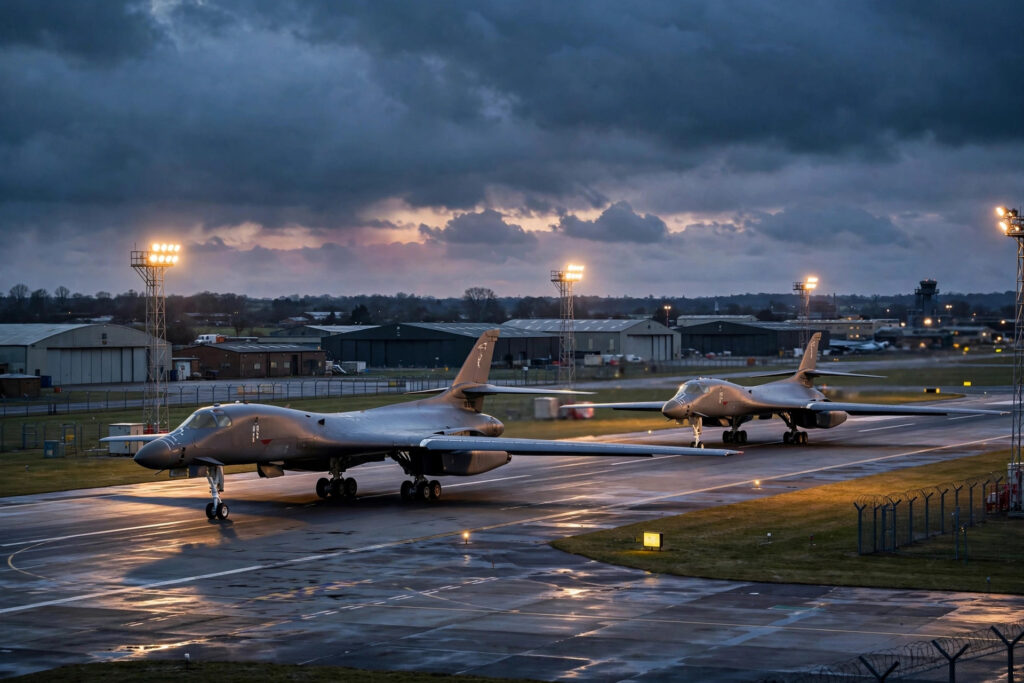
RAF FAIRFORD, England — The United States has pulled every bomber it had stationed at RAF Fairford in Gloucestershire, removing the long-range aircraft that anchored America’s air campaign against Iran from Britain amid a suspected terror plot against the base.
The Pentagon confirmed the move on Sunday, saying all US bombers deployed to Fairford had “re-deployed to their home stations in the United States.” Roughly a dozen B-1 bombers had been based there, and aviation watchers had tracked dozens of B-52 and B-1 aircraft operating from the Cotswolds airfield since the earliest days of the war with Iran.
A Pentagon spokesman, responding by email, said operational security had kept the military from confirming the movement in real time, but added that America’s bomber force — its B-1s, B-2s and B-52s — remained ready to deliver strikes “anywhere, anytime,” including from bases inside the continental United States.
An airbase under investigation
The withdrawal caps an alarming week for the installation. In the early hours of September 27, counter-terrorism police arrested five British men in their twenties near the perimeter of the base, on suspicion of preparing terrorist acts and explosives offences. Three vans were seized. The men were later released on bail under stringent conditions after investigators found no explosive devices — only a quantity of petrol in the vehicles.
On Thursday, police arrested a 25-year-old dual British-Iranian national in London in connection with the suspected plot, deepening the mystery around who was behind it and what the intended target was. Dozens of homes near the base were evacuated during the scare.
British Prime Minister Andy Burnham said this week there were “strong indications” that Iran had played a part in the alleged scheme — an accusation Tehran has dismissed as baseless. President Donald Trump said those involved had planned to cause “big damage” at the airbase, and Secretary of State Marco Rubio pointed to the involvement of a “foreign actor.”
A rare move
A US official told American media outlets that the redeployment followed an unspecified new threat, described by one source familiar with the situation as a “real world incident.” The official noted that it is unusual for the military to bring long-range bombers all the way back to their home stations rather than dispersing them to another base in the region — a sign, analysts said, of how seriously the threat to the facility is being taken.
The Wall Street Journal first reported the withdrawal, and the Pentagon’s confirmation came after aviation watchers observed the B-1s departing the base on Sunday.
Fairford, about 160 kilometres west of London, is the only airbase on Britain’s mainland used for this purpose. Britain gave Washington permission in March to use it for strikes against Iranian missile sites that were targeting shipping in the Strait of Hormuz. US bombers flying from the base have been a central instrument of the air campaign ever since the war began on February 28.
A war in its eighth month
The move comes at a sensitive moment. Benchmark Brent crude has pushed above $100 a barrel as the war disrupts energy flows, and the G7 has pledged to release 100 million barrels of oil and fuel products to ease supply pressures. Trump said on Saturday, as he left the White House for a rally in Ohio, that Iran had been “decimated” and that the only question was whether the end would come “the easy way, or the hard way.”
Diplomacy, for now, looks stalled. US special envoy Steve Witkoff said Washington was hopeful of meetings with Iran this week, while Tehran says there is no military solution to the conflict.
For the residents of Gloucestershire, the immediate question is what becomes of the airbase that brought the war to their doorstep. For American war planners, the challenge is the one the Pentagon’s statement was meant to answer: showing that pulling the bombers home has not shortened their reach. The aircraft may have left the English countryside, but the war they were flying goes on — and so does the hunt for whoever tried to strike the base they left behind.