MADRID — Spain will hold a snap general election on November 29, Prime Minister Pedro Sánchez announced on Monday, gambling that the country’s housing crisis — the issue that broke his government in Parliament last week — can instead rescue it at the ballot box.
Sánchez, 54, made the announcement in a televised address from Moncloa, his official residence, saying he would convene an extraordinary meeting of the Council of Ministers to dissolve Parliament. The move cuts the current legislature short by more than six months; it had been expected to run into 2027.
The election call follows a bruising parliamentary defeat on Friday, when two emergency decrees on housing were voted down in Congress. The measures — which would have strengthened protections against evictions and curbed speculative property purchases — were defeated after Junts, the right-wing Catalan separatist party, joined the conservative Popular Party (PP) and the far-right Vox in voting against them.
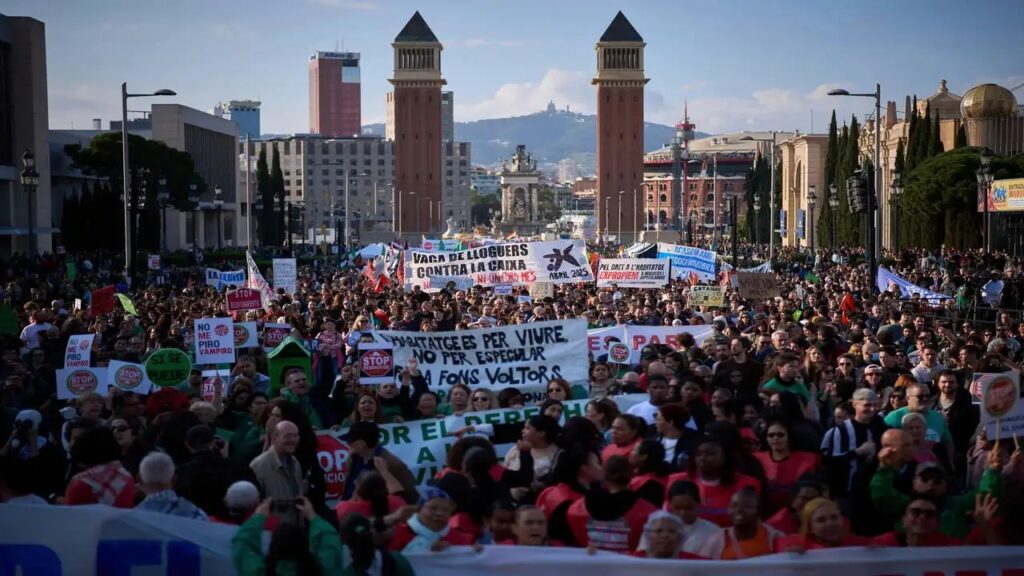
Public anger over housing had been building for weeks. It reached a breaking point in late September with the eviction of María del Carmen Abascal, known across Spain as Maricarmen, an 87-year-old woman removed from the Madrid flat where she had lived for more than 70 years. After an international investment fund bought her building, her rent was raised from €500 a month to €2,650 — a sum she could not pay. Her case became the defining symbol of a housing emergency that has pushed rents far beyond the reach of millions.
Since then, hundreds of protesters have camped in a tent city in Madrid’s Puerta del Sol, and tens of thousands marched in the capital and other cities on Saturday. Alicia del Río, a spokeswoman for the Madrid Tenants’ Union, which has led the protests, said the movement would not back down: “This wave of indignation is unstoppable and we are not going to stop.”
In his address, Sánchez acknowledged his government’s failures and asked voters directly for a fresh mandate. “It’s time you, the Spanish people, decide which future you want for yourselves and for the country,” he said. He added that his aim was “to secure a much broader, progressive majority in parliament” — a frank admission that the current parliamentary arithmetic had left him unable to deliver on housing, the issue his own voters care about most.
Sánchez, who leads the Socialist Workers’ Party (PSOE), has been in office since 2018, making him one of Europe’s longest-serving leaders. His minority government has been hobbled from the start: he has never managed to pass a national budget through the current legislature, and Spain has effectively been operating under the 2023 budget for years.
Recent polls suggest he is fighting from behind. A SocioMétrica survey conducted September 24–26 put the conservative PP at 33.9 percent, with Vox at 18 percent and the Socialists trailing at 25.7 percent. PP leader Alberto Núñez Feijóo said after Friday’s vote: “We are ready. We can’t continue down the path we’re on.” He has signaled his party could govern with Vox’s support.
Why this matters: Sánchez is betting that the anger which humiliated his government in Parliament — fury over evictions and unaffordable rents — will push voters toward him rather than away from him when he frames the election as a choice between progressive housing protections and the right-wing bloc that killed them. It is a high-risk wager. If the polls are right, he could end up handing power to Feijóo, whose PP might form Spain’s first national government dependent on the far right — a shift that would redraw the country’s political map for years to come.
The decree dissolving parliament is expected to be published on Tuesday, kicking off the 54-day electoral period required under Spanish law and locking in the November 29 date.