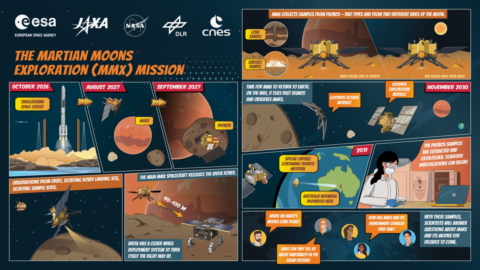
Informopedia Explains: Some time before dawn on Tuesday, Japan sent a spacecraft to chase a moon the size of a city. The Martian Moons eXploration probe — MMX, Japan’s space agency calls it — lifted off from Tanegashima at 4:41 a.m. on an H3 rocket, beginning a five-year round trip to Mars’s misshapen little moon Phobos. It plans to bring back at least 10 grams of its dust in 2031 — dust that could settle an argument planetary scientists have been having for nearly 150 years.
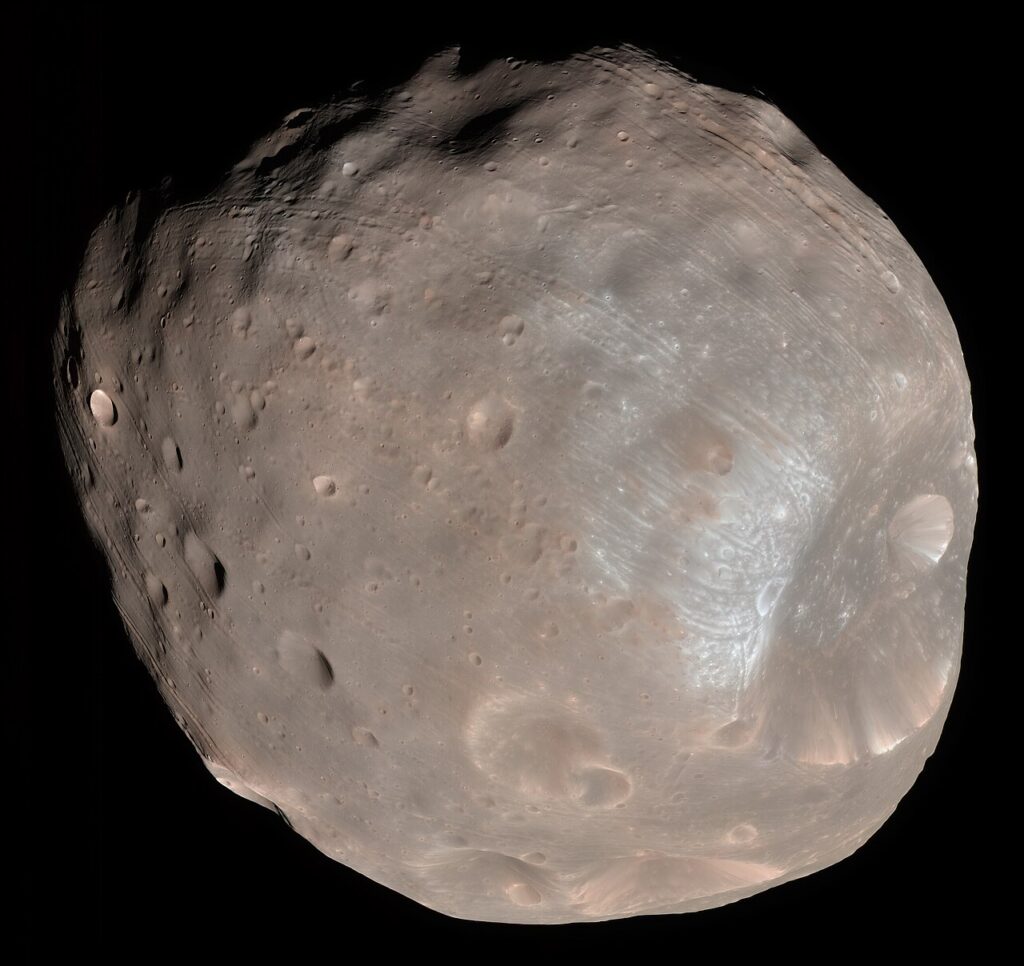
Phobos and its smaller sibling Deimos are the strangest pair of moons in the solar system. Fear and terror, named for the sons of the Greek war god Ares, discovered by the American astronomer Asaph Hall in 1877. Phobos is about 22 kilometers across, lumpy as a potato, and circles Mars every seven hours and 39 minutes. It is spiraling slowly inward and, in a few tens of millions of years, will likely be torn apart into a ring of rubble. A 9-kilometer dent called Stickney crater dominates its whole face.
Nobody knows where either of them came from. And the answer matters far beyond Mars, because it is really an answer about how planets — including Earth — got their water, their organic chemistry, and their moons.
The two old theories, and why both are stuck
The first theory is the intuitive one: the moons are captured asteroids. They look like asteroids, after all — dark, cratered, irregular. Early Mars, the story goes, wandered through a solar system full of loose rocky bodies and snared two. If that is right, the samples should resemble primitive chondritic meteorites: ancient, unaltered building blocks of the early solar system, with chemical fingerprints unrelated to Mars.
The trouble is the orbits. Phobos and Deimos travel in near-circular paths hugging the plane of Mars’s equator. A random asteroid snared by gravity should arrive on a wild, tilted, stretched-out trajectory — not a neat circle. Making two of them settle into such tidy orbits takes special pleading that many researchers find unconvincing.
So the second theory says the moons were born in violence: a giant impact on Mars, billions of years ago, blasted a debris disk into orbit, and the moons coalesced from that wreckage — much the way Earth’s own Moon is thought to have formed when a Mars-sized body slammed into our planet. This would make Phobos and Deimos, in a real sense, chips off the red planet.
“The slightly inclined, near-circular orbits of these moons, a few dozen km in diameter, support the theory that they were created by a huge object striking Mars, just as the Moon was formed by an impact on the Earth,” Antonella Barucci, an astronomer at the Paris Observatory and principal investigator of MMX’s MIRS spectral imager, told Le Temps. “But their spectral characteristics and their shape would instead place them in the category of primitive asteroids from the main belt, located between Mars and Jupiter. Two of them could have been captured by the red planet and drawn into orbit at a time when such bodies were circulating in large numbers in this region of space.”
There, in one breath, is the entire deadlock. The orbits say impact. The surfaces say asteroid. And the giant-impact idea has its own nagging problem: debris blasted off Mars should look like bright basaltic rock. Phobos and Deimos look dark — like the primitive asteroids of the outer solar system.
The third idea: an asteroid that came too close
In 2025, a paper in the journal Icarus added a third suspect to the lineup. Led by Jacob Kegerreis, a planetary scientist at NASA’s Ames Research Center, a team ran hundreds of supercomputer simulations of a scenario that blends the two old camps: an asteroid strayed too close to Mars, crossed the so-called Roche limit — where a planet’s tidal forces overwhelm an object’s strength — and was ripped apart. Mars kept a fraction of the debris. The fragments collided, ground each other down, settled into a ring, and eventually clumped into Phobos and Deimos.
The appeal is that it answers both objections at once. A shattered, re-accreted asteroid would look like a primitive asteroid and inherit circular, equatorial orbits — the debris disk, not the asteroid, sets the flight paths. It also needs a much smaller parent asteroid than the giant-impact scenario needs an impactor, and medium-sized asteroids are far more common.
“It’s exciting to explore a new option for the making of Phobos and Deimos – the only moons in our Solar System that orbit a rocky planet besides Earth’s,” Kegerreis said when the study came out. And it makes a prediction MMX can test: if both moons are rubble from one destroyed asteroid, they should be chemical twins. Two independently captured asteroids would be strangers.
What 10 grams of dust can actually prove
Ten grams — two teaspoons — sounds absurdly small to settle a 150-year argument. But precision beats volume: in 2020, Japan’s Hayabusa2 returned just 5.4 grams from the asteroid Ryugu, and that handful of dust rewrote large parts of asteroid science.
The decisive measurement is isotopic ratios — the proportions of different isotopes of oxygen, chromium, titanium, and other elements locked into rock at its formation. These ratios are chemical fingerprints: Mars rocks carry Mars’s fingerprint, primitive asteroids their own. A laboratory on Earth can read them to a precision no orbiting instrument ever could. Spectra hint; samples conclude.
MMX’s sampling system is deliberately layered. A NASA-built pneumatic sampler on one landing leg will use bursts of nitrogen gas to gather loose surface material, while Japan’s corer will punch a few inches deeper — past the surface layer that eons of radiation and micrometeorite bombardment have altered. From orbit, a spectrometer called MEGANE (the Japanese word for “eyeglasses”) will map elemental composition. And the samples themselves will be hunted for water and organic compounds. If the fingerprints read “Mars,” the giant-impact camp takes the century’s biggest round. If they read “carbon-rich primitive body,” the capture — or disruption — theories take the crown.
There is a bonus prize either way. Billions of years of impacts have mixed fragments of Martian crust into Phobos’s regolith — MMX could hand scientists pieces of early Mars, from the planet’s water-rich, potentially habitable era, without ever having to launch a rocket off Mars’s surface.
Why it matters beyond Mars
The argument about two tiny moons is really an argument about how the terrestrial planets were stocked with the raw materials of life. As Tom Statler, NASA’s program scientist for MMX, puts it: “Having the answer will help illuminate that early era when Earth and the other inner planets may have been acquiring much of their water and organic compounds.”
Then there is the practical side. JAXA — Japan’s space agency — has openly talked about Phobos as a “natural space station,” a staging ground for future human missions. Its gravity is about one two-thousandth of Earth’s: enough to hold a lander down, but so weak that lifting off for Mars’s surface takes a fraction of the fuel. A crew that parks supplies on Phobos before dropping to Mars has a far easier journey than one flying straight in.
What happens next
The spacecraft is on its way now — 71 minutes and 13 seconds after liftoff, MMX separated from its H3 booster and set course for Mars. The long middle of the story is patience. It will arrive in Mars orbit in August 2027, slip into orbit around Phobos the following month, and spend roughly three years studying both moons.
Before the mother ship dares touch down, a 25-kilogram rover named IDEFIX — the 25-kilogram French-German rover named for Asterix’s dog — lands first, testing the regolith under a lander’s legs. The sampling landings follow in 2030, at two different sites. On the way home, the return module will swing past Deimos for a close look; then the sample capsule re-enters over Australia and lands at the Woomera Prohibited Area in 2031, where recovery teams whisk it to clean rooms in Japan.
One small sample, five agencies, eleven years from launch to laboratory. Somewhere inside those two teaspoons of Phobos dust is the fingerprint of Mars or of a dead asteroid that wandered too close. The argument has run since 1877. The jury is about to get its evidence.