What just happened?
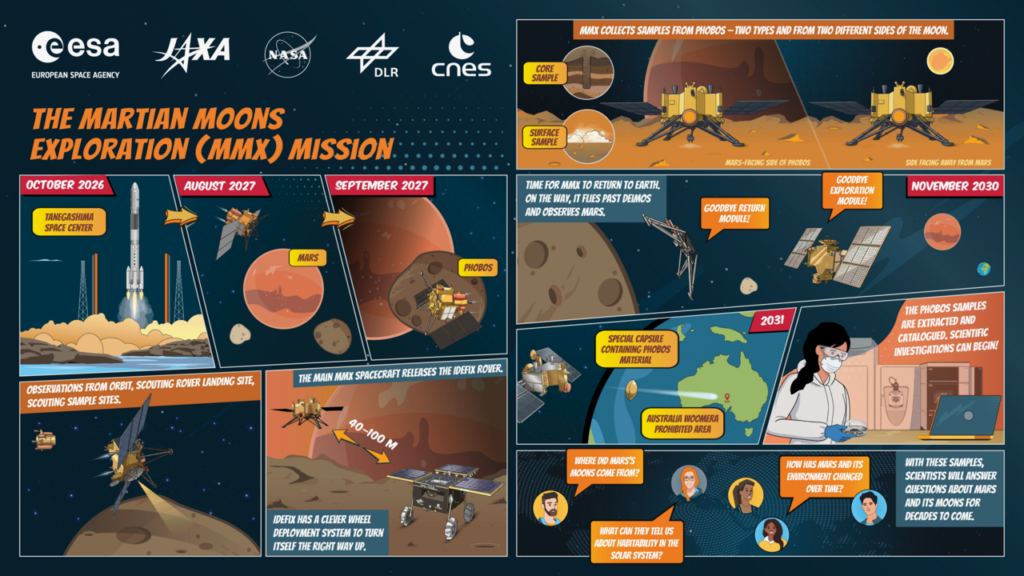
At 4:41 a.m. on Tuesday, Japan’s space agency launched a five-ton spacecraft toward Mars’ moons. The probe — MMX, for Martian Moons eXploration — rode an H3 rocket off the launch pad at the Tanegashima Space Center, on a small island south of Kyushu. JAXA, the Japan Aerospace Exploration Agency, timed the liftoff to the second: a Mars-bound craft doesn’t park in Earth orbit first — it’s thrown directly onto a trajectory that meets another planet, and the geometry for that lines up only briefly each day.
About 71 minutes later, the spacecraft separated from the H3’s upper stage and entered its planned trajectory. “I’d dreamt of this day, so I’m incredibly happy,” JAXA scientist Mari Aida told the AFP news agency. “Right now I feel really relieved.”
Why Phobos? What’s the mystery?
Phobos is the larger of Mars’ two moons, a dark, misshapen lump orbiting the planet three times a day. Deimos, its smaller companion, trails further out. For decades, scientists have argued over a simple question: captured asteroids trapped by Mars’ gravity, or rubble from a colossal impact that blasted chunks of Mars itself into space?
Whatever the answer, Phobos has never been touched. Cameras have photographed both moons since the 1970s, and NASA has landed nine craft on the Martian surface — but no probe has landed on either moon, and no one has ever returned samples from anywhere in the Martian system. Russia tried: its Phobos-Grunt probe, launched in November 2011 with a similar goal, never left Earth orbit.
“It is a world-class, top of the line mission,” said Jonathan McDowell, an honorary professor of physics at Durham University and a historian of spaceflight. “It is a really ambitious mission for Japan.”
How will it grab the samples?
MMX is expected to reach the Mars region in August 2027. Because Phobos’ gravity is feeble, the spacecraft won’t orbit the moon directly — it will enter a quasi-satellite orbit, circling Mars while matching Phobos’ speed.
The plan calls for two touchdowns. A small French-German rover called IDEFIX — built by France’s CNES and Germany’s DLR — goes down first to scout safe landing terrain. The main craft will then collect at least 10 grams from two sites using JAXA’s coring arm and NASA’s pneumatic sampler, which fires high-pressure nitrogen to stir dust into a collector.
Ten grams sounds like nothing — Hayabusa2 brought home about 5.4 grams from the asteroid Ryugu in 2020, and that dust rewrote textbooks about water in the early solar system. The craft carries 13 instruments in all: “kind of a Swiss Army knife, in terms of the science,” said European Space Agency (ESA) planetary scientist Elliot Sefton-Nash, who is working on the mission.
What could the samples tell us?
The leading question is origin. But the payoff runs wider. If Phobos is blasted-off Mars, its rock is Martian crust — a sample of the red planet collected without landing on Mars and launching off it again, something no agency has yet managed. If it’s a captured asteroid, the material is a preserved fragment of the early solar system, possibly carrying water and organic compounds in something close to their original form.
Either way, the dust in that return capsule — due to land at Woomera, a remote desert test range in South Australia, in 2031 — will tell scientists what the inner solar system was made of. On the way home, MMX will also swing past Deimos for a closer look.
Why does this matter beyond the science?
Because it’s Japan’s quiet bid to stop being the best second act in planetary exploration. JAXA’s Hayabusa and Hayabusa2 made it the only agency to return asteroid samples — twice. But asteroids are Japan’s home turf; Mars is NASA and China’s, and no Japanese craft has ever been there.
MMX changes the map: a five-year round trip, a landing, a sample collection, a return flight — by a country that has never done any of it. If it works, Japan becomes the first country in history to hold pieces of the Martian system in a lab — a credential no one else has, not even the United States. The Perseverance rover’s record-setting trek across Mars shows how far ground exploration has come; MMX asks what the moon above it can reveal.
There’s a human horizon too: long stays beyond Earth’s protection remain the hardest unsolved problem — which is why researchers keep asking what eight months in space does to the human body. Robotic returns like MMX buy that future time and safety data.
What happens next?
Then: ten months of cruising, three years around Phobos, and a 2031 touchdown in the Australian outback. “There’s a lot of adrenaline and a lot of excitement and a lot of wow,” said NASA astrophysicist Tom Statler, who is involved with the project. For once, the adrenaline is fully earned.