Four Canadian Soldiers Named as Dead in CFB Wainwright Grass Fire — PM Carney Calls It One of Canada’s Worst Peacetime Tragedies
Canada’s military has named the four soldiers killed in the fast-moving grass fire that swept through Canadian Forces Base Wainwright in Alberta — an inferno that officials say advanced a full kilometre in 30 to 60 seconds when winds suddenly shifted to 96 kilometres per hour.
The dead are Sergeant Morgan Wong of the Loyal Edmonton Regiment and Privates Shaun Farrell, Aidan Goulding and Hayden Lykkemark, all serving with the 3rd Battalion of Princess Patricia’s Canadian Light Infantry (3 PPCLI) based in Edmonton, about 210 kilometres west of the base. Thirty-nine people were taken to hospital, 19 of them in critical condition.
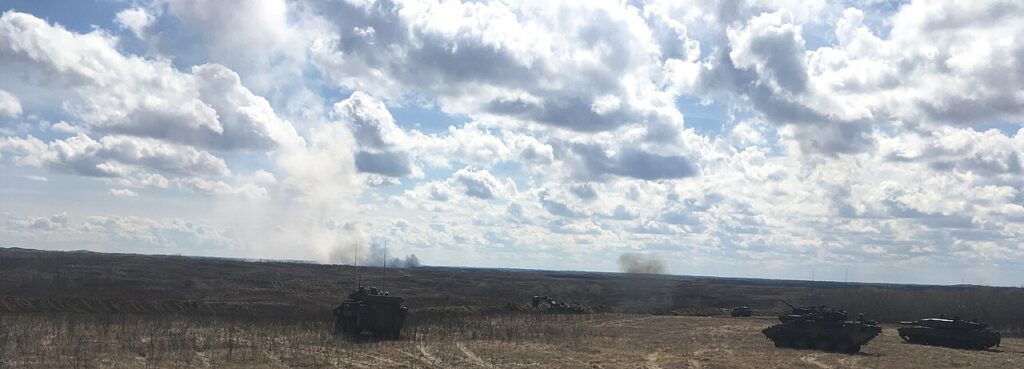
The blaze began around 4 p.m. local time on Saturday as a smouldering grass fire in the base’s training area, where 85 soldiers of 3 PPCLI were conducting what the military described as “high intensity” combat training with live munitions. The troops were preparing for a deployment to Latvia, where Canada leads a NATO battle group — the country’s largest international military operation.
Winds were below 50 kilometres per hour through most of the day. Then, without warning, they spiked. Major General Wade Rutland, commander of the 1st Canadian Division, told reporters the flames travelled a kilometre in 36 seconds.
“I’ve certainly never seen anything like it,” Rutland said. He called the sudden acceleration an “uncommon, rapid” event — and acknowledged the military had known about the grass fire for hours but judged it contained enough to let training continue before the wind turned.
That admission is now likely to anchor the investigation. Defence Minister David McGuinty described the situation as “very, very active and delicate,” while the military stressed there was no indication the fire was linked to terrorism. What ignited the grass fire in the first place remains unknown.
Prime Minister Mark Carney addressed the country on Sunday. “The nation is in mourning for those brave members of our Armed Forces whom we have lost,” he said, and ordered flags on federal buildings across the country lowered to half-staff. Carney described the disaster as one of the worst peacetime tragedies for Canada’s military on home soil.
Alberta Premier Danielle Smith warned that the recovery would be long: many of the injured will require “weeks and months” of specialised, intensive medical care.
The confirmed toll revises earlier, unconfirmed reports that put the death count higher. The military’s Sunday briefing is the first authoritative accounting — four named dead, 39 hospitalised, 19 critical — and it supersedes the fragmentary figures that circulated in the first hours after the fire.
Why this matters
Peacetime training deaths hit differently. These were not casualties of combat but of an exercise on Canadian soil, at one of the country’s busiest training bases — and the detail that will haunt the inquiry is that commanders knew a fire was burning nearby and kept the exercise going. A prairie grass fire, 96 km/h winds, live munitions and 85 soldiers in the open: the physics of that combination needed no enemy.
For Canada, the timing compounds the shock. The troops who burned were preparing to deploy to Latvia, where Canada’s contingent is the backbone of a NATO mission that has grown steadily more exposed as the war in Ukraine grinds on. A military that asks its soldiers to absorb risk abroad has just taken its worst domestic hit in memory.
The investigation now has to answer the question every Canadian family will ask: who decided a “contained” grass fire was compatible with high-intensity live-fire training, and how many minutes separated that decision from the moment the wind shifted?
Read earlier coverage: Deaths Confirmed After ‘Serious Incident’ Sparks Major Fire at Canada’s CFB Wainwright Army Base and At Least 7 Dead After Live-Fire Drill Hits Gas Line at Canada’s CFB Wainwright.