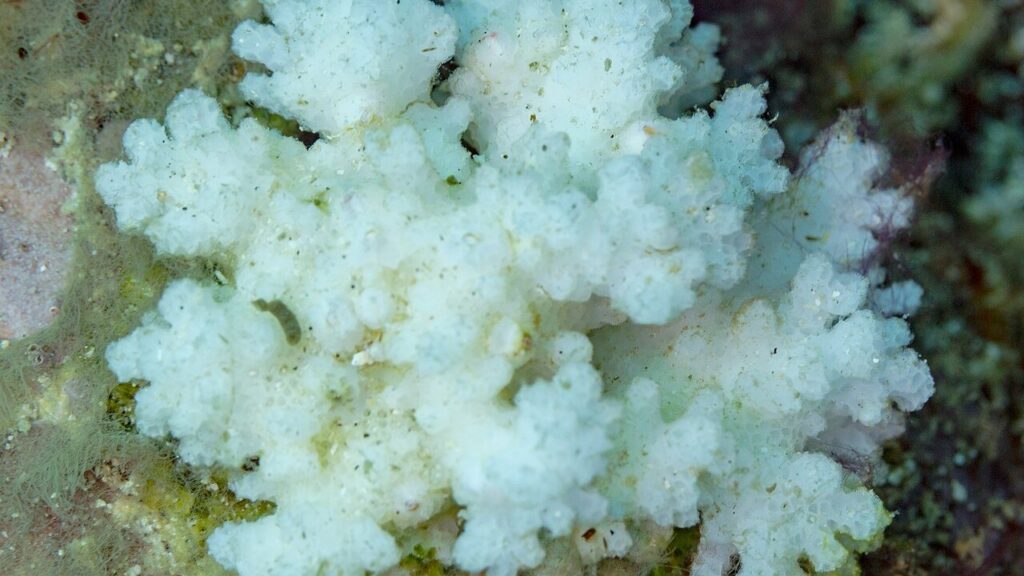
In early 2025, two fragments of cauliflower coral tipped over in a tank at Stanford’s Hopkins Marine Station and landed against each other — one healthy, one bleached white. Nobody planned it. But where the two pieces touched, color began seeping back into the pale one.
Stephen Palumbi, a marine scientist at Stanford’s Doerr School of Sustainability, spotted the accident and showed it to Daniel Collins, a PhD student in his lab. Collins remembers the eureka moment: he rushed to his supervisor’s office with the first positive results. “It’s stunning,” he told AFP.
That toppled tank became a study, published Wednesday in the journal Science Advances, that reports the fastest documented coral-bleaching recovery on record — and a mechanism nobody had seen before.
Ten pairs, five touching, five apart
Collins set up a simple experiment. He assembled ten pairs of fragments of Pocillopora damicornis, the cauliflower coral — one bleached and one healthy in each pair, all cut from the same animal. Five pairs were placed in direct contact. The other five sat a few millimeters apart, which in coral terms might as well be another ocean.
The difference was absolute. The bleached fragments touching a healthy clone fully recovered within about seven weeks. The fragments kept apart did not recover — they died.
Powerful laser microscopy revealed what was happening at the point of contact. Within a day or two, the tissues of the two corals began fusing, creating what the researchers called a “nutrient highway” between the pair. Through that living bridge, the healthy donor pumped symbiotic algae — the zooxanthellae that give corals their color and most of their food — along with nutrients into the bleached recipient. Beneficial algae began crossing within three days, and once inside, they multiplied at extraordinary speed: during the second week, the algae in bleached fragments doubled roughly every four days, about ten times faster than in wild corals.
“Once beneficial algae enter bleached corals, they don’t just spread out,” Palumbi said. “They flood in and start dividing at the fastest rates seen in corals.”
Five days is enough
The team also tested how long contact needed to last. Three days of contact was the minimum to get recovery started; about five days guaranteed it. Pairs separated after roughly a week still completed their full recovery in about seven weeks — the same as pairs left touching the whole time — because the transferred algae kept multiplying on their own inside the recovering coral.
There was one strict condition. The rescue worked only between genetically identical fragments. When the team paired corals from different genetic backgrounds, the corals deployed stinging cells — a hostile response Palumbi likened to organ rejection in humans. “Genetically identical corals recognize one another when they come into contact,” he said. “Their tissues fuse if they are from the same clone. We see something similar in humans. Organ transplants are often successful if the donor is your identical twin.”
A lab finding, not a reef rescue plan
The authors are blunt about the limits. The experiment used small fragments in tanks, not colonies on a wild reef — and the method needs a healthy, genetically identical copy of every bleached coral, which is not feasible at the scale reefs would require. “We likely will not be touching corals to each other on reefs,” Collins said.
What the study opens instead is a different path: extracting healthy symbionts, culturing them, and delivering them in large batches to bleached corals — a step that would sidestep the genetic-mismatch problem entirely, since the mismatch applies to the corals, not the algae. In the coming months the team plans to test delivery methods that do not require continuous contact, including banking algae from healthy corals before heatwaves strike.
Why this matters
The stakes are hard to overstate. NOAA’s Coral Reef Watch found that the fourth global coral-bleaching event — which ran from early 2023 to mid-2025 — exposed an estimated 84% of the world’s reef area to bleaching-level heat stress, with mass bleaching documented in at least 83 countries and territories. Marine heatwaves, intensified by El Niño conditions that keep breaking temperature records, are striking more often and more severely, and natural recovery after bleaching can take months to years — if it happens at all.
Against that backdrop, the Stanford result reframes what a bleached coral is. Bleached corals had largely been written off because of their high mortality rate. “While bleached corals may be dying, they are not dead yet,” Collins said — and the new work, he added, shows they “really shouldn’t be thought of as a lost cause.”
That is not the same as a cure. Independent scientists note that grafting algae cannot rebuild coral populations that have already died, and that cutting greenhouse gas emissions remains the most reliable way to give reefs a chance. The Stanford team agrees: this is a proof of concept from a laboratory, and the distance from a lab tank to a living reef is vast. But it is also the first time anyone has watched a coral on the brink of death pull itself back through the touch of its own clone — and it gives restoration science a mechanism it did not have before.