On Monday, October 19, voters in Alberta — Canada’s oil-rich western province — will cast ballots in a referendum that has the country’s prime minister warning about the survival of the federation itself. Here is what is actually happening, minus the noise.
Is Alberta voting on independence?
No — and that distinction matters. The ballot carries ten questions, and only the tenth touches the country’s future. It asks whether Alberta should remain in Canada or begin the legal process toward a future binding referendum on separation. The vote is non-binding. Even a strong “yes” on the process question would start a long constitutional procedure, not trigger independence. Election day is October 19; advanced voting ran October 13–17, with more than 450,000 ballots already cast; results are expected October 29.
Why is this happening at all?
The referendum was called on May 21 by Premier Danielle Smith, Alberta’s head of government, after a petition battle. Two rival citizen petitions circulated this spring: a pro-separation “Stay Free Alberta” campaign gathered around 223,000 signatures, while a pro-Canada petition collected more than 400,000. A separate separatist petition was struck down on May 13 over failures in Indigenous consultation. Smith herself says she favors staying in Canada — she framed the referendum as a way to settle the question rather than let it fester.
What is driving the separatist mood?
Three long-running grievances: alienation from the federal government in Ottawa, anger at federal energy and environmental policy — Alberta’s economy runs on oil and gas — and resentment over equalization payments, the system by which tax revenue is redistributed from wealthier provinces to poorer ones. The backdrop: the federal Liberals, led until recently by Justin Trudeau and now by Mark Carney, won a fourth consecutive term in 2025, a result many Albertans read as the rest of Canada voting against their interests again.
What did Carney say?
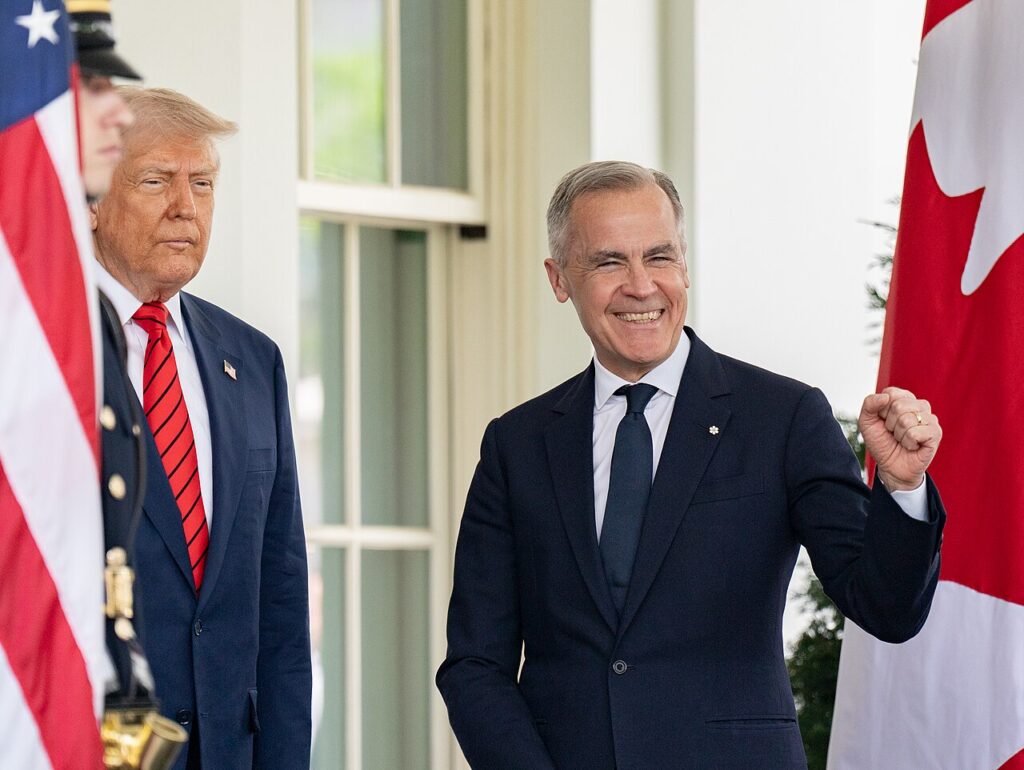
At a pro-unity “Forever Canadian” rally at Calgary’s BMO Centre on October 15 — 5,000 to 7,000 people, with a second rally in Edmonton the next night — the prime minister delivered the sharpest language of his tenure: “The world has become more dangerous and divided. Some outside our borders are working to break us so they can own us.”
He did not name the United States. He did not need to. The subtext is months of trade-war pressure and repeated “51st state” threats from Washington, which have defined the US-Canada relationship this year. Carney also warned voters against treating the ballot as a protest: “Don’t be fooled by the idea you can ‘send a message’ with your vote… This is not poker. A vote against Canada is a dangerous bluff.” His closing line: “Let Alberta lead, not leave.”
What do the polls say?
Roughly two-thirds of Albertans say they would vote to remain, with under a third backing the separation process. The referendum is unlikely to endorse separation — but that was never quite the point. A referendum on the country’s unity, even a non-binding one, forces every political actor in Canada to position themselves on the federation’s future, and gives separatist organizers a voter list, a campaign machine, and a result to cite.
Why does this matter beyond Canada?
Because the pattern is traveling. Across the democratic world, the same ingredients keep producing the same dish: a resource-rich region that feels exploited by its capital, a national government distracted by a bigger neighbor’s bullying, and a vote designed to “send a message” that turns out to be harder to walk back than anyone expected. The Brexit referendum was advisory too. Non-binding votes have a way of binding anyway — through the politics they unleash, not the law they make.
On Monday, Alberta votes on a process. The real question — the one Carney was answering in Calgary — is whether the federation’s immune system still works. Results October 29.



One Comment