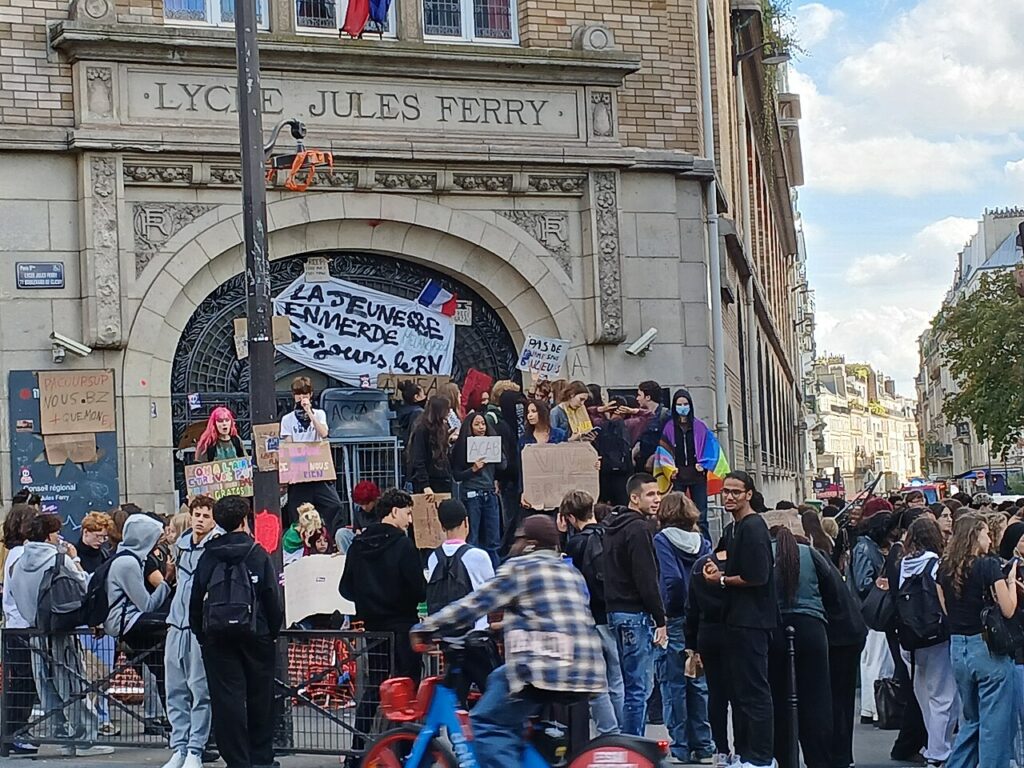
Eight years after they nearly toppled a government, the Yellow Vests are coming back to the streets — and this time, the students are marching with them.
Organizers calling themselves the “17 octobre gilet jaune” have listed 1,365 separate actions across France for today, Saturday, October 17: 611 demonstrations, gatherings at 158 roundabouts — the roundabout blockades that became the movement’s signature — plus pickets at 320 service stations, 88 railway stations, 45 bridges, six ports, 95 motorway toll barriers, five refineries and 37 oil depots. Police sources estimate nearly 200,000 people could take part nationwide, with 40,000 in Paris. The Paris prefecture has banned protests in the heart of the capital.
The call has gone out as the “yellow and youth” demonstrations. Where the 2018 revolt began with anger over fuel taxes, Saturday’s mobilization explicitly merges the new student revolt with the old yellow-vest one, and with broader cost-of-living fury.
From the classroom to the roundabout
The students have been protesting for weeks. High-school blockades, marches, clashes with police — and a crackdown whose numbers tell their own story: more than 6,800 people have been taken into police custody since the protests began, and 86 percent of them are minors. Thirty-six investigations have been opened by the IGPN, the police oversight body. AFP reported that several teenage protesters were maimed during the clashes, and public anger at perceived police brutality has grown alongside the movement.
The government tried to defuse the student revolt by announcing 3,000 substitute teachers for selected schools. The students said it wasn’t enough and kept marching.
Now the Yellow Vests — the movement that paralyzed France in 2018 and 2019 — have seized on that energy. Former movement figure Jérôme Rodrigues told supporters in a widely shared Facebook video: “Yellow vests, lycée students, workers, pensioners, our struggles can come together, and today we have a date to focus on: October 17, 2026.” The video drew more than 360,000 views. Another veteran of the 2018 protests, Eric Drouet, called on farmers, refuse collectors, firefighters and railway workers to join Saturday’s actions. An online movement against rising fuel prices has gathered momentum in the run-up to the day.
“I have a feeling that (Saturday) will be a sort of culmination,” 18-year-old Marie-Lou, a protesting university student in the city of Lille, told AFP. “We’ll be joined by workers and by the Yellow Vests, who are also mobilising again. There’s a sense of hope that all these different struggles might converge.”
Macron appeals for calm from Brussels
President Emmanuel Macron was not in France when the storm broke. Speaking in Brussels, where he was attending European Union talks, he called for “calm and respect,” saying the right to protest went hand in hand with “respect for people and property.”
Earlier this week, Macron argued that the students’ demands were legitimate but were being “exploited for political purposes” — a claim that drew fury from the protesters’ supporters.
His prime minister is visibly worried. Sébastien Lecornu ordered a crisis cell to monitor the demonstrations and said Thursday he feared clashes after what he called “urban violence” during the student protests. Interior Minister Laurent Nunez told France 2 television: “We’re expecting a pretty big turnout.”
Why the budget is the trigger
At the heart of the crisis is money — or rather, how the government refuses to spend it. Lecornu is trying to push a cost-cutting budget through parliament, aiming to rein in France’s growing public debt by raising taxes and reducing expenditures. The protesters demand the opposite: protection from inflation that has surged above three percent — driven, notably, by the Middle East war — and better-funded public services, especially education.
The political vultures are already circling. Jean-Luc Mélenchon, leader of the far-left France Unbowed party, has backed the student protests and marched in one demonstration on Tuesday. Marine Le Pen, whose National Rally leads the presidential-election opinion polls, has planted her flag on the side of the police. The two-round presidential election comes in April and May, and Saturday’s turnout will be read as an early weather vane.
Why this matters
France is the European Union’s second-largest economy and the eurozone’s second-biggest debtor — when Paris spends, borrows or cuts, bond markets and EU partners pay attention. A winter of rolling protests and refinery or fuel-depot blockades would tighten the government’s room to pass its budget at the worst possible moment, and a new wave of images of unrest in France tends to embolden copycat movements elsewhere in Europe, from student blockades to trucker protests. For the rest of the world, today’s mobilization is also the first big test of whether the cost-of-living pressures created by the Middle East war are about to reopen the street-politics playbook that defined Europe’s late 2010s.
Related: France student protests October: nearly 500 arrested — Albania’s student protests enter their third day


2 Comments