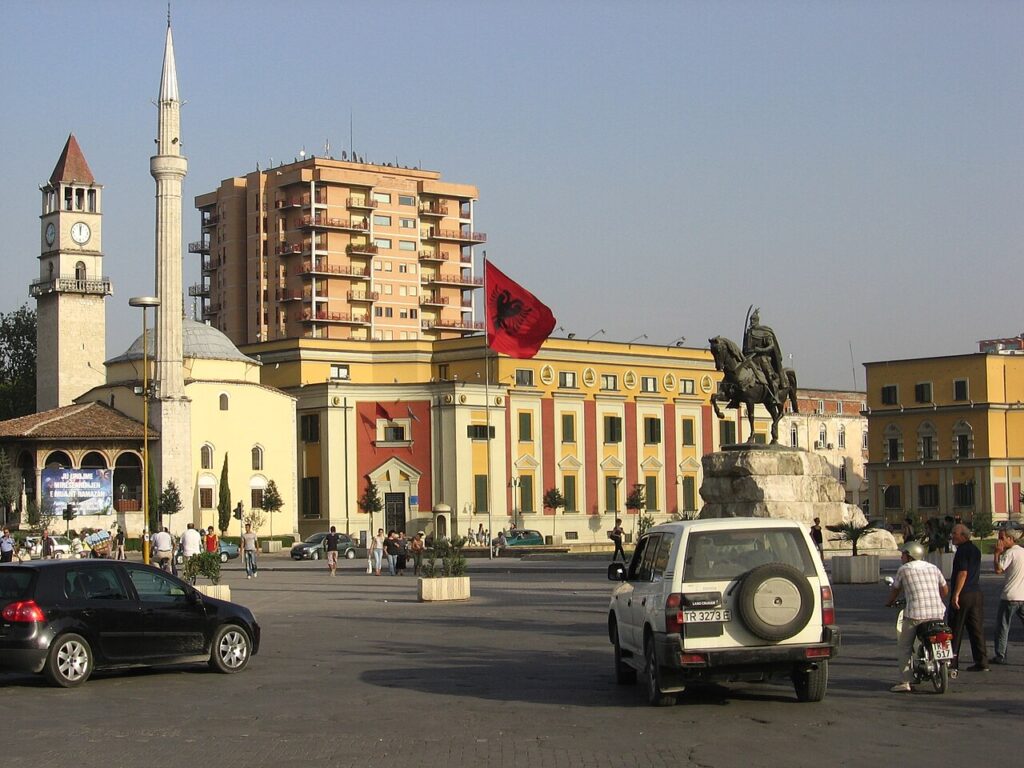
For the third straight day, students have clashed with police in Tirana, turning what began as a campus protest into the most serious unrest Albania has seen in years. They call it the “flamingo movement” — after the flamingo signs they carry — and on Thursday they issued the prime minister an ultimatum: resign by 1:00 p.m. He did not.
The timeline so far
The backstory — months in the making. The anger traces to a €1.4 billion luxury resort planned for Albania’s southern coast, linked to Donald Trump’s family: Jared Kushner’s investment firm is behind the project, with Ivanka Trump involved. The site sits in a protected coastal area home to flamingos and sea turtles, and scientists warned as early as July that the project had already caused irreparable coastal damage. Protests against the resort flared in June and July; by one opposition MP’s count, the broader movement is more than 130 days old.
Tuesday, October 13 — the students move. University students began protesting in Tirana, folding the resort anger into long-standing grievances about education costs, university conditions, and corruption.
Wednesday, October 14 — riots. The protests turned violent. Demonstrators attacked government buildings, banks, and businesses; buildings were set alight across Tirana, including around the prime minister’s office and ministry buildings. The Health Ministry reported 89 people injured, including 61 police officers. Police said 65 people were arrested for “attacking police officers, institutions, public and private property.”
Thursday, October 15 — day three. Youths clashed with police outside the Education Ministry — stones against tear gas and water cannons. Parliament cancelled its session. The protests spread beyond the capital: in Korce, students smashed high-school windows, and demonstrations reached the southern coastal cities at the heart of the resort dispute. High school students joined the university protesters. The “flamingo movement” issued its ultimatum demanding Prime Minister Edi Rama’s resignation by 1:00 p.m.
Friday, October 16. Protesters are gathering again in Tirana’s central square. The government shows no sign of yielding, and the students show no sign of leaving.
What the protesters want
The demands have grown beyond the resort: education reforms, lower education costs, better university conditions, government accountability, an end to corruption — and now, Rama’s resignation. “We will be in the square every day,” organizer Mateo Yskollari said, promising to “expand the protest, civil mobilization, and disobedience.” Journalism student Teftalia Papa told AFP the students would not be moved.
What Rama says
Rama, in power for about 13 years after winning a fourth term in 2025, refuses to go. “As for calls for my resignation, governments are changed through democratic elections. We had elections last year, not a revolution,” he told Reuters. He has offered dialogue on what he calls legitimate concerns while blaming the opposition and “foreign actors” for the violence — a line Interior Minister Ervin Demo echoed. The opposition Democratic Party has backed the students and demanded a caretaker government and early elections. Education Minister Mirela Kumbaro appealed to parents to keep children home; the ceremonial President Bajram Begaj urged restraint.
The EU is watching — and worried
The European Union’s delegation in Tirana condemned the “violent escalation,” urging restraint on both sides: “We call on protesters to exercise restraint and to refrain from any acts of violence. Violence has no place in democracies.” It also demanded a prompt investigation into allegations of excessive police force against protesters and journalists.
That last sentence matters. Albania is a NATO member and, together with Montenegro, leads the Western Balkans’ EU accession talks, aiming for entry as early as 2028. Brussels does not admit countries whose streets are burning and whose police are accused of beating journalists. The flamingo movement is now, whether it intended to be or not, a direct threat to Albania’s European bid.
Why this matters beyond Albania
Europe has seen student anger before — the student protests that rocked France earlier this month drew nearly 500 arrests — but Albania’s version fuses three explosive ingredients: a leader who has not lost an election in 13 years, a corruption narrative with a Trump-family face, and an EU membership bid that gives Brussels real leverage. Rama’s bet is that elections in 2029 are the only verdict that counts. The students’ bet is that the square is. One of them is about to be proven wrong.
Correction: An earlier version of this article misspelled the name of Albania’s Interior Minister Ervin Demo. It has been updated to reflect the correct spelling. 17 October 2026

One Comment