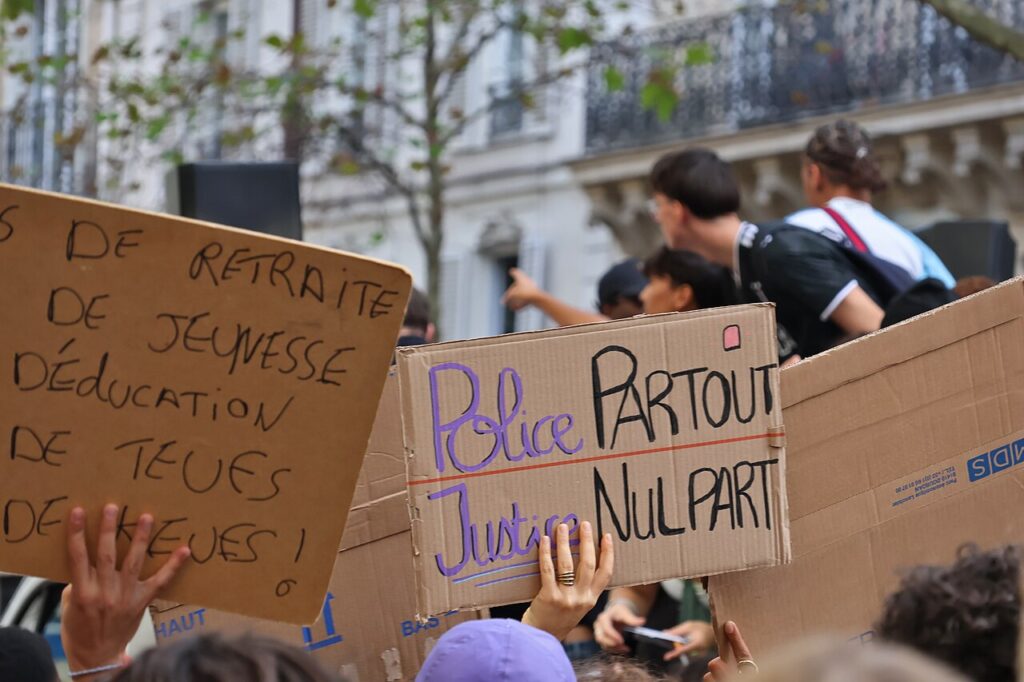
The day of action France’s protest movement had been building toward for weeks finally arrived on Saturday — and by nightfall, it had turned ugly. Police fired tear gas and water cannon in Paris and other cities as masked groups peeled away from the marches, torched buildings, smashed into city halls and stripped shops bare.
France’s Interior Ministry said around 550,000 people joined the demonstrations across the country, including 110,000 in Paris. The CGT, one of France’s biggest trade unions, put the figure at 800,000. Interior Minister Laurent Nuñez said some 400 people were arrested nationwide, about 110 of them in the capital, and 60 police officers were injured — two badly enough to be taken to hospital unconscious.
The unrest marked the moment a movement born in France’s classrooms became a nationwide crisis. What began in late September as student protests over teacher shortages and crumbling school buildings merged on Saturday with trade unions and the heirs of the gilets jaunes — the yellow-vest protesters whose fuel-tax revolt of 2018 became the biggest challenge of Emmanuel Macron’s presidency. Organizers had listed 1,365 protest actions across the country under the banner of “yellow and youth.”
Most of those marches were peaceful. But in several cities, violence erupted on their edges.
In Paris, police used tear gas against masked groups near Place de la République as cars were set alight and shop windows smashed. Several hundred protesters briefly erected construction barriers at the bottom of the Champs-Élysées before being dispersed. As night fell, groups of young people looted shops and started fires in the capital’s narrow streets, prompting baton charges.
The most dramatic damage was outside the capital. In Limoges, masked protesters set fire to the city’s 143-year-old town hall; flames reached the roof and the building’s historic clock tower collapsed. In Marseille, demonstrators smashed down the front door of the city hall and stormed inside. In Lille, protesters broke into the town hall. In Lyon, a 19th-century building housing a tourist office was ransacked and set ablaze — and firefighters were reportedly blocked from putting out the flames. In Bordeaux, rioters broke into the prefect’s official residence and the local police compound, ransacking both.
Dozens of shops were looted in Paris, Marseille, Nice, Bordeaux and Lille. An Apple store in Lille was stripped bare, according to AFP journalists on the scene. In Saint-Étienne, a protester lost his hand when a police crowd-control grenade exploded — the second such maiming of this protest wave, after a 15-year-old lost his hand to a police stun grenade during a demonstration in Lens on October 5.
“No room for violence in our Republic”
President Emmanuel Macron responded late Saturday on X: “No room for violence in our Republic. Those who have broken, attacked the prefectures as well as businesses, looted even our town halls, will be prosecuted and punished.” He expressed the nation’s support for the police, whom he called the guardians of the right to demonstrate, and said the country must stand united against those who sow chaos.
Prime Minister Sébastien Lecornu, who headed an interagency crisis cell at the Interior Ministry during the day, condemned what he called “violence of extreme intensity.” “Peaceful protests have their full place in our Republic,” he said. “Looting and attacks have none.” Nuñez blamed the destruction largely on militants “associated with the hard and extreme left,” and said the vast majority of demonstrators had been lawful.
France’s opposition split along familiar lines. Marine Le Pen, the far-right National Rally leader, accused far-left groups of “poisoning” the protests. Jean-Luc Mélenchon of the left-wing France Unbowed party insisted “everything is unfolding in calm” and accused the media of fixating on the violence.
Why this matters
Saturday’s toll — hundreds of thousands marching, hundreds arrested, town halls in flames — tells a story about more than a single day. The student movement that started over classrooms and teacher pay has fused with the cost-of-living anger that brought the original yellow vests onto the streets eight years ago. Together, they have given France its broadest protest coalition since 2018, and its most violent street confrontation in years.
The timing is no accident. France votes for a new president in April 2027, and Macron, term-limited, cannot stand again. Every night of televised disorder becomes ammunition for the candidates positioning to succeed him — Le Pen on the right, Mélenchon on the left — each accusing the other of being the violence’s true sponsor. Saturday may be remembered less for the peaceful majority who marched than for the question it forced on the French state: whether the country’s famous protest tradition, which has toppled governments and forced presidents to retreat, still has a peaceful path to being heard.