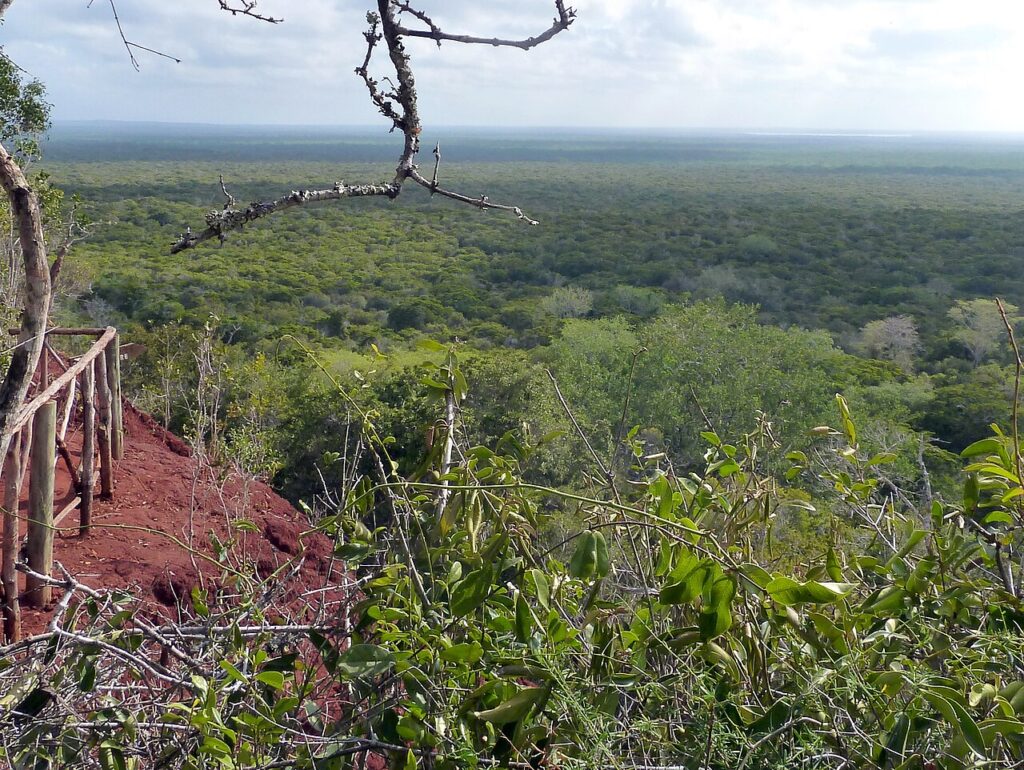
Informopedia Explains: when Justice Diana Kavedza Mochache finished reading her judgment in Mombasa on Monday, she had been speaking for more than eight hours. The courtroom had heard how children were isolated and denied food while their parents watched, and how the dead were celebrated as having “wedded with Jesus”. Paul Mackenzie, a former taxi driver turned preacher, and 28 co-accused stood convicted of murdering 191 people — 190 children and one adult — in an organised system of enforced starvation in Kenya’s Shakahola forest. Our full report on Monday’s Shakahola verdict carries the details of the conviction.
Sentencing is set for November 6. Francis Wanje, who lost eight members of his family — including his daughter and two grandchildren — travelled to Mombasa to hear it. Mackenzie’s defence insisted the victims fasted voluntarily; the judge rejected that argument outright. But the verdict answers the legal question, not the human one: how did ordinary parents come to follow a man who told them to starve their own children to death?
Shakahola was not the first
The pattern is older than Mackenzie and longer than any one country. In Guyana, on November 18, 1978, more than 900 followers of the American preacher Jim Jones died in a single day — most of them poisoned with cyanide in the remote settlement of Jonestown, hours after Jones ordered the assassination of a visiting US congressman, Leo Ryan, at a nearby airstrip. Hundreds of the dead were children; armed guards were ordered to shoot anyone who tried to run. Jones had moved his congregation to Guyana the previous year, promising a socialist utopia far from American capitalism.
Nineteen years later, in the San Diego suburb of Rancho Santa Fe, police entered a rented mansion on March 26, 1997 and found 39 bodies. They were Heaven’s Gate, followers of Marshall Applewhite, dressed in matching black clothes and Nike sneakers, covered in purple shrouds. They had swallowed phenobarbital mixed into applesauce, washed it down with vodka, then placed plastic bags over their heads — convinced a spacecraft trailing the Hale-Bopp comet would carry their souls away. They recorded farewell videos expressing joy about “graduating”.
And in Tokyo, on the morning of March 20, 1995, members of the Aum Shinrikyo movement punctured bags of liquid sarin nerve gas on subway trains at rush hour, killing 13 people and sickening more than 6,000. The group’s leader, Shoko Asahara, declared himself Christ and the first “enlightened one” since Buddha. His followers were not society’s cast-offs; they included graduates of Japan’s top universities, hand-picked as aides. Asahara was hanged in 2018.
The details differ, but researchers who study these movements say the machinery underneath repeats itself with unsettling regularity.
How researchers say recruitment works
The first thing the research insists on: it does not start with death. It starts with small steps. Psychiatrist Marc Galanter’s classic 1979 study of converts to the Unification Church — the Moonies — traced a sequence of small decisions about accepting authority, each one easy to say yes to, that gradually restructured how a convert thought. Nobody joins a cult. People join a group, then another meeting, then another — until they hold beliefs completely different from the ones they started with.
The second mechanism is isolation — and the Shakahola judgment reads like a case study in it. Mackenzie’s followers were moved off the grid into the forest at Chakama Ranch in coastal Kilifi County, hours from Mombasa. The court found the church discouraged formal schooling and medical treatment; in her ruling, Justice Kavedza said medical care had been “presented as an instrument of Satan”. A 2024 literature review at Portland State University, surveying a century of cult scholarship, found the same toolkit across groups: cut the lines to the outside world, and the leader becomes the only compass left.
That is where charismatic authority takes over. Cult researchers keep returning to Stanley Milgram’s 1963 obedience experiments, in which ordinary people administered what they believed were dangerous shocks on an authority figure’s orders — not to excuse anyone, but to explain why “I would never” is such an unreliable prediction. In a group where everyone around you treats the leader as the voice of God, dissent feels like madness long before it becomes dangerous.
The fourth piece is the story that makes it all meaningful. Doomsday gives suffering a plot. Mackenzie preached that the world was ending and fasting to death was the way to meet Jesus — an apocalyptic narrative hands a person with an ordinary life a cosmic starring role. Psychologist Leon Festinger’s 1956 study of a failed prophecy group even found the counterintuitive twist: when the predicted apocalypse doesn’t arrive, believers often double down — admitting the prophecy failed means admitting everything they sacrificed was wasted. By the time Mackenzie’s followers reached the forest, they had given up homes, schooling, medicine and contact with the outside world. Cognitive dissonance, the researchers argue, made it easier to believe the fast than to face what the belief had cost them.
Finally, there is us-versus-them. Schools, hospitals, the government — every institution that might have pulled a follower back was cast as the enemy. That part of Mackenzie’s teaching was not decorative: prosecutors showed the fasting directive was communicated through village elders, reinforced at meetings, and enforced by guards who beat those who tried to escape. Children were made to fast first, then women and young men, then the remaining men. When the whole world outside the group is declared evil, the forest stops feeling like a trap and starts feeling like the only safe place left. The San Diego State University’s Jonestown archive shows the same architecture in Guyana: the community was told the outside world was coming to destroy them, right up to the day of the poisonings.
One more finding matters, because it is the one people resist. The research says cults do not recruit the weak or the stupid. They recruit people in transition — a death in the family, a lost job, a move, a crisis of meaning. That is the uncomfortable part of the Shakahola question: the parents who followed Mackenzie into the forest were not aliens. They were people who were offered certainty by a confident man at a fragile moment, and then had the exits quietly closed behind them.
The warning signs
The same red flags turn up in study after study:
- A leader who cannot be questioned, whose authority is placed above family, conscience and evidence.
- The outside world painted as corrupt, evil or doomed — schools, doctors, governments recast as enemies.
- Cutting ties: moving away, dropping friends, quitting jobs, pulling children out of school.
- Escalating demands: each sacrifice small enough to accept, each one making the next one harder to refuse.
- Urgency: an apocalypse always around the corner, leaving no time to check.
- No visible exit: leavers shamed, threatened or cut off entirely.
Shakahola checked every box. So did Jonestown, Heaven’s Gate and Aum Shinrikyo, each in its own idiom.
Why this matters, and what happens next
Kenya is now doing what societies always do after a mass death: arguing about what the state should have done. President William Ruto has acknowledged that government agencies should have intervened; the country’s ombudsman found what it called “a gross dereliction of duty” by officials who ignored warnings about Mackenzie between 2021 and 2023. Ruto’s presidential task force proposed a separate statute and the re-registration of every religious institution; the resulting draft Religious Organisations Bill was approved in outline by the cabinet in July 2025 — then stalled after church leaders appealed for it to be withdrawn. This month, the Senate formed an 11-member ad-hoc committee to investigate Shakahola and propose regulation. The debate is the same one every country faces after a cult disaster: how to stop the next Mackenzie without handing the state a weapon against every unpopular belief.
Jonestown, Heaven’s Gate, Aum Shinrikyo, Shakahola — four countries, four decades, and in every case the same quiet mechanics: small commitments, a closed world, a confident leader, a story that made death look like meaning. The court could not answer the human question: 190 children are dead, and the adults who loved them believed they were saving them. Until we understand how that becomes possible — not in monsters, but in ordinary people — the forest is never as far away as it looks.