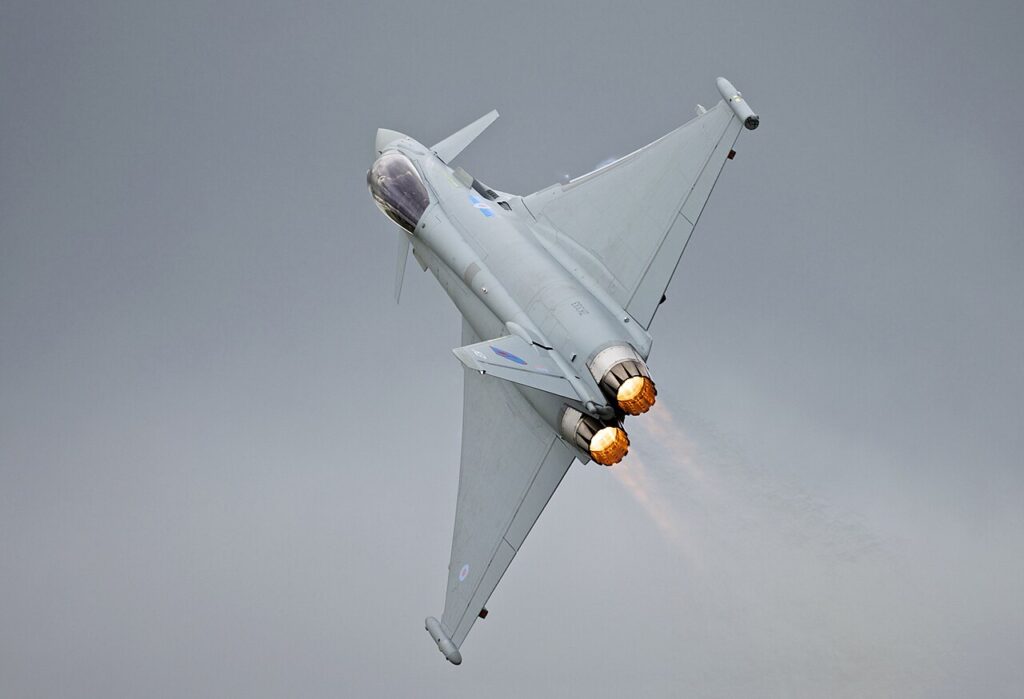
Britain is sending its fighter jets to Saudi Arabia. On Tuesday, the UK Ministry of Defence announced that Royal Air Force Typhoon warplanes will fly “defensive counter-air missions” to protect Saudi cities and critical infrastructure from missile and drone attacks by Yemen’s Houthi rebels.
The jets will intercept incoming drones and missiles. They will not, London stressed repeatedly, conduct offensive strikes against the Houthis inside Yemen. A Downing Street spokesperson told reporters the Typhoons “will intercept missiles and drones launched against Saudi Arabia and will not conduct offensive strikes inside Yemen.”
Alongside the fighter jets, Britain is sending an Atlas A400M transport aircraft to move heavy equipment around the kingdom and British military advisers to support Saudi counterparts on the ground. London is also extending the air-to-air refuelling support it already provides for Saudi air operations — a mission RAF Voyager tankers have been flying since September, when Britain first announced defensive military assistance for the kingdom.
Why now
The announcement follows a month of escalating Houthi attacks. On October 10, a missile strike on Riyadh’s King Khalid International Airport killed 13 people and wounded more than 300 — the deadliest attack on Saudi soil in over a decade. The airport remains closed. The Houthis struck oil giant Aramco’s Dhahran headquarters for the first time last week, and on Monday they hit a government military training camp in southern Yemen’s Shabwa province, killing 58 recruits. Air-raid alerts sounded in Riyadh on Monday night, and Saudi authorities said on Tuesday they had downed another missile over the capital.
“The continuing attacks from the Houthis on our ally Saudi Arabia are absolutely despicable,” Defence Secretary Wes Streeting said in the ministry’s statement. “The targeting of the airport in Riyadh in particular shows the lengths the Houthis are going to escalate the situation in the region.”
“That’s why today I have approved further UK military support. RAF Typhoons will fly defensive air missions to help protect Saudi airspace from drones and missiles. This builds on the UK equipment and personnel we already have in the country to defend against Houthi air attacks,” he added.
The Times reported that the Typhoons, currently based in Qatar, will fly defensive missions over Saudi airspace — a move understood to have been authorised by Prime Minister Andy Burnham. A defence source told the paper: “If Houthi drones or missiles come over the border towards Saudi Arabia they will take them out.”
A wider scramble for allies
The British announcement landed a day after Egypt’s parliament delayed — for the second day running — a vote on President Abdel Fattah el-Sisi’s request to authorise military support for Saudi Arabia if the kingdom asks for it. State media said the vote would be rescheduled for October 26.
Saudi Arabia has been running low on missile interceptors, and has been asking allies from France to Pakistan for help. The Houthis — formally Ansar Allah, an Iran-aligned armed movement that controls much of northern Yemen — have been fighting the internationally recognised Yemeni government, which is backed by Saudi Arabia, in a war that has intensified dramatically since the Houthis announced they would target Saudi infrastructure after a Saudi strike on Sanaa airport in July.
The group has claimed strikes on targets ranging from Aramco facilities in Yanbu to the Shaybah oilfield and Riyadh’s airport, while Monday’s camp strike in Shabwa was the deadliest single blow against pro-government forces in months. The Houthis have also been hitting shipping in the Red Sea and the Strait of Hormuz, where crude prices have surged past $110 a barrel.
Why it matters beyond the Gulf
For Britain, this is a meaningful step up. In March, Downing Street announced fighter jets would provide defensive cover in the region from Iranian missiles — but the Typhoon mission over Saudi airspace against the Houthis is new, and it puts British pilots into a live combat zone, even in a strictly defensive role.
There is a domestic motive, too. Al Jazeera’s reporting from London noted that the government is partly driven by rising energy prices — Brent crude over $110 hits British households directly. “What’s happening in the Gulf has a direct impact on people’s homes,” the network reported, calling the deployment a sign of “increasing engagement by the UK” in the region.
The risk, of course, is escalation by accident or design: a British pilot shooting down an Iran-supplied missile over Riyadh is a headline that writes itself in Tehran. London’s insistence that the mission is purely defensive is meant to keep it that way. Whether the Houthis — and their backers in Iran — see it the same way is now the question that matters.