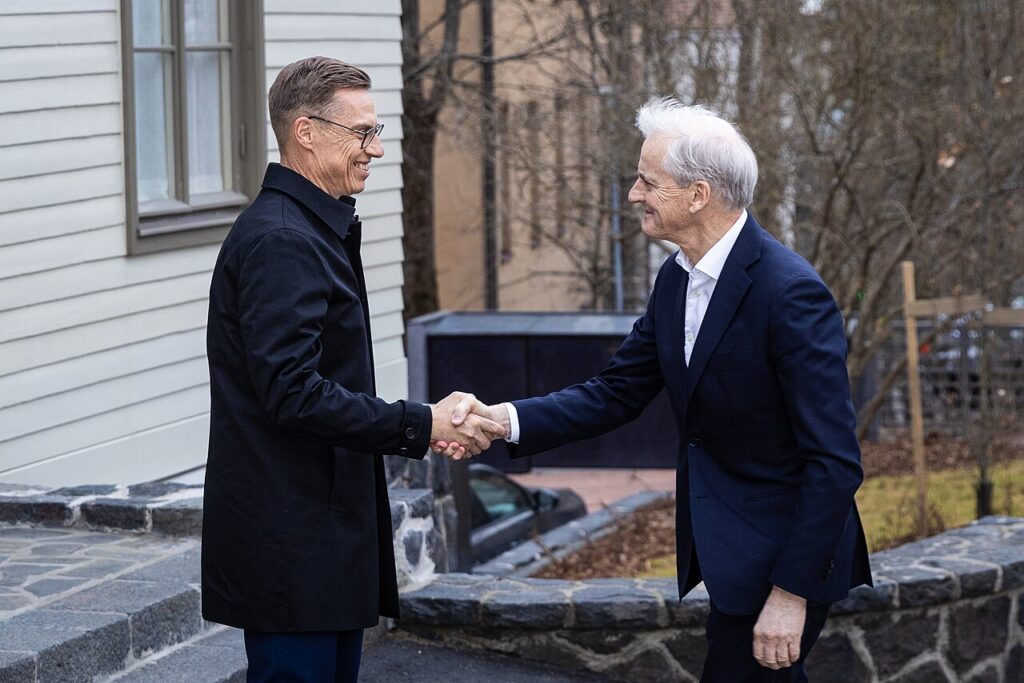
Finland’s President Alexander Stubb and Norway’s Prime Minister Jonas Gahr Støre picked up the phone to Vladimir Putin on Tuesday — and stayed on the line for an hour and a half, three times longer than planned. It was the first time leaders of European countries firmly in Ukraine’s corner have spoken directly to the Russian president since France’s Emmanuel Macron called him in July last year.
The two Nordic leaders made the call from Helsinki, where Støre was attending a meeting of Nordic leaders. They initiated it themselves, they said in a joint statement, as a follow-up to a meeting in Oslo on October 20 that included Ukraine’s President Volodymyr Zelenskyy — and after consulting Kyiv in advance.
“The discussion was frank and substantive,” Stubb said. “We are neighbouring countries to Russia. The outcome of this war will have a direct impact on our and the broader European security. Ending the war requires direct discussions.”
Støre was blunter about how far apart the two sides remain. “There are big differences in views,” he told Norwegian broadcaster NRK after the call, describing the talks as substantive and professional but saying he disclosed no further details.
According to the Kremlin’s account, Putin told the pair that a just and long-term peace is possible only if Russia’s legitimate interests are taken fully and unconditionally into account. Reuters, citing a source close to the Kremlin, reported that Putin also told them Russia would not compromise over Donbas, the eastern Ukrainian region Moscow claims.
After the Putin call, Stubb and Støre rang Zelenskyy. “Alex and Jonas made it clear to the Russian leader that real de-escalatory steps are needed regarding our energy and infrastructure,” Zelenskyy said afterwards.
The timing is not accidental. Russia, Ukraine and the United States are preparing for a possible round of negotiations in Abu Dhabi in early November, and the Nordic leaders said the point of the call was to carry messages about those talks directly to Putin. Kremlin spokesman Dmitry Peskov said no date for the Abu Dhabi meeting has been confirmed yet.
The call drew swift criticism from Denmark, which questioned the outreach, and it landed on a day when the war itself showed no sign of pausing. Overnight, Russia struck Kyiv with 16 ballistic missiles and more than 280 drones, hitting the capital’s South Bridge and forcing its closure, while a separate truce took hold in the southern town of Oleshky to let aid reach civilians close to starvation.
That contrast — diplomacy on the phone, missiles over Kyiv — is the story of this war’s fifth year. Europe’s allies of Ukraine have spent months trying to secure a seat at a negotiating table that Washington and Moscow may set without them. Stubb and Støre argued their case for a seat on geography: both countries share a border with Russia, and both have watched the war reshape security across the Baltic Sea and the High North.
The call also follows a renewed American push. US special envoy Steve Witkoff visited Putin in St Petersburg last week, after talks in Oslo with Zelenskyy and the two Nordic leaders. With Washington’s patience with Kyiv visibly thinning in public, Europe’s pro-Ukraine governments are testing whether a direct line to the Kremlin can move anything at all.
Ninety minutes of frank talk did not produce a breakthrough — nobody claimed one. But after fifteen months in which Kyiv’s European backers refused to call Moscow at all, the phone line itself is the news. The question now is whether the Abu Dhabi talks give it something to carry.
Why this matters: For readers outside Europe, this call is a signal about who shapes the end of the Ukraine war. If the fighting stops through a deal negotiated only between Washington and Moscow, Europe lives with the consequences — and so do energy markets, grain supplies and security arrangements far beyond the continent. Two small neighbouring states just insisted on being heard before that deal is written. Whether Putin listened is a different question, and the answer will show up first in Abu Dhabi.
Related reading: The Oleshky Truce Has Begun. The Aid Hasn’t Moved — and Nobody Is Monitoring It and EU Leaders Rally Around Zelensky in Brussels After Trump Calls Him “More Difficult” Than Putin. The official Finnish presidency statement on the call is here.