Informopedia Explains: On January 11, 2020, scientists in China posted the genetic sequence of a new coronavirus on the internet, free for anyone to read. Two days later, a small American biotech company had finished its vaccine design. Sixty-three days after that, the first volunteer in Seattle received a shot. If that timeline makes you suspicious, it should. Medicine simply did not work that fast — until it did. This is the story of the most important medical technology of our time: thirty quiet years behind an “overnight” success, and where it goes next.
The recipe that changed everything
Traditional vaccines are built from the germ itself: killed virus, weakened virus, or purified viral protein. High-security labs, months of culture, factories built around each disease — effective, but slow and rigid.
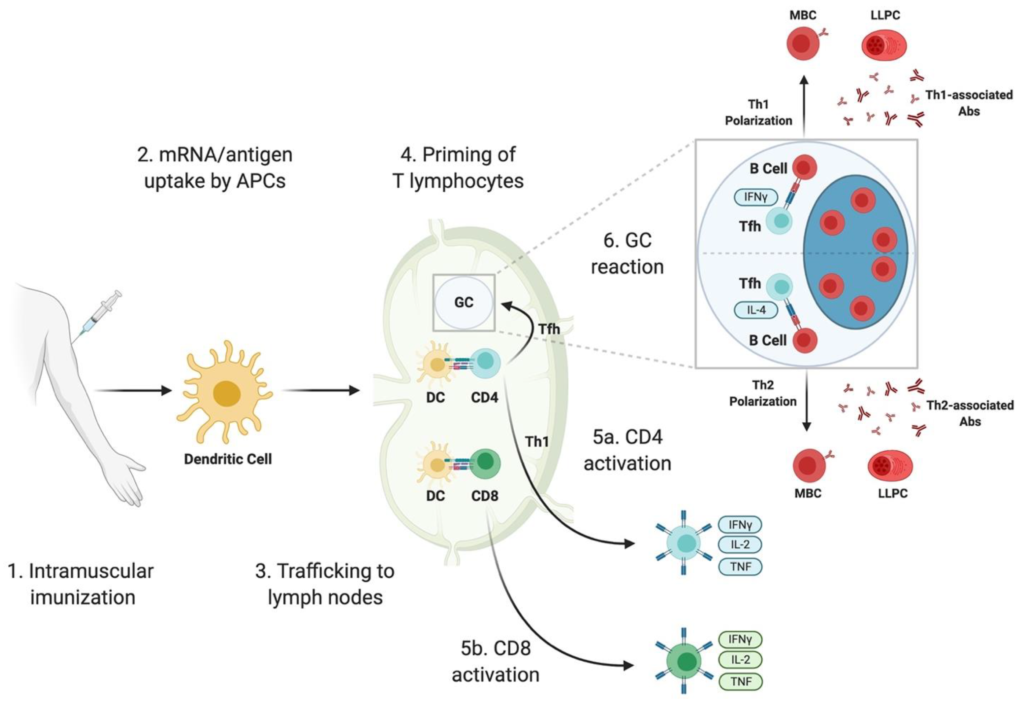
mRNA vaccines threw out the recipe. Instead of delivering the pathogen’s protein, they deliver the instructions for making one piece of it — a short strand of messenger RNA. Your cells become temporary factories: they build the viral protein, display it, then shred the instructions within days. The immune system sees the protein, learns it is foreign, and prepares a defense. You never encounter the actual virus, and there is nothing alive in the syringe.
The letter in the fatty envelope
Each COVID-19 mRNA shot is the same basic package: synthetic mRNA encoding the coronavirus spike protein, wrapped in tiny droplets of fat called lipid nanoparticles. Bare RNA is fragile — enzymes in blood chop it to pieces in minutes, and the molecule is too large and too charged to drift through a cell membrane. The nanoparticle is a delivery shell: lipids grip the RNA while cholesterol and pegylated lipids stabilize it.
Inside, the particle escapes into the cytoplasm — never the nucleus, which is why the vaccine cannot touch your DNA. Ribosomes read the mRNA and build copies of the spike protein. Fragments are displayed on the cell surface, activating killer T cells that destroy infected cells; the free-floating protein is noticed by B cells, which pump out antibodies built to block the spike. Memory versions of both cell types persist, so your immune system responds within hours, not days, the next time it meets the real virus.
The photocopier meeting that took 30 years
Lab-made RNA was useless as medicine because the body’s alarm systems shredded it on sight: human cells evolved to treat foreign RNA as a viral invasion, so synthetic mRNA triggered inflammation while the material was destroyed. For two decades, mRNA vaccines were a punchline.
The punchline ended at a University of Pennsylvania photocopier, where biochemist Katalin Karikó — whose grant applications kept being rejected — met immunologist Drew Weissman in the late 1990s. Their 2005 paper answered a precise question: what makes the immune system attack synthetic RNA but tolerate the body’s own? Replace one RNA building block, uridine, with its modified cousin pseudouridine, and the alarm bells go quiet. The mRNA survives long enough to work. In 2023, Karikó and Weissman won the Nobel Prize in Physiology or Medicine.
The lipid shell had its own long road: thirty years of toxicity and manufacturing failures before nanoparticle formulations safe enough for human use emerged — the unsung hero of the whole enterprise.
Why 2020 went so fast — and why it was still real
With the puzzle pieces on the table, the modern timeline makes sense. An mRNA vaccine is software as much as medicine: once you know the target’s genetic sequence, you only have to type a new sentence. Moderna finalized its candidate two days after the sequence appeared, had a clinical batch by February 7, and dosed the first volunteer on March 16 — 63 days from sequence to human testing.
The trials were not skipped; they ran in parallel at enormous cost. Tens of thousands of volunteers enrolled in the Phase 3 studies — Pfizer’s showed roughly 95% efficacy, Moderna’s about 94% — and because the virus was everywhere, infections accumulated in the placebo groups within months instead of years. Governments poured billions into manufacturing before results were in, building factories for vaccines that might never be approved. That gamble bought the speed. Britain cleared the Pfizer shot in early December 2020; the United States followed within weeks. Within four years, more than 13.5 billion doses of COVID-19 vaccines had been administered.
The freezer drama
The same fragility made RNA hard to store. Pfizer’s vaccine had to travel and sit at around minus 70°C — colder than an Antarctic winter — and once thawed kept for only five days in a normal fridge. Moderna’s tolerated a standard freezer at minus 20°C, and stayed good for 30 days in a refrigerator. Pfizer designed dry-ice shipping boxes, nicknamed “pizza boxes,” to keep doses alive on the road. A real constraint, not a scandal: it is what happens when your medicine is a molecule enzymes evolved to destroy. Later formulations relaxed these limits, which is why the ultra-cold saga belongs to 2020 and 2021, not to the platform itself.
What the shot actually does to you — honestly
The honest safety record has three layers. The first is ordinary: a sore arm, fatigue, headache, muscle aches, chills or a low fever for a day or two — an immune system doing its job. The second is rare but real. Severe allergic reactions occur in roughly a handful of people per million doses, which is why sites observed recipients for 15 minutes. Heart inflammation — myocarditis and pericarditis — is the most serious confirmed risk: a few cases per 100,000 doses, concentrated in adolescent and young adult males after the second dose, usually mild and resolving with rest. Pfizer’s own analyses through 2025 confirm that pattern, and regulators concluded the benefit — protection against severe COVID — outweighed it. For comparison: one large study found myocarditis at 2.7 per 100,000 after vaccination versus 11 per 100,000 after COVID-19 infection itself. The virus is worse for the heart than the vaccine.
The third layer is what never happened. The mRNA does not enter the cell nucleus, does not convert into DNA, and does not integrate into the genome — it is read and recycled within days. No mechanism exists for it to rewrite anyone’s genes, and after more than 13 billion doses, surveillance data have not produced one. The strongest-evidenced claim in this article.
Where the technology goes next
The pandemic was a demonstration, not a destination — researchers are now pointing the programmable platform at one disease after another.
The clearest validation arrived in August 2026, when Moderna and Merck announced their personalized mRNA cancer vaccine, intismeran autogene (formerly mRNA-4157), had succeeded in a Phase 3 trial of 1,137 melanoma patients — the first time any individualized neoantigen therapy had cleared that bar. The recipe: surgeons remove the tumor, labs sequence its DNA for the mutations unique to that cancer, and Moderna manufactures a single-patient mRNA vaccine encoding up to 34 of them, given with the immunotherapy drug Keytruda. A five-year follow-up of the earlier trial showed the combination cut the risk of recurrence or death by 49% and of distant spread by 59% versus Keytruda alone. Not yet approved — full data are expected at a medical conference this year — but cancer mRNA is no longer a fantasy.
In August 2026, the FDA licensed Moderna’s mRNA flu shot, mFLUSIVA, for adults over 50 — the first flu vaccine on the platform, after the agency refused to review the application in February over the trial design and reversed course two weeks later. In a trial of more than 40,000 people across 11 countries, the mRNA shot was 26.6% more effective than the standard flu vaccine. An mRNA RSV vaccine, mRESVIA, has been in use since May 2024. The platform’s promise for flu is speed: instead of growing strains in eggs for half a year, the sequence can be rewritten in weeks — a better match to whatever strain is circulating.
Politics intrudes: in August 2025, U.S. health authorities canceled around $500 million in mRNA vaccine contracts, citing skepticism about the platform. The cancer vaccine result lands in that debate as a counterweight.
Why this matters
The mRNA story is not about a clever molecule. It is about the economics of patience: Karikó’s papers rejected for years, the nanoparticle work limping along for three decades — then the world needing all of it at once, and it being there. The uncomfortable lesson for the next pandemic: you cannot fund basic research only when the emergency arrives, because the emergency needs thirty years’ head start.
What happens next
Within a decade, the likely reality is mundane in the best way: flu shots reformulated in weeks, RSV and combination respiratory vaccines for older adults, and personalized cancer treatments manufactured for one patient at a time. The technology will keep arguing with its skeptics. But the biology at its core — instructions in, protein out, instructions shredded, memory kept — has been tested at a scale no medicine in history has matched. That experiment is over. What comes next is engineering.

One Comment