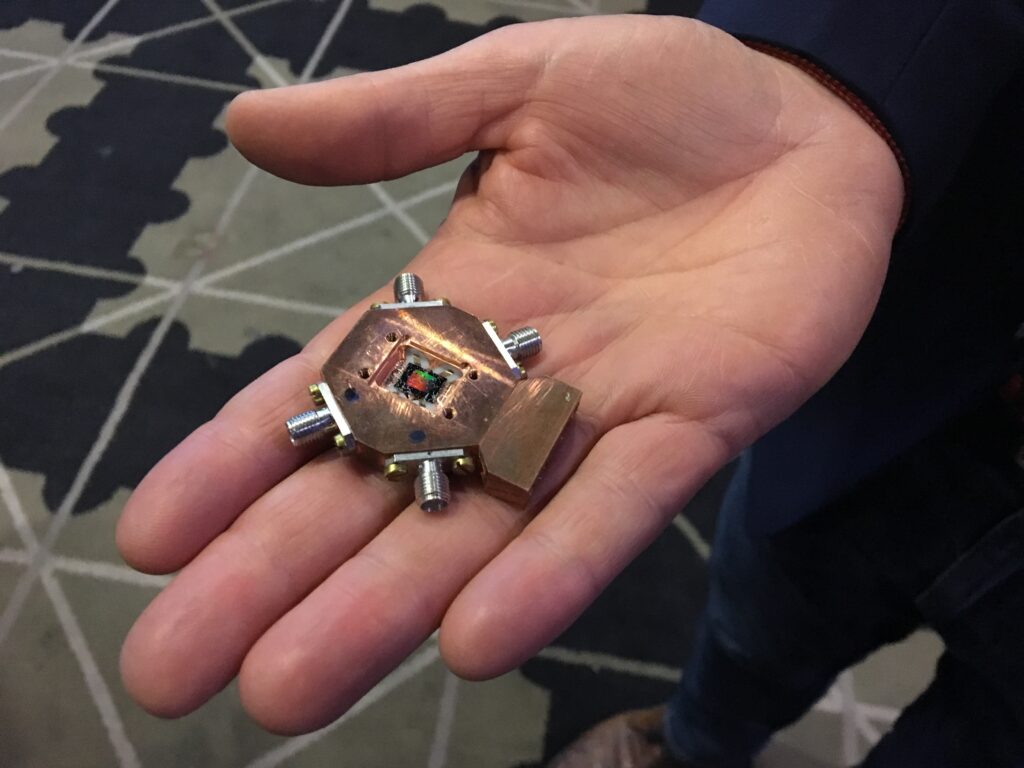
The most interesting quantum computer in the world right now does not exist yet. What exists is one molecule, controlled on its own, linked to light — and a credible argument that millions of its siblings could one day be printed onto chips the way phone screens are made.
That is the claim in a paper published on Wednesday in the journal Nature by German startup NVision, titled “A Single-Molecule Spin-Photon Interface”. Until now, molecular spins — the tiny magnetic orientations of electrons that could serve as quantum bits — could not be individually and coherently controlled. NVision says it has broken that barrier: the core building block of a molecular quantum computer can now be controlled at the single-molecule level.
The backstory is almost better than the breakthrough. NVision did not set out to build a quantum computer. It built a machine to improve medical imaging: it zaps special sugar molecules until the spins of their electrons align, making those sugars a thousand times easier for MRI scanners to see — useful because cancer cells consume sugars far faster than healthy cells. While working in that field, the team realised the same techniques could work on organic molecules similar to those used in OLED displays, the glowing layers inside phone and television screens.
From there it became a search problem. NVision used artificial intelligence to simulate hundreds of candidate molecules, then physically synthesised about 40 of them until it found one that could be laid down as a thin film over a chip made with conventional technology. “We found this ‘Goldilocks’ molecule,” chief technology officer Ilai Schwartz told Reuters.
Why does that matter? Quantum computing’s hardest problem is not proving the physics — it is manufacturing. Today’s leading machines are hand-built marvels, and scaling them to the millions of qubits needed for the most ambitious problems looks like an industrial nightmare. A molecular qubit that can be deposited as a thin film, like an OLED material, directly onto photonic chips made in standard factories would change the shape of that problem entirely. NVision has also announced a partnership with US chipmaker HyperLight, which specialises in thin-film lithium niobate photonics, to integrate its molecular qubits onto photonic circuits — the light-based wiring that would link qubits within and across processors.
Chief executive Sella Brosh told Reuters the ambition goes beyond selling molecules. “We want to do the whole thing, to fabricate the chips, to deposit the molecules, to do all the error correction on top of it,” she said. “Eventually, what we will sell is a rack-ready computer.”
Keep the excitement honest, though. This is one molecule’s interface, demonstrated in a paper — not a working quantum computer, and not yet a processor anyone can program. Error correction, manufacturing yield, and linking many qubits together all remain unsolved at this scale. NVision, based in Ulm, Germany, has raised $120 million from public and private sources including Abbott Laboratories, according to a corrected company figure. What the Nature paper does is move molecular qubits from “interesting idea” to “demonstrated building block”. In a race where every approach has a different fatal flaw, that is a meaningful step — and it came from a medical-imaging side project, which is a useful reminder that the next breakthrough rarely arrives through the front door.
For context on the wider race, see how Google cracked a 20-year quantum problem earlier this month.