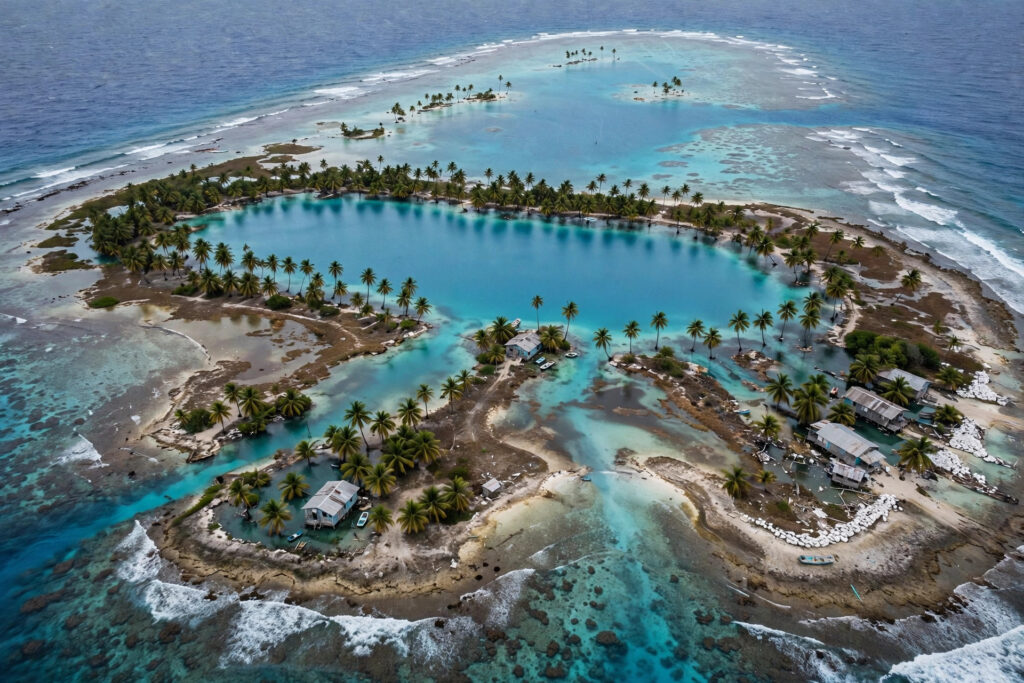
NADI, Fiji — On Monday, delegates flying into this resort city will collect their badges, their briefing papers, and an agenda written in careful diplomatic language. Some of them will then take a short flight to Tuvalu, where the briefings stop and the water starts.
Funafuti, Tuvalu’s capital, sits at most two meters above the sea. Two of the country’s nine coral atolls are already largely swallowed. The government is openly preparing for a future in which the entire population may have to leave. That is the backdrop for the October 5–8 talks in Nadi — the preparatory meeting before November’s COP31 summit in Antalya, Turkey.
How we got here
- August 2026: A UN report puts the crisis in blunt terms — the sea is rising at a record pace, driven by warming oceans and melting glaciers, with Pacific island nations facing sea level rise at twice the global average. Up to 1.2 billion people could be displaced by 2050.
- September 2026: Tuvalu’s Prime Minister Feleti Teo tells the UN General Assembly: “Sea-level rise is not a future threat, it is a present reality.” Back home, engineers are building reclaimed land — manufacturing higher ground while diplomats schedule retreats.
- October 5–8, 2026: The Nadi preparatory talks convene in Fiji, with Pacific leaders determined to make the adaptation finance gap impossible to ignore.
- November 2026: COP31 meets in Antalya, Turkey — where the question is whether Nadi produced anything more than communiqués.
The gap nobody can close with words
The numbers explain the Pacific’s impatience. Developing countries need an estimated $310 to $365 billion to adapt to climate change. What was actually available in adaptation finance, as of 2023: about $26 billion. Pacific leaders arriving in Nadi intend to make that chasm the center of the conversation.
Their demands are specific. Hold the line at 1.5 degrees Celsius of warming. Open the taps on climate finance. And give the oceans — which absorb most of the heat humanity produces yet get a fraction of the negotiating time — a serious seat at the table.
Here is the honest read on Nadi: these preparatory talks will be judged not in November but on the shoreline. The Pacific has learned to measure summits by what changes on the water, not by what gets declared in the room. On that measure, the last few decades have not been kind — and the gap between the communiqués and the coastline keeps widening. Antalya will reveal whether anything said in Fiji survived the flight home.