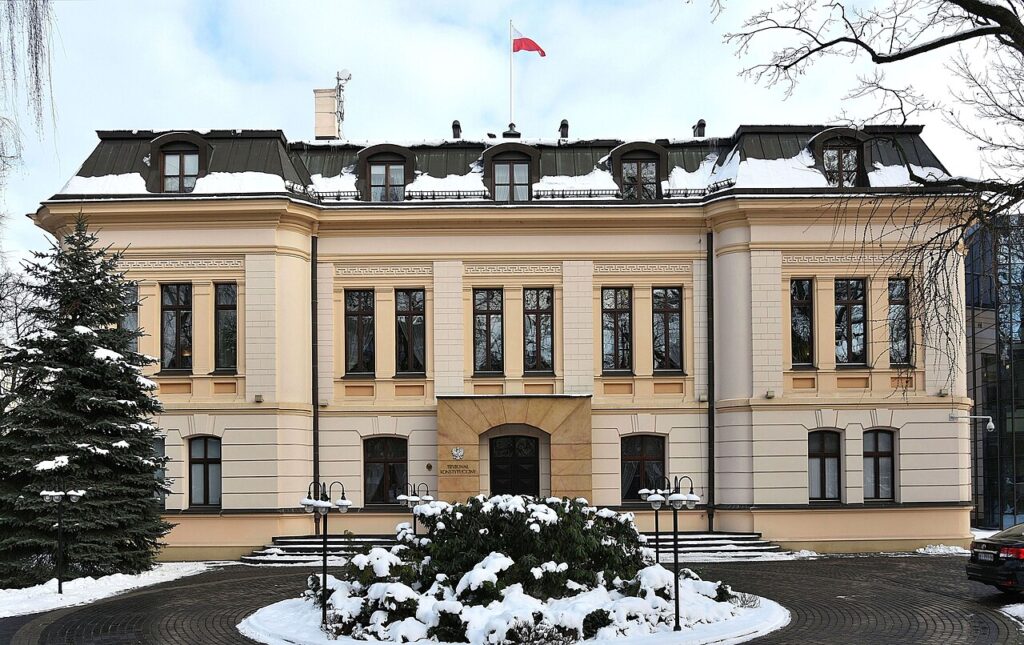
Poland’s president pushed his way through a police cordon and into the country’s highest court in the early hours of Saturday, capping a night in which the government suspended the court’s chief, police surrounded its Warsaw headquarters, and the court’s own account accused the authorities of a coup.
President Karol Nawrocki had been in the air on his way to Senegal on Friday when news of the suspension reached him. “At such a moment, the President must be in Poland. I’m interrupting my flight to Senegal. I’m returning,” he wrote on X. By early Saturday, after a meeting at the presidential palace with the suspended chief and a former head of the court, he was filmed forcing his way past officers guarding the entrance to the Constitutional Tribunal building, accompanied by the court’s first president, Zbigniew Kapiński.
The crisis had erupted hours earlier, on Friday afternoon. Judge Anna Korwin-Piotrowska, elected to the Tribunal by the current parliament, the Sejm, in March 2026, signed orders suspending the court’s president, Bogdan Święczkowski, and its vice-president, Bartłomiej Sochański, for one month. She then declared herself the court’s acting head, saying she was its longest-serving judge, and called a general assembly of its judges for 3 November.
Police moved onto the Tribunal’s grounds between 5pm and 6pm local time. Warsaw police said they acted on Korwin-Piotrowska’s warning of possible threats to judges and staff, and after objects were thrown at officers during a protest outside. Three people were detained after jumping a fence onto the grounds. Whether officers entered the building itself is disputed: police said they stayed on the perimeter, while other accounts said officers entered the premises. The court’s website went dark on Friday evening after posting the suspension notice at about 6pm.
The suspended leadership rejected the move outright. The Tribunal’s official X account said its website had been unlawfully taken over, that Święczkowski remained president, and that Korwin-Piotrowska was not a judge of the Tribunal. “All persons participating in these actions are committing the crime of a coup d’état,” the account said. Outside the building, supporters of the opposition Law and Justice party (PiS) — the nationalist party that governed Poland from 2015 to 2023 — chanted “Tusk traitor” and prayed with rosaries. PiS leader Jarosław Kaczyński, who addressed the crowd, called the operation an attack on the Tribunal. “From today, Poland becomes a police state, and from there there is already a direct path to authoritarianism,” he said.
Prime Minister Donald Tusk, whose pro-European government has been locked in a decade-long fight over the court, defended the action. “Restoring the rule of law is our duty,” he wrote on X on Friday. “After years of PiS-led lawlessness, this is a difficult process, sometimes painful, and it requires decisive action. There is no other way.” Foreign Minister Radosław Sikorski defended the police deployment on Saturday, saying intervention was necessary so the Tribunal could resume its constitutional responsibilities.
The government’s case, as set out by Justice Minister and Prosecutor General Waldemar Żurek, is that Święczkowski and Sochański blocked judges elected by the current parliamentary majority from taking up their duties. Żurek told reporters he had asked for the immunity of both men to be lifted so criminal proceedings could be brought against them. Korwin-Piotrowska’s own position is itself contested: she was elected by the Sejm but, her critics say, never took the oath of office before the president, which Polish law requires before a judge’s term begins.
The fallout was immediate. Poland’s ambassador to China, Jakub Kumoch, resigned on Friday evening, saying that “in light of the events in the country” it was no longer possible for him to remain in his post.
This is not a quarrel that began on Friday. Poland’s Constitutional Tribunal — the court that decides whether laws comply with the constitution — has been at the centre of a constitutional crisis since 2015, when PiS, then in power, appointed judges in a process the European Court of Human Rights later ruled irregular. Brussels froze European Union funds over Poland’s judicial drift, and the court repeatedly ruled Polish law above EU law. Since Tusk returned to power in December 2023, his government has refused to recognise much of the court’s authority or publish some of its rulings. Earlier this year Nawrocki, a PiS ally elected president in 2025, refused to swear in three of six judges nominated by parliament, while Święczkowski, a former deputy justice minister under PiS, declined to let judges chosen by the current majority take their seats. Friday’s suspension was the moment that long paralysis turned into a physical standoff.
Why this matters beyond Poland: the country is the European Union’s largest eastern member and a frontline NATO state bordering Ukraine, Belarus and Russia’s Kaliningrad exclave. A top court with two rival leaderships claiming authority cannot rule on the laws a government needs to govern — and the last time Poland’s judiciary became a European flashpoint, it ended with frozen EU funds and a years-long standoff with Brussels. How the EU institutions respond this time, and whether the Tribunal’s 3 November assembly produces a single recognised leadership or deepens the split, will say a great deal about whether Poland’s constitutional order can still resolve its own disputes through law rather than through police cordons and presidential push-throughs.
What happens next is uncertain. Nawrocki has given no public statement since entering the building early on Saturday. The immunity requests against Święczkowski and Sochański are pending, the assembly Korwin-Piotrowska called is set for Tuesday, and the question both sides are now fighting over — who lawfully leads Poland’s highest court — has no agreed answer. For now, the court at the heart of the crisis has a suspended president, a self-declared acting president, a president of the republic inside its building, and police outside it.
For readers following Poland’s political crisis, Informopedia earlier reported on an alleged plot to assassinate Prime Minister Tusk and the defence minister.