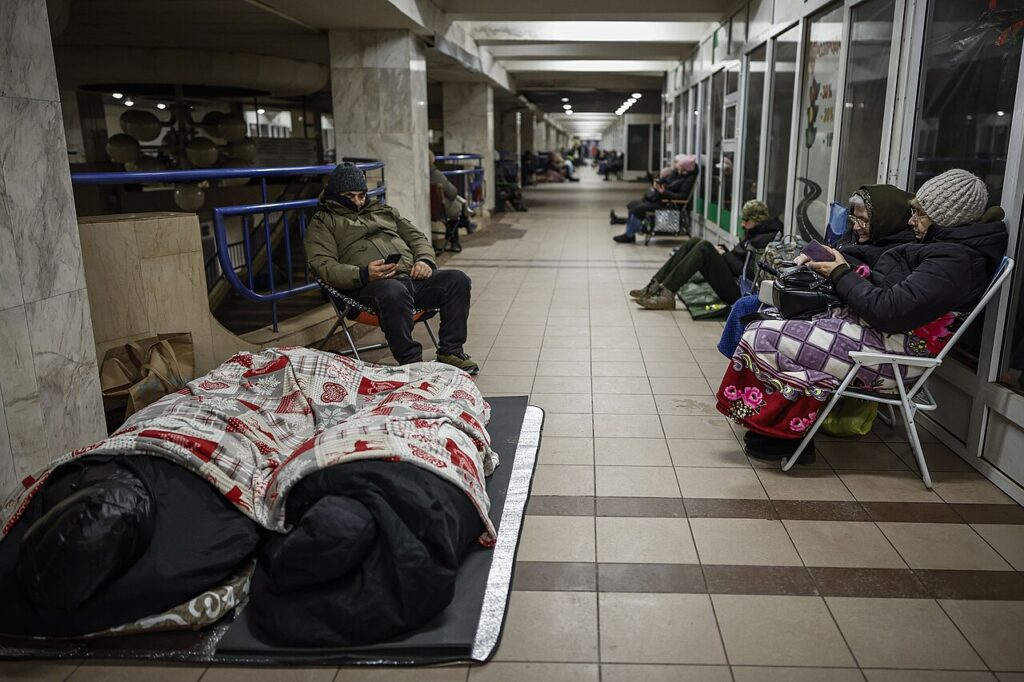
On Sunday night, phones across Ukraine lit up with the warnings people there dread most. A radiation threat in Kyiv. A chemical attack. Street fighting in the capital, with an order not to go outside. Within the hour, officials confirmed what many suspected: none of it was real. The country’s air-raid alert app had been hacked.
The false messages began at about 10.47pm Kyiv time. The first, in Ukrainian, declared a radiation threat in Kyiv. A second, written in Russian, claimed a nuclear alert would be issued across Ukraine and told readers not to worry because, in its words, a Russian Oreshnik ballistic missile was flying. Two more followed at 10.49pm: a chemical-attack warning for Kyiv, and a claim that street fighting was under way in the city. A series of all-clear messages arrived at 11.53pm, cancelling each threat one by one.
The scare did not stay on screens. In the western Lviv region, a radiation-hazard signal sounded briefly on public loudspeakers because of the app, regional authorities said, before they confirmed there was no radiation danger. The governor of the Vinnytsia region, Natalya Zabolotna, called the incident a cyber-attack and warned residents not to click a link carried in one of the messages, which she said could be a phishing attempt.
Ukraine’s Air Force moved quickly to calm the public. “The Air Alert application has probably been subjected to hostile interference. There is no radiation threat! Stay calm and follow our updates on our channel,” it said on Telegram. Air Force spokesman Yuriy Ignat later confirmed to reporters that the app had been hacked. The team behind the app said outside parties had interfered with its work, that it had switched off push notifications and temporarily suspended the service, and that the app stores no personal data, so users faced no data threat from the breach.
Hours later, Russia reported a mirror-image incident. Early on Monday, the country’s Emergencies Ministry said its own mobile app had suffered what it called a massive cyber-attack that let attackers send false information to the public. Ukrainian outlet UNN reported that the fake alerts inside Russia warned of a nuclear threat. A Ukrainian partisan group operating in Russian-held territory, Atesh, claimed responsibility for the Russian hack, but that claim has not been independently verified, and neither incident has been conclusively attributed.
The timing is what makes the night hard to dismiss as a prank. Ukraine’s false alerts began thirteen minutes before a rare six-day local ceasefire in the Kherson region was due to expire — the truce that had allowed civilians to leave the Russian-occupied city of Oleshky, and which expired on Sunday with no extension announced. Hundreds of those evacuees had only just arrived back in Ukrainian-held territory on Saturday after years apart from their families. Officials in Kherson had already urged residents near the Dnipro River to stay away from frontline “red zones” as the pause ended.
Why this matters goes beyond one frightening night. Air Alert is not a news app. It is part of the warning chain that gives Ukrainians minutes, sometimes only minutes, to reach shelter when missiles and drones are inbound. A system that can be turned into a source of false nuclear warnings can do two kinds of damage at once: it can send frightened people running for shelter, or into the streets, for no reason, and it can teach them to doubt the next alert — the one that might be real. That second risk is the more lasting one, and it applies on both sides of this war. Russia’s ministry, notably, said its national public-alert system was not affected, and Ukraine’s State Emergency Service said its nationwide system kept operating normally, with street sirens still working. Kyiv’s separate city app, Kyiv Digital, was unaffected.
What remains unknown is as important as what is confirmed. Ukraine’s Centre for Strategic Communications blamed Russia for the hack of its app, but no evidence has been published, and the Russian hack has no verified culprit either. Two emergency apps failing hours apart does not, by itself, prove a coordinated campaign or retaliation. What is confirmed is narrower: on the night a fragile local truce expired, the apps millions of civilians consult to decide whether to take cover were compromised, in both countries, within hours of each other.
Ukrainian officials are now telling people to rely on sirens, loudspeakers and official channels while the app is restored, and the country’s Centre for Countering Disinformation has warned that threat information shown in the app does not currently correspond to reality. For civilians living under nightly air raids, that advice is a reminder of how much of modern civil defence now runs through a phone — and how quickly trust in it can be shaken.