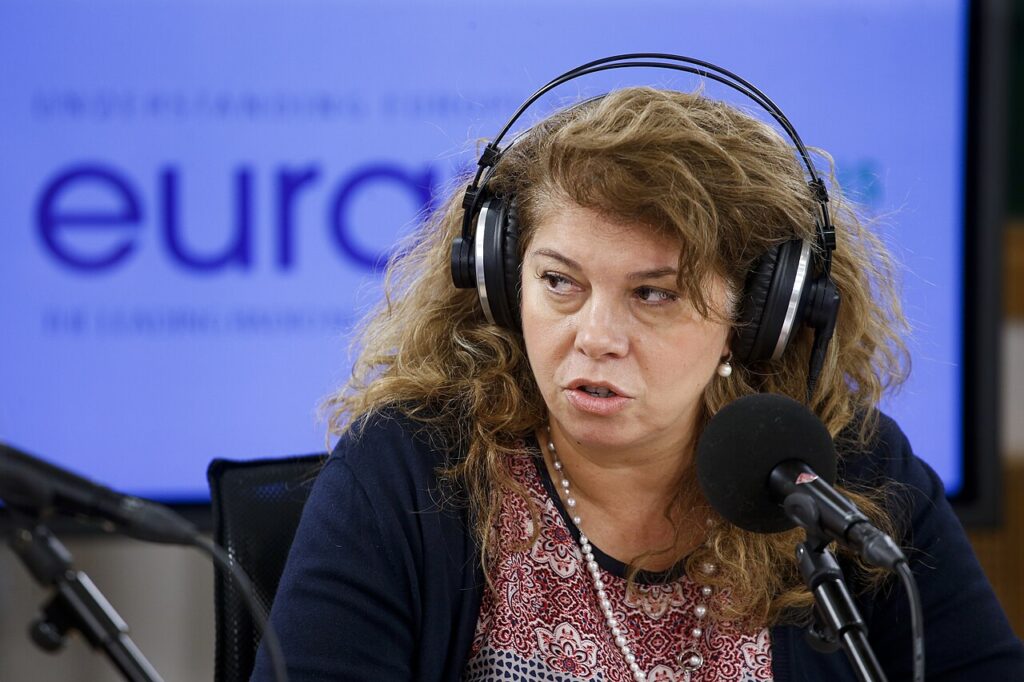
Exit polls from three separate polling agencies point the same way: incumbent president Iliana Iotova is on course to win Bulgaria’s presidential runoff, defeating pro-Western challenger Andrey Gyurov and becoming the first woman ever elected president of the Black Sea country.
The Myara agency put Iotova at 51.0 percent against 44.7 percent for Gyurov, with 4.3 percent choosing “none of the above.” Alpha Research gave her a slightly wider lead, 52.5 percent to 43.4 percent. A third survey, by Market Links for bTV television, put her at 50.7 percent against 44 percent for Gyurov. All three are estimates drawn from voters interviewed as they left polling stations — not counted ballots — and none of the agencies has formally called the race.
Polling stations closed at 8 p.m. Sofia time on Sunday. Bulgaria’s Central Election Commission is expected to release preliminary official results on Monday, and its results portal is the authoritative source for the count. Until those figures arrive, the outcome remains a projection, not a result.
The runoff followed a first round on October 25 in which neither candidate came close to an outright win. Iotova finished first among 27 tickets with 34.76 percent of the vote, against 31.95 percent for Gyurov, on a record-low turnout of just 23 percent. Turnout estimates for the runoff, between 26.8 and 29.1 percent, suggest more voters returned this time — but still fewer than three in ten of Bulgaria’s roughly 6.6 million registered voters.
The choice on the ballot was, in substance, a choice about the war in Ukraine. Iotova, a longtime ally of Prime Minister Rumen Radev who took over the presidency in January when he resigned to contest parliamentary elections, has campaigned as a “president of peace”: she favours dialogue with Moscow and opposes military aid to Ukraine, while supporting Bulgaria’s membership of the European Union and NATO. Gyurov, a 50-year-old former caretaker prime minister and former deputy governor of the Bulgarian National Bank, is backed by the pro-Western reformist parties and has argued for stronger backing for Kyiv.
The contrast sharpened during a televised debate before the runoff, when Gyurov criticised Iotova for failing to blame Russia directly for a series of drone attacks on merchant ships off Bulgaria’s Black Sea coast in the past month. “Russia must stop its aggression so that the next steps can be taken. Let us name the country from which the threats are coming,” he said. Iotova answered that “peace can come only through negotiations,” warning that pouring more money and more sophisticated weapons into Ukraine “leads only to more destruction and the deaths of many people on both sides.”
Those Black Sea attacks — including two ships struck by drones off Bulgaria’s coast in October, one of which sank with 11 sailors missing — hung over the whole campaign. They followed earlier strikes in Bulgaria’s Black Sea waters in which one vessel sank and a crew member went missing. Political analyst Teodor Slavev told AFP that voters were giving their verdict on what he called Iotova’s “unconvincing response” to Russian threats in the Black Sea.
Bulgaria’s president is directly elected for five years, commands the armed forces, can veto legislation and appoints interim governments during political crises. The office is often described as largely ceremonial, but in a country that has cycled through repeated elections and caretaker governments, the president’s power to shape interim administrations — and to speak for the country abroad — carries real weight.
That is why this result will be read well beyond Sofia. Bulgaria is a member of both the EU and NATO with a long Black Sea coastline, and the war in Ukraine has turned its waters into a front line of drone and missile strikes on commercial shipping. A president who presses for a negotiated settlement pulls in a different direction from one who wants deeper military support for Kyiv, and the gap between those two positions is exactly what the runoff put to voters.
The other story of the night is the empty polling station. Even with the runoff’s higher turnout, roughly seven in ten registered voters stayed home. Sociologist Boriana Dimitrova told AFP before the vote that the low first-round turnout may have reflected voters assuming Iotova’s victory was already assured, as well as disappointment with Radev’s coalition. If the exit polls hold, the first woman elected to Bulgaria’s presidency will take office with the backing of barely a quarter of the electorate — a mandate that is real, but narrow, and one her opponents will not let her forget.