Informopedia Explains: high above the poles, the Sun’s magnetic field snaps and reconnects with Earth’s — and the energy released paints the sky and rattles our technology.
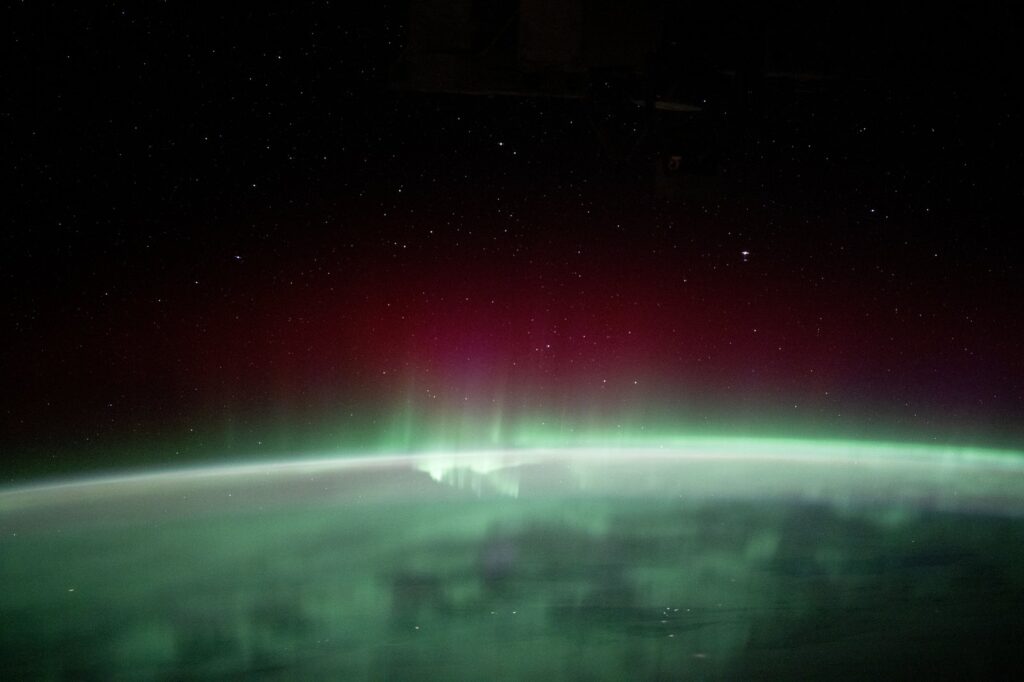
On a clear night near the poles, the sky ripples green and red, and it looks like magic. It is, in fact, the visible end of a violent argument between two magnetic fields. The Sun pours out a continuous wind of electrically charged particles, and that wind carries the Sun’s magnetic field with it. When it reaches Earth, it slams into our planet’s magnetic shield — the magnetosphere — and the two fields do something that, in everyday life, magnets never do: they break, swap partners and snap back together. Physicists call it magnetic reconnection, and it is one of the most important processes in the solar system that almost nobody has heard of.
A snap that moves energy
Think of two rubber bands stretched in opposite directions, then cut and retied the other way. The snap releases the stored tension all at once. In space, the “rubber bands” are magnetic field lines, and the snap dumps their stored energy into the surrounding particles, accelerating them to high speeds and heating them. Some of those particles funnel down into the upper atmosphere near the poles, where they excite gases that glow — the aurora. Others race through the magnetosphere, disturb satellites, confuse GPS signals and, in a strong geomagnetic storm, induce currents in power lines on the ground. Reconnection also powers solar flares and the colossal explosions that fling plasma from the Sun toward Earth. Understanding it is not academic: it is the physics behind forecasting space weather, the same way understanding convection is behind forecasting rain.
Why it took two satellites flying in formation to study it
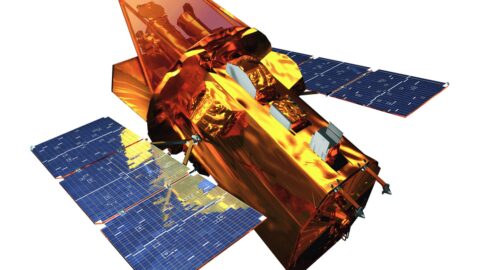
The trouble with reconnection is that it happens at a boundary — the magnetopause, where the solar wind meets Earth’s field — and that boundary moves. If you fly one satellite through it, you cannot tell whether a change you measure happened because the process itself changed over time, or because you flew through a different part of it. NASA’s TRACERS mission, short for Tandem Reconnection and Cusp Electrodynamics Reconnaissance Satellites, was built to solve exactly that ambiguity. Two identical spacecraft, launched on July 23, 2025, fly one behind the other in a Sun-synchronous orbit, passing repeatedly through the polar cusps — funnel-shaped regions above the magnetic poles where field lines converge and solar-wind particles pour into the upper atmosphere. The second satellite samples, minutes later, almost the same place the first just sampled. Compare the two, and you can separate “it changed while we waited” from “it is different over there”.
What the first results say — and what they don’t
The first published TRACERS findings, in the Journal of Geophysical Research: Space Physics (Fuselier and colleagues, 2026), analyse paired observations from Nov 7, 2025 to Feb 28, 2026. Of 207 paired encounters with the southern polar cusp, 129 were dominated by spatial variability, 48 by temporal variability and 30 were ambiguous. In plain language: where reconnection is happening seems to move around more than how fast it is happening changes. “Analyzing the data TRACERS collected gave our team a clearer view of solar wind particle behavior and how it connects to reconnection events,” said Stephen Fuselier, the mission’s deputy principal investigator at the Southwest Research Institute. The result is preliminary — the authors and NASA both stress that more measurements are needed to confirm it — but it points forecasters in a useful direction: if location matters most, then predicting space weather means tracking a moving, patchy boundary, not just watching a single dial go up and down.
What happens next
TRACERS now crosses the southern cusp several times a day, and in September NASA extended the mission into spring 2027, giving the team more seasons of data to test whether the spatial pattern holds. The mission also complements its bigger cousins: the four-spacecraft Magnetospheric Multiscale mission studies reconnection up close, while TRACERS watches how its effects show up, repeatedly, in the funnel over the pole. The next time the aurora dances — or a solar storm warning flashes across a satellite operator’s screen — it will be reconnection at work, a snap in the sky 100 kilometres up, measured at last by two small satellites flying in each other’s footsteps.
Why this matters: civilisation now runs on systems that live inside Earth’s magnetic shield — satellites, navigation, power grids — and all of them are downstream of a process we are only just learning to watch properly. TRACERS’ first answer is modest, and that is its strength: it replaces a guess about how reconnection behaves with a measurement, and measurements are what forecasts are built from.
Related coverage on this site: our explainer on gamma-ray bursts, and our report on the Halloween auroras lit by a solar wind stream.