What is happening? A fast stream of solar wind is on its way to Earth, and the US National Oceanic and Atmospheric Administration’s Space Weather Prediction Center has issued a G1 — minor — geomagnetic storm watch for 31 October and 1 November. The watch, issued on 29 October, puts the chance of minor storming on 31 October at about 40%, with a 30% chance of a stronger, moderate G2 storm.
What causes it? Not an explosion this time. The culprit is a coronal hole — a gap in the Sun’s outer atmosphere where magnetic field lines open out into space, letting solar wind escape at high speed. This particular hole sits near the Sun’s equator and rotates back to face Earth regularly. Its stream is expected to arrive late on 30 October and run through 31 October.
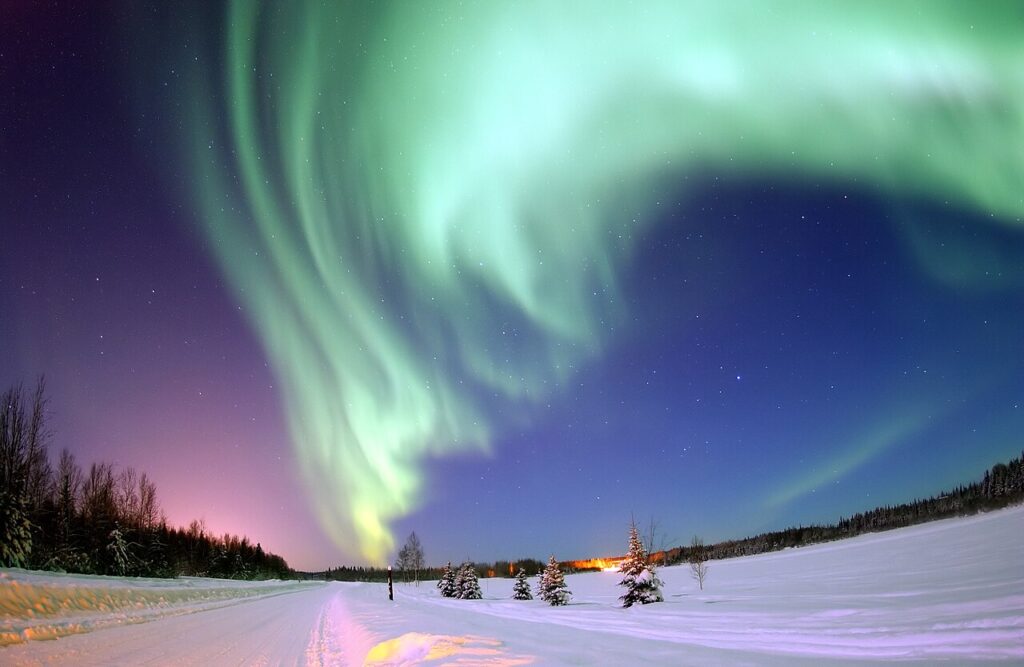
What will it look like? A G1 storm is the lowest rung of NOAA’s five-level scale, but it still pushes the aurora oval south. The planetary K-index, the measure forecasters use, is expected to reach 5 — the G1 threshold — in the early hours of 31 October in Universal Time. In practice, that means bright, dynamic auroras overhead in the far north, and a chance of seeing them low on the northern horizon from places like northern Michigan, Maine, Banff and Inverness.
Will it disrupt anything? Probably not much. G1 storms mainly affect regions poleward of 60 degrees geomagnetic latitude, with minor effects on power grids and satellite operations at high latitudes. This is a show, not a threat — a useful distinction, because the Sun is perfectly capable of both. For the violent end of the scale, see the most powerful explosions in the universe.
Why Halloween? Coincidence, mostly — but a fitting one. Late October 2003 brought the famous Halloween storms, when an X17 flare and a second X10 flare hurled plasma at Earth and triggered G5, extreme, geomagnetic storms that pushed auroras as far south as Florida and the Mediterranean. One flare on 4 November 2003 was so intense it saturated its measuring instruments and was later estimated at around X45, among the strongest ever recorded. This weekend’s storm is nowhere near that scale. The Sun itself has been quiet this week, with only weak B-class flares and no coronal mass ejections aimed at Earth.
How can I see it? Get away from city lights, look north after dark, and give your eyes 20 minutes to adapt. The aurora is fickle — a forecast is a probability, not a promise — and a phone camera on a long exposure will often catch colour your eyes miss. If the sky stays dark where you are, that is still the right answer: the forecast said 40%, not certain. But on a night when the Sun is sending a Halloween greeting across 150 million kilometres, stepping outside to check costs nothing.