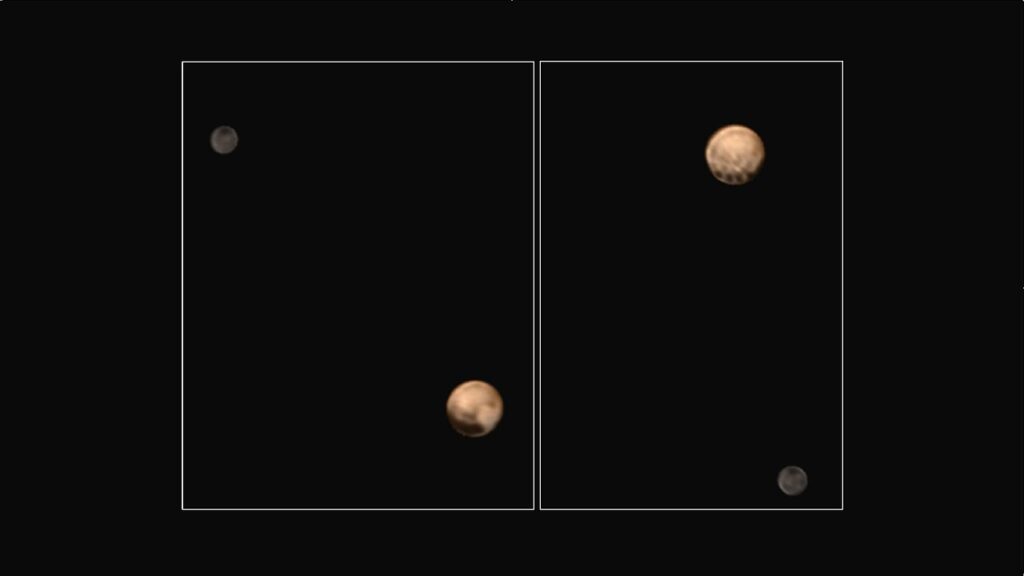
Informopedia Explains: in August 2006, in a hall in Prague, a few hundred astronomers voted on a question that had never needed an answer before — what, exactly, is a planet? When the vote ended, Pluto was not one anymore. School textbooks were rewritten, mugs were printed, and a generation of children learned a new word: dwarf planet.
Twenty years later, that word is back in the news. The Rubin Observatory has found 2026 ED138, a large icy body beyond Pluto that may become the sixth recognised dwarf planet. But “may” is doing a lot of work in that sentence. Becoming a dwarf planet is not a matter of being big, or far away, or interesting. It is a matter of passing three tests — and ED138 has, so far, clearly passed only some of them.
The vote that created the category
Before 2006, there was no formal definition of a planet at all. Astronomers had managed for centuries on shared understanding: Mercury through Neptune, plus Pluto, discovered in 1930 by Clyde Tombaugh at Lowell Observatory, a speck of light that moved against the stars.
The trouble began in the outer solar system. In 2005, astronomers announced Eris, a body slightly more massive than Pluto, orbiting even farther out. If Pluto was a planet, Eris had to be one too — and Eris was only the first of what promised to be dozens. The International Astronomical Union (IAU) faced a choice: admit an ever-growing crowd of planets, or draw a line.
In Prague, it drew one. A planet, the IAU declared, must do three things: orbit the Sun; be massive enough for its own gravity to pull it into a nearly round shape; and have “cleared the neighbourhood” around its orbit — meaning it gravitationally dominates its zone, sweeping up or flinging away competing bodies. Pluto failed the third test: it shares its orbital neighbourhood with a swarm of other Kuiper Belt objects and is even influenced by Neptune. So Pluto, Eris, and their kin got a new label: dwarf planet. A dwarf planet passes the first two tests and fails the third.
That distinction is the whole game. Ceres, the largest body in the asteroid belt between Mars and Jupiter, had been called a planet when it was discovered in 1801, then demoted to asteroid as more belt objects turned up, then promoted again in 2006 as a dwarf planet — the only one that lives inside Neptune’s orbit. Haumea and Makemake, found in the Kuiper Belt, joined the list. Five worlds, five stories of near-miss planethood.
Test one: does it orbit the Sun?
ED138 passes this one easily. Its orbit has been traced for more than a decade: thirty Rubin observations on twenty nights between March and July 2026, plus archival images going back to 2016, recovered from a camera in Chile through a service that searches old photographs for objects nobody knew to look for. ED138 circles the Sun at about 46 astronomical units — 46 times the Earth–Sun distance — beyond Pluto’s average of 40. It is a trans-Neptunian object, a resident of the deep outer solar system, and nobody disputes its membership in that club.
Its orbit also tells a story. Tilted almost 25 degrees off the plane of the solar system, ED138 belongs to the “hot-classical” population of Kuiper Belt bodies — objects that were gravitationally stirred, probably by Neptune, out of the flat disc where they formed. Reading that tilt is like reading a scar: it says something violent happened to this world a very long time ago, and that the giant planets did not stay where they were born.
Test two: is it round? This is the open question.
Roundness sounds simple, but at a distance of 46 astronomical units, nobody can photograph ED138’s shape directly. Astronomers infer size from a combination of distance, brightness and reflectivity: a bright object could be small and shiny, or large and dark. For ED138, that calculation gives a range of 600 to 1,500 kilometres across.
That range matters because roundness has a threshold. Small, rocky or icy bodies keep whatever lumpy shape they were born with; only when a body is massive enough does its own gravity overcome the strength of its material and pull it into a sphere — the state astronomers call hydrostatic equilibrium. For icy bodies, that threshold sits somewhere around 400–600 kilometres. ED138’s estimated range sits above it, which is why the Rubin team says icy bodies this large “are expected to be round.” Expected, not proven.
Proof will come from infrared observations, which measure the heat an object radiates and pin down its size far more tightly than visible light can. If infrared data puts ED138 solidly above the roundness threshold, test two passes. If it lands near the bottom of the range, the argument gets harder — and ED138 may join the long list of “dwarf planet candidates” that never graduate, a category with dozens of members and no official status.
Test three: has it cleared its neighbourhood? (It should fail — and that is the point)
Here is the part most explanations get backwards. For ED138, failing the third test is not a problem — it is a requirement. A dwarf planet is defined by failing to clear its neighbourhood. ED138 orbits among the Kuiper Belt’s swarm, crossing no cleared zone, dominating nothing. If it somehow had cleared its orbit, it would be a planet candidate, not a dwarf planet candidate, and the argument would be far stranger.
So the real question is narrower than it looks: is ED138 round? Everything else is paperwork — an orbit refined over years, a formal name eventually assigned by the IAU (2026 ED138 is only a provisional designation, encoding its discovery year and the half-month of its first observation), and a vote or decision that adds it to a list of five.
Why a sixth dwarf planet matters
It matters because of where ED138 was hiding. It sits in a region of sky close to the plane of the Milky Way, a field so crowded with stars that earlier surveys missed it entirely. Rubin found it by photographing the whole southern sky repeatedly and letting software pick out the movers — and then by searching old images for a trail nobody had noticed.
If one large world can hide in the Milky Way’s glare, others can too. The census of the outer solar system is incomplete, and every addition rewrites the story of how the giant planets migrated and scattered the icy leftovers of planet formation. A sixth dwarf planet would not just be a new entry in a textbook. It would be evidence that the textbook’s map still has blank spaces — in our own backyard, among the stars we thought we had already counted.
That is also why this story pairs naturally with the year’s other sky surprises, from a planet reborn from a dead star to the brightest explosions in the universe. Astronomy keeps teaching the same lesson: the universe is not running out of discoveries. We are just getting better at looking. The details of ED138’s discovery are in Rubin’s announcement — and the infrared verdict, when it comes, will decide whether a sixth dwarf planet joins the family, or remains a candidate forever.


