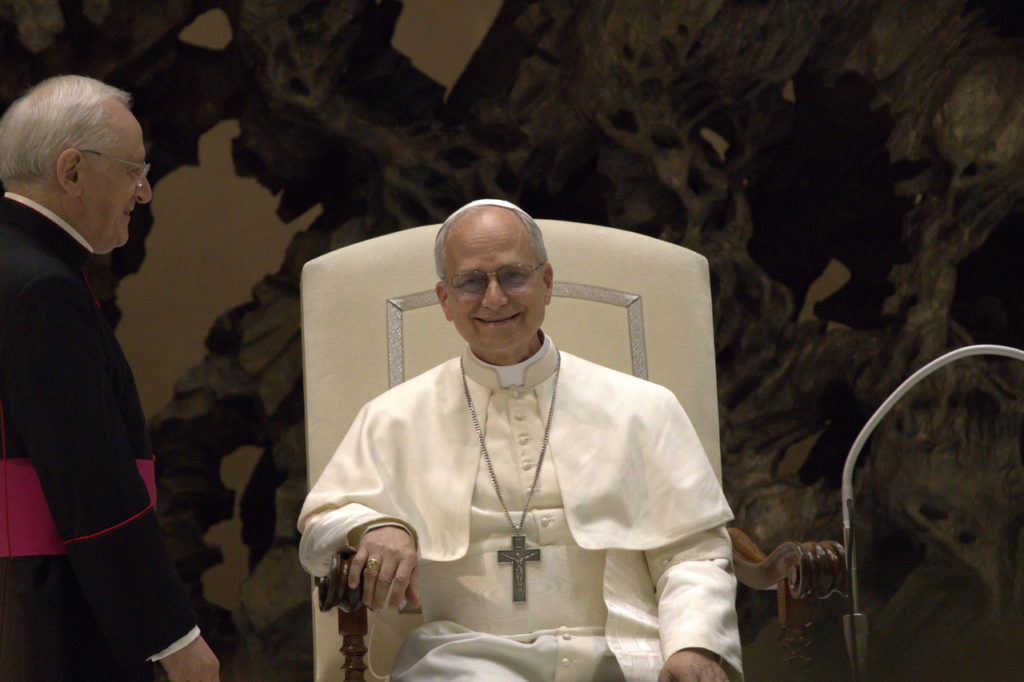
The first sign that Pope Leo XIV was back at work came from the tenth floor of Rome’s Gemelli Hospital, not from St. Peter’s Square.
Earlier on Friday, the Vatican released the first photographs of the pope since he underwent surgery on October 13 to remove a cancerous tumour from his right lung. There he was — the 71-year-old pontiff, Chicago-born, in a green vestment at a makeshift altar, celebrating Mass with the hospital’s medical staff. The images were meant to reassure the world’s 1.4 billion Catholics that their leader was recovering well. His doctors said he could now “carry out normal activities with full independence,” and preparations for his November trip to South America — Uruguay, Argentina and Peru, starting November 6 — are going ahead as planned.
Then, on Friday evening, came the surprise announcement that showed just how independent those activities are.
Pope Leo had picked up the phone and called Vladimir Putin.
The subject of the call was one city: Oleshky, in the Russian-occupied Kherson region of southern Ukraine. According to the Vatican, the pope “expressed his deep concern about the grave humanitarian situation in the city of Oleshky,” and called for a ceasefire — not a permanent one, but a humanitarian pause — to allow food and medical supplies to reach the city, and to let civilians leave voluntarily and safely.
Oleshky’s name is unfamiliar to most people outside Ukraine, but its situation has become one of the war’s grimmest humanitarian pockets. The city sits in a “gray zone” near the front line, caught between Russian and Ukrainian forces. Ukrainian church groups say Russian forces have imposed a blockade on humanitarian relief: food supplies were last delivered to the area at the end of May. Around 6,000 civilians are estimated to remain there, including some 200 children — effectively trapped. Ukraine’s foreign minister, Andrii Sybiha, has described “chilling accounts” of residents scavenging for food scraps and gathering grass because there is simply nothing else to eat. On Friday, the UN High Commissioner for Human Rights, Volker Turk, denounced what he called a “desperate” situation and publicly called on Russia to let the civilians evacuate.
The pope’s call did not come out of nowhere. On September 19, the Ukrainian Council of Churches and Religious Organizations had written to him and other global religious leaders, urging them to intervene for Oleshky’s civilians. And Friday, October 16, was World Food Day — the pope used his message for the occasion to describe “regular access to safe, adequate and sufficient food” as a basic human right that nations must safeguard. Within hours, he was asking the Kremlin to make it real in one specific place.
Moscow’s response was the classic two-track Kremlin statement. The Russian presidency confirmed the call — which it said took place “in a constructive atmosphere of mutual respect” — and said Putin had given the pope “a detailed explanation” of what it called “the Kyiv regime’s responsibility for the difficult humanitarian situation” in Oleshky. It added that Putin wished the pope a speedy recovery and stressed the “importance of Russian-Vatican cooperation in promoting unifying spiritual and moral values.”
Why this matters: the Vatican is one of the few actors left that can talk to both sides of Europe’s wars and be listened to, at least politely. Pope Leo is only the second pontiff ever to take the name Leo — and as the first American pope, he carries a particular weight in Washington, where the White House’s own Ukraine diplomacy has been fracturing visibly this week, with the US president openly calling Ukraine’s leader ‘more difficult’ than Putin. When the Holy See makes a personal, named-city humanitarian appeal from a hospital bed three days after major surgery, it puts Oleshky — and the question of humanitarian corridors across the front line — back on the agenda in a way that press statements never do. Whether Moscow responds with anything more than words is another matter. But 6,000 trapped civilians now have the world’s most prominent religious leader saying their names aloud.
For now, the clearest signal of the pope’s condition is simpler: he is expected to make his first public appearance on Sunday since the operation — and Friday’s schedule suggests his recovery is further along than anyone outside the hospital walls guessed.

One Comment