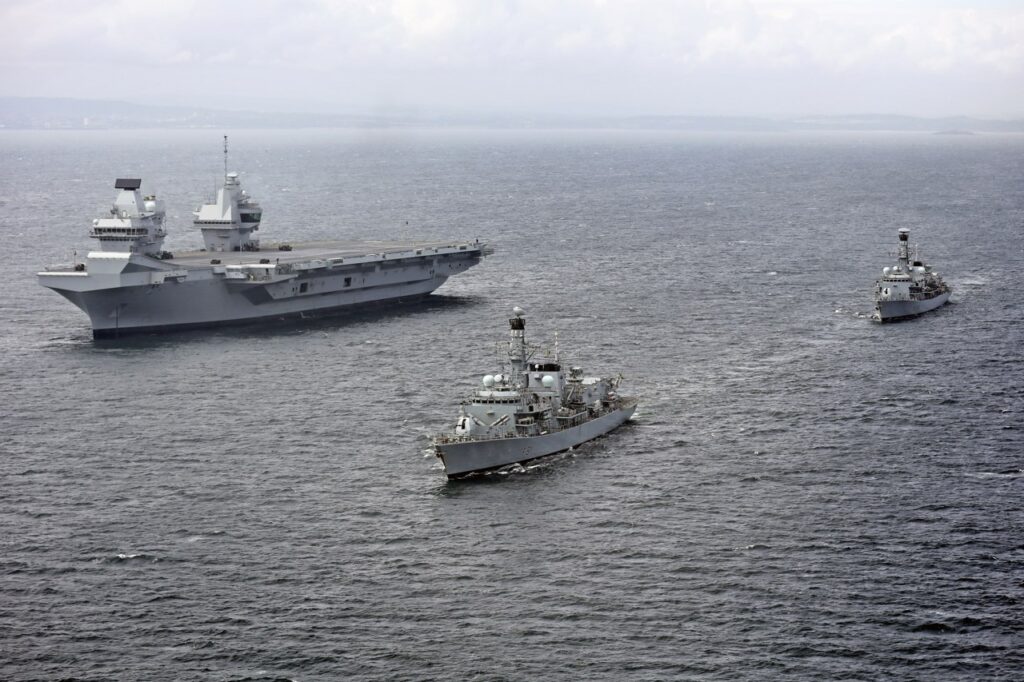
Iran’s Foreign Ministry announced on Sunday that it has designated Britain’s Royal Navy and Royal Air Force as terrorist organisations and classified the Secret Intelligence Service, MI6, as a hostile group — a formal escalation in the confrontation between Tehran and London that lands in the middle of an already dangerous standoff over Iran’s nuclear programme and the Strait of Hormuz.
The designations, announced in a ministry statement on 1 November, took effect on publication, according to Iran’s semi-official Tasnim news agency. They were authorised by a resolution of Iran’s Supreme National Security Council, the country’s top security body, and they split into two legal tracks: MI6 was classed as a hostile group under an Iranian law that toughens penalties for espionage and cooperation with Israel and states Tehran considers hostile, while the Royal Navy and the RAF were placed under a countermeasures law Iran passed in response to the United States’ designation of the Islamic Revolutionary Guard Corps (IRGC).
“In a reciprocal response to the United States’ designation of the Islamic Revolutionary Guard Corps (IRGC) as a terrorist organisation, the Royal Navy and the Royal Air Force of the United Kingdom are recognised as terrorist organisations as of the publication of this statement,” the ministry said.
بيان وزارة الخارجية الإيرانية: اعتبارا من 1 نوفمبر 2026؛ يُدرج جهاز الاستخبارات الخارجية البريطاني (MI6)، ضمن فئة «الجماعات المعادية»، وتخضع كل من البحرية الملكية البريطانية (Royal Navy) وسلاح الجو الملكي البريطاني (Royal Air Force) بوصفهما منظمتين إرهابيتين.
— الخارجية الإيرانية (@IRIMFA_AR) November 1, 2026
Tehran framed the move as retaliation on two counts. The first is London’s own decision on 13 July to designate the IRGC — Iran’s powerful military and security force — under the National Security (State Threats) Act 2026. The second is what the ministry called Britain’s role in the US-Israeli war against Iran, accusing London of giving American and Israeli forces access to military bases and logistical facilities under British jurisdiction. The statement warned that Britain would bear responsibility for any negative consequences.
London pushed back within hours. A UK Ministry of Defence spokesperson said: “We utterly reject this designation. The UK Armed Forces will continue to defend our people, personnel and interests, working closely with our allies and partners.” No separate Foreign Office statement had been identified at the time of writing.
The step is not without precedent. In February, after the European Union listed the IRGC, Iran designated the naval and air forces of EU member states as terrorist entities in a similar reciprocal move. That earlier designation did not, by itself, change European deployments — and the same is likely true here. But the context is far more volatile now. The US-Israeli war on Iran began in February and has driven up global energy prices, Iran has restricted shipping through the Strait of Hormuz, the narrow waterway that normally carries around a fifth of the world’s oil, and Tehran and Washington have spent weeks disputing whether that route is safe at all.
The announcement also comes while diplomacy is still, just barely, alive. Iranian negotiators met Qatari mediators in Doha on Saturday, and Washington has remained in contact with the mediators, even as President Donald Trump said on Friday that the United States still had “one or two sites” in Iran it could hit “in 10 minutes” and Iran’s supreme leader ordered commanders to widen their target list. Washington has separately warned allies to brace for possible strikes after the US midterm elections on Tuesday.
Why this matters beyond the two countries: designations like this are mostly legal theatre until someone acts on them, but they narrow the space for accidents not to happen. A British warship in the Gulf or an RAF aircraft flying from Akrotiri in Cyprus can now, under Iranian law, be treated as a terrorist asset rather than a foreign military presence — a reclassification Tehran could cite if a confrontation at sea or in the air turns violent. It also tells London, plainly, that its IRGC listing carries a price, and it tells the mediators in Doha that Tehran is still willing to escalate while it negotiates. The questions to watch now are concrete ones: whether Iran says anything about enforcement, whether Britain answers through the Foreign Office rather than only the Defence Ministry, and whether the designation hardens or merely accompanies the talks that are supposed to prevent the next round of strikes.
The ministry did not say how the designations would be enforced, and the statement’s practical effects remain unclear. What is certain is that a formal legal label has now been attached to two branches of another country’s armed forces — and that, in a war that has already redrawn the region’s shipping lanes and alliances, is not a step either side takes lightly.