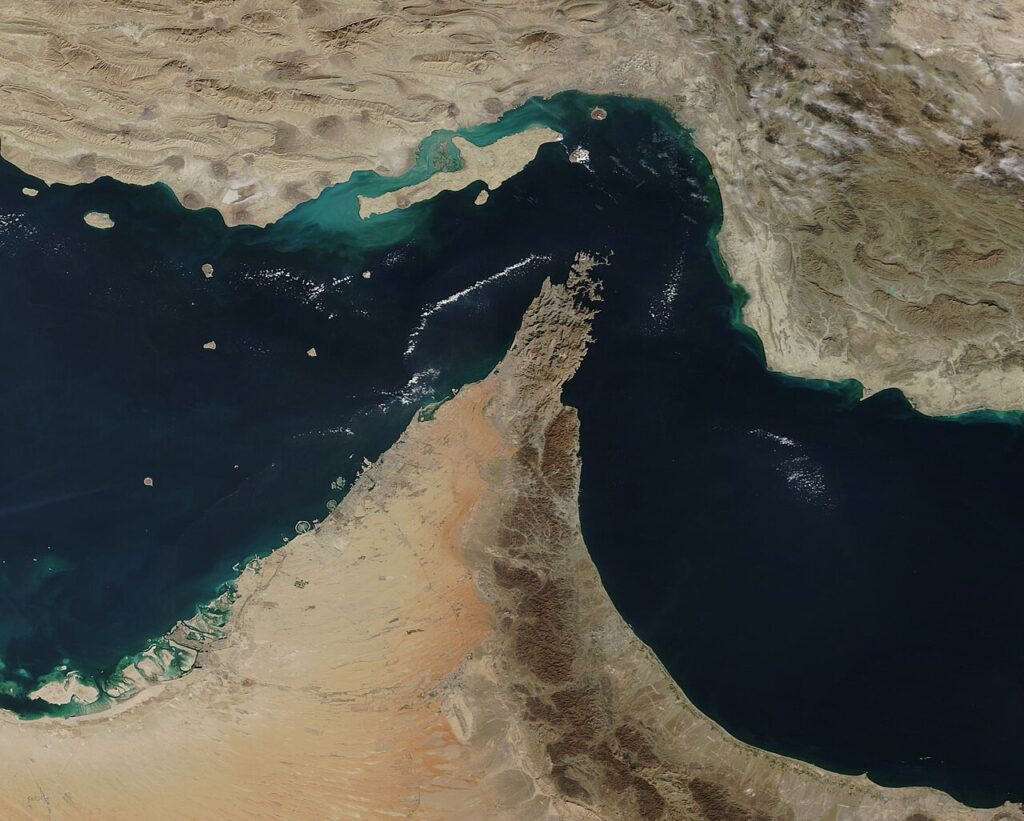
Iran’s Revolutionary Guard navy said on Sunday night that two oil tankers, including a supertanker, exploded after striking naval mines in the Strait of Hormuz, the narrow waterway that carries a fifth of the world’s traded oil and gas.
According to a statement published on the Guard’s official news outlet, Sepah News, both vessels were using what Tehran calls an unauthorised route through the strait, had switched off their navigation and identification systems, and had ignored repeated warnings to stay out of restricted waters. The supertanker, the statement said, suffered a massive explosion and is burning. Both ships came to a halt where they were hit.
The claim has not been independently confirmed. No names, flags, cargoes or casualty figures have been released for either vessel, and no outside party has yet verified that mines caused the blasts. What does corroborate that something happened in the waterway is a separate warning from the United Kingdom Maritime Trade Operations centre, which reported an incident in the strait on 1 November, at about 15:09 UTC, after a merchant ship relayed a Mayday call saying another vessel had been struck by an unknown projectile. UKMTO did not mention mines.
Speaking at a conference in the southeastern Iranian province of Kerman on Sunday, Guard spokesman Hossein Mohebbi said Iranian forces had, in his words, determined a vast battlefield to inflict damage on the enemy and achieve complete deterrence. The language fits a pattern: Tehran has spent the past week warning, in increasingly blunt terms, that any renewed attack on Iran would be answered without geographic limits.
That warning matters because of where it sits in the calendar. The United States holds midterm elections on Tuesday, and President Donald Trump has publicly suggested that limited action against remaining Iranian targets is still on the table after the vote. At the same time, mediators from Qatar and Pakistan have been shuttling between Tehran and Doha with a compressed plan to reopen the strait, and Iranian officials say they are still reviewing a recent letter from US Vice President JD Vance. Nothing in those talks has produced a deal.
The mine claim is also the latest in a run of similar announcements. Iran said a supertanker hit a mine in the strait in mid-October, then reported further tanker strikes days later, and on 29 October said three tankers had hit mines on the same unauthorised southern route. Each time, the vessels went unnamed and the claims went unverified by outside sources, while shipping through the strait kept thinning as owners weighed the risk against the cargo.
Why this matters goes beyond two ships. The Strait of Hormuz is only about 33 kilometres wide at its narrowest point, between Iran on one side and Oman and the United Arab Emirates on the other, and there is no practical alternative route for the oil and liquefied natural gas that flows through it. A burning supertanker in those waters is not just a shipping accident: it is a signal, from a navy that has mined the strait before, that it can close the world’s most important energy chokepoint or make using it prohibitively dangerous. Markets have reacted to far smaller Hormuz scares this year, and any confirmed closure threat would feed straight into fuel prices within days.
There is a second, quieter risk. With both sides talking about deterrence and battlefield expansion while diplomats talk about timetables, a misread incident — a mine strike blamed on the wrong actor, a dark ship mistaken for a military target — could do what months of negotiation have avoided: turn a standoff into a shooting war days before an American election. That is why the missing details matter as much as the explosions themselves. Until the ships are named, the crews accounted for and the damage independently seen, this remains an Iranian claim about a dangerous waterway, not a confirmed account of what happened in it.
What to watch now: whether Iran names the vessels or releases images, whether UKMTO or another maritime authority ties its 1 November incident to the mine claim, whether any crew casualties emerge, and whether Washington responds before Tuesday’s vote.