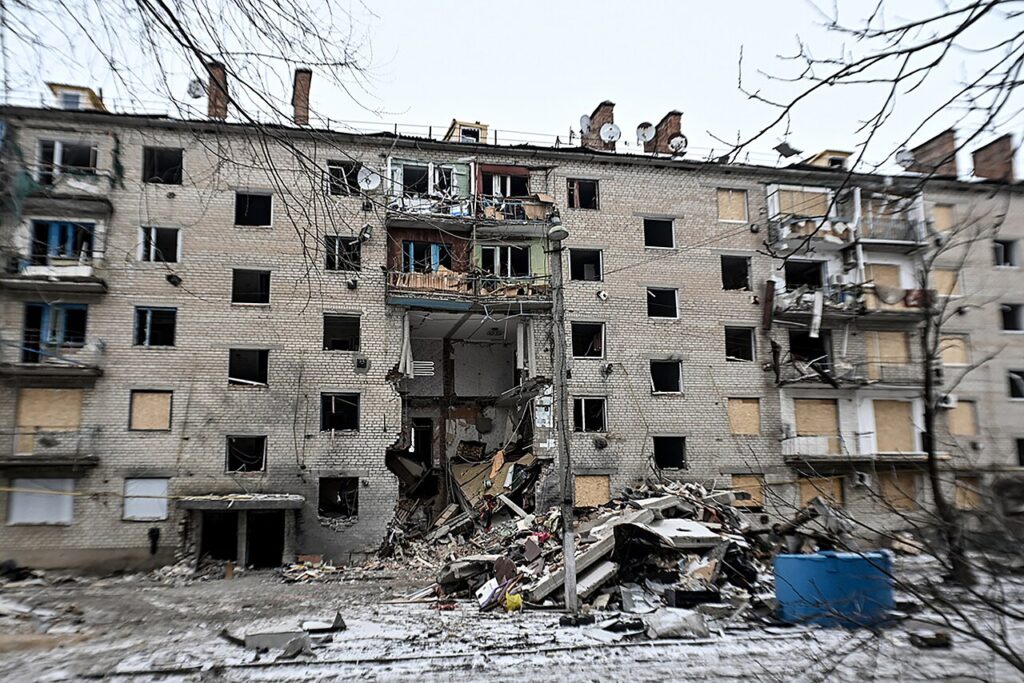
At least 18 people were killed on Monday when Russian guided bombs struck a school being used to hand out humanitarian aid in the village of Komyshuvakha, in Ukraine’s southern Zaporizhzhia region. Five more people were injured, and 27 remain missing under the rubble, with rescue teams still searching the wreckage as the toll threatens to rise.
The attack came in two waves, according to Ukrainian President Volodymyr Zelensky. The first strike hit the school itself. Then, he said, came a repeat strike — nine more bombs dropped directly on the shelter where people had gathered.
Regional officials gave the same grim picture in different numbers: the head of the Zaporizhzhia region, Mykhailo Semikin, said at least nine aerial bombs, each weighing 3,000 kilograms, hit the village, while Ukrainian authorities put the total at 10 guided bombs. A video posted by Zelensky showed a huge crater and rescue workers picking through debris in search of survivors.
The people caught in the bombing were not passing through by chance. They were residents who had stayed in Komyshuvakha, and they collected their humanitarian aid at that same spot every week. It was, in other words, a known and regular gathering point for civilians in need of supplies — which is what makes the second strike, on the shelter, so hard to explain away as an accident.
“The Russians could not have been unaware that every week residents who have remained in Komyshuvakha were receiving assistance aid right there,” Zelensky wrote on Telegram. “This is yet further proof that Russia does not want any kind of de-escalation, any real justice.”
The timing sharpened his point. The bombing came on the very day a rare six-day local ceasefire around the Russian-occupied town of Oleshky, further south in the Kherson region, expired without an extension. That pause had allowed aid deliveries and civilian evacuations, and Zelensky had held it up as a moment when, in his words, “the next steps could show that peace is possible”. Monday’s strike, he argued, sent the opposite signal: “With such killings, Russia is sending the exact opposite signal — Russia is counting on further killings.”
Komyshuvakha was not the only place hit on Monday. Ukrainian rescue services said 24 people were killed across the country during the day, and Ukrainian authorities also reported multiple Russian drone attacks. The Komyshuvakha toll — 18 dead, five wounded, 27 unaccounted for — accounts for most of that total, and it is likely to move as the search continues.
Why this matters beyond Ukraine’s front lines: aid distribution points are the thin thread keeping civilians alive in front-line villages, and they only work if both sides treat them as off-limits. A strike that hits the same aid point twice — first the building, then the shelter — does more than kill the people gathered there. It tells every other village weighing whether to show up for the next weekly distribution that gathering for food and medicine can itself be fatal. That is how a local atrocity becomes a region-wide humanitarian problem, and it is why the fate of limited truces like Oleshky’s matters far beyond the towns they cover. If even a pause negotiated with outside help collapses into a day like Monday, the next one will be harder to arrange — and the civilians it was meant to protect will have one fewer reason to trust it.
The casualty account in this article comes from Ukrainian officials, including President Zelensky and the Zaporizhzhia regional administration; the figures remain provisional while 27 people are still listed as missing.
Related coverage: Kherson Ceasefire Expires With No Extension: What Happens to Oleshky Now? and After 1,711 Days Apart, Oleshky’s Evacuees Are Home in Ukraine. Both internal links were verified live (HTTP 200) before publishing — if either fails when you check, drop that link rather than publishing a broken one. Do NOT add any outbound links: no verifiable primary-source URL was found for this story.