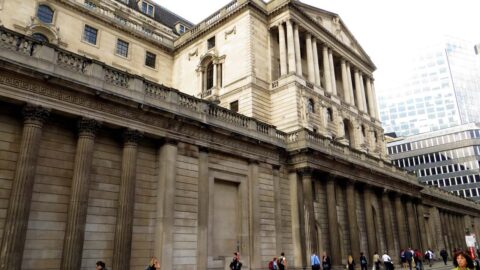
Informopedia Explains: this week, the Bank of England is expected to raise Bank Rate to 4.0% on Thursday, its first rate rise in more than three years. The headlines will give you a number — Bank Rate up from 3.75% to 4.0% — and then move on. But a rate rise is not a number. It is a chain reaction that runs through mortgages, savings accounts, business loans and shop prices, and it does so slowly, unevenly, and with side effects nobody voted for. Here is how it actually works.
What is Bank Rate?
Bank Rate is the interest rate the Bank of England pays to commercial banks and building societies that hold money with it — and charges on loans it makes to them. It is the core interest rate in the UK economy. When the Bank moves it, banks usually move their own rates in the same direction: what they charge borrowers goes up, and what they offer savers goes up too. Not by the same amount, and not straight away, but the direction holds. That is why a quarter-point move at the Bank matters to a mortgage holder in Manchester who has never heard of the Monetary Policy Committee.
Who decides?
Nine people, meeting about every six weeks. The Monetary Policy Committee looks at how fast prices are rising, how the economy is growing, how many people are in work, and what is expected in the coming months — then votes to raise, cut or hold Bank Rate. The government sets the target they aim at: inflation at 2%. Low, stable inflation is the goal because it lets people and businesses plan. When prices rise unpredictably, planning breaks down, and the poorest households — who spend the largest share of income on essentials — get hurt first.
The chain, step by step
Raise Bank Rate, and borrowing gets more expensive. A household with a variable-rate mortgage pays more each month and has less left for everything else. A company thinking about borrowing to expand finds the loan pricier and may wait. Savers, meanwhile, earn more by leaving money in the bank, which makes spending less attractive. Add those decisions up across millions of people, and overall spending falls. When spending falls, businesses find it harder to raise prices — and inflation slows. That is the whole mechanism, and the Bank of England’s own explainer describes it in the same terms.
Why it takes so long — and why it hurts unevenly
The chain has lags. A rate rise today affects mortgage payments over months, business investment over quarters, and inflation over a year or more. That is why central bankers talk about acting before the evidence is conclusive: by the time inflation is obviously entrenched, the medicine is late. The pain is also uneven. Borrowers feel it immediately; savers benefit; people on fixed-rate mortgages feel nothing until their deal expires, and then feel it all at once. Renters can be hit twice, if landlords pass higher borrowing costs through in rent. A rate rise is a blunt tool, and blunt tools leave bruises in specific places.
What a rate rise cannot do
It cannot lower the price of oil, end a war, or fix a broken supply chain. Monetary policy works on demand — how much people spend — not on supply. When inflation comes from energy prices, as it does now, the Bank can only stop the shock from spreading: higher energy bills pushing up wage demands, which push up prices across the board. Economists call that a second-round effect, and it is what Governor Andrew Bailey says the Bank cannot wait to see proven before acting. Its inflation and interest rates FAQ is frank about the limit: the Bank’s job is to make sure higher inflation does not persist and have long-lasting effects, not to control global energy prices.
What about the other tools?
Interest rates are the main tool, but not the only one. In extreme cases central banks buy government and corporate bonds — quantitative easing — to push money into the economy and bring down longer-term borrowing costs. It was used heavily after the 2008 financial crisis. It works in the opposite direction to a rate rise, and unwinding it is its own headache. For now, the rate is the lever being pulled.
What to watch on Thursday
Three things matter more than the headline number. The vote split: a 7–2 vote tells a different story from a 5–4 squeak. The forecasts: whether the Bank still expects inflation above 4% early next year. And the language: whether Bailey pushes back against market bets on three or four more hikes in 2027. If he does, Thursday’s rise looks like a correction. If he does not, it looks like the first step of a climb — and the IMF’s warning that the cushion is thinning will feel uncomfortably close. Either way, the number in the headline is the least interesting part. The chain it sets off is the story.