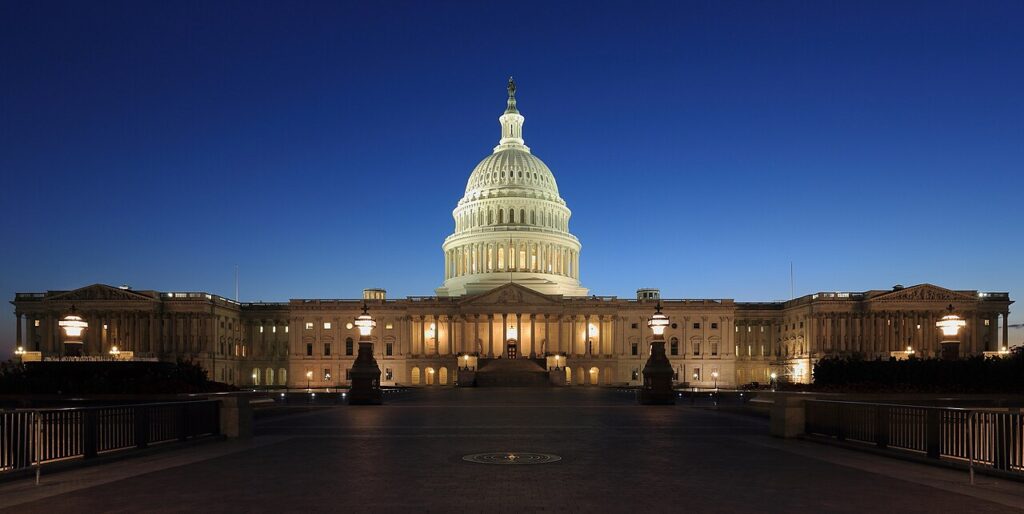
Americans vote on Tuesday, November 3, 2026, in midterm elections that will decide who controls Congress for the second half of Donald Trump’s presidency. The president himself is not on the ballot. What is on the ballot is almost everything else: every seat in the House of Representatives, more than a third of the Senate, 36 governorships, and thousands of state and local offices.
Midterms get their name from their timing. They fall halfway through a president’s four-year term, and they are usually read as a verdict on the sitting administration. This time, the verdict also comes with a practical consequence that will shape the next two years: whether the president can still pass major legislation, or whether he faces a Congress able to block him, investigate his administration, and reject his nominees.
What is on the ballot
The numbers are straightforward. All 435 House seats are contested, as they are every two years. In the Senate, 35 of the 100 seats are up: the 33 regular Class II seats, plus two special elections. One, in Ohio, fills the seat JD Vance vacated when he became vice president; the other, in Florida, fills the seat Marco Rubio vacated to become secretary of state. Thirty-six states elect a governor on the same day, and voters in many states will also decide ballot measures on issues including abortion access and voter identification.
Millions of Americans have already voted. Most states offered early in-person voting or voting by mail in the weeks before election day, and those ballots are counted under rules that vary from state to state — one reason some close races will not be called on the night.
The arithmetic in Congress
Republicans go into election day holding both chambers, but narrowly. In the House, they hold 218 seats to the Democrats’ 214, with the remaining seats vacant or held by an independent who sits with the Republicans. A majority needs 218 seats, so Democrats need a net gain of three seats to take the chamber. In the Senate, Republicans lead 53-47, so Democrats need a net gain of four seats — and must hold all 13 of their own seats on the ballot. A 50-50 Senate would stay in Republican hands, because Vice President Vance casts the tie-breaking vote.
That arithmetic is why a small number of districts and states matter so much. The Cook Political Report rated 76 races competitive in its final pre-election assessment: 53 for the House, 11 for the Senate, and 12 for governor. Ten states redrew their congressional maps mid-decade, a fight that Cook estimated could hand Republicans a net gain of about four House seats — roughly the size of the Democrats’ entire target.
The Senate races to watch
The Senate is the harder climb for Democrats, and the forecasters agree it is close. Fox News rated control of the chamber a toss-up in its final pre-election rankings, while statistical models gave Democrats a narrow edge. The most competitive contests, by most ratings, are in Alaska, Iowa, Kansas, Ohio and Texas, with South Carolina also rated competitive.
Ohio is the race both parties have circled. Republican Senator Jon Husted, appointed to Vance’s old seat, faces former Democratic Senator Sherrod Brown in a special election. Democrats see one of their best pickup chances in North Carolina, where former Governor Roy Cooper is the Democratic candidate. On defence, Democrats must hold seats in Michigan, Georgia and New Hampshire, where the contests have stayed competitive to the end.
Governors and ballot measures
The 36 governor races matter beyond state politics. Governors elected now will run state election systems during the next presidential election, and several states are choosing leaders who will set policy on taxes, education, abortion and voting rules. The pure toss-ups, according to Cook, are Kansas, Nevada and Georgia. Democrats are defending five states that Trump won in 2024 — Arizona, Kansas, Michigan, Pennsylvania and Wisconsin — while Republicans are defending two states that Kamala Harris won, New Hampshire and Vermont.
Ballot measures add another layer. Voters in several states, including Missouri, Nevada, Virginia, Idaho, California, Arizona, North Carolina and Ohio, are deciding questions on abortion and voter ID, among others. These measures can outlast any single election cycle: they change state constitutions and laws directly, without going through a legislature.
How voting works, and when results arrive
Polls open on Tuesday morning, mostly between 6 and 8 a.m. local time, and close at different hours across the country’s time zones. The first polls close at 6 p.m. Eastern Time; the last regularly scheduled polls close at 1 a.m. Eastern on Wednesday, in Alaska’s western Aleutian Islands. Voters unsure of their polling place can check through the federal Vote.gov portal or their state election office.
The first results will come on Tuesday night in the United States — overnight into Wednesday in Pakistan and much of Asia — but a final picture will take longer. Some states count mail ballots quickly; others cannot begin counting them until election day, and close races can take days to call. Recounts are possible where margins are tight. Anyone expecting a settled answer by Wednesday morning should expect a partial one instead: the House may be called relatively early if the margin is wide, but control of the Senate could stay uncertain while the closest states finish counting.
Election officials have been on alert in the run-up to the vote. The FBI has already investigated suspicious letters mailed to election offices in the weeks before polling day, and the campaign’s final days were marked by a federal raid on the home of a sitting member of Congress — a reminder of how charged this election cycle has become.
Why it matters beyond America
For readers outside the United States, the result will shape more than domestic politics. Congress controls federal spending, including foreign aid; it confirms ambassadors and judges; and it can constrain or enable the president on trade, sanctions and military deployments. A Congress controlled by the opposition does not stop a president from governing, but it does force negotiation on every major bill — and it gives the opposition the committee gavels, and with them the power to hold hearings and demand documents.
Forecasts heading into polling day leaned towards Democrats retaking the House, with the Senate rated a genuine toss-up. Forecasts, however, are not results. Polling has missed before, turnout on the day decides close races, and the redistricting fights mean the map itself is partly untested. The one certainty is the scale of what is being decided: by Wednesday, Americans will have chosen the Congress that will govern alongside Trump from January 2027 — and the state leaders who will run the next presidential election.
This is a voting-day guide. It makes no claim about results, which will be reported as they are called.