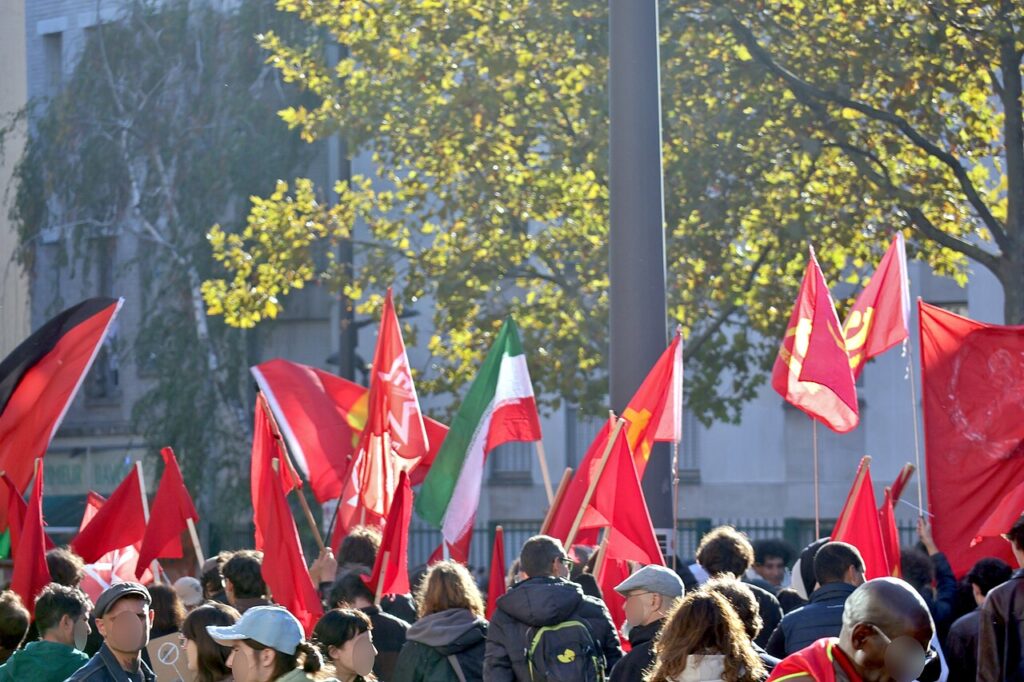
Paris — Hundreds of thousands of people marched across France on Thursday in the country’s biggest day of strikes in years, as five trade union federations that rarely agree on anything took to the streets together for the first time since the pension reform protests of 2023.
The Interior Ministry put the turnout at 600,000 people nationwide. The CGT, one of the unions behind the strike, said 1.6 million had taken part — a gap of a million that says plenty about how both sides measure power in France.
In Paris, the main march set off in the afternoon from Place de la République and headed for Place de la Nation, with tens of thousands in the capital alone. More than 250 demonstrations were held across the country, from Marseille to Lyon, and around 70,000 police officers were deployed nationwide.
The day passed off largely peacefully. There were clashes with police in Paris and Lyon, and smaller confrontations in Nantes, Pau, Orléans, Rennes and Toulouse, but nothing on the scale of the rioting that shook France on 17 October, when some of the worst unrest in years broke out during the student-led protests.
The strike itself was wide. The Eiffel Tower closed for the day. About 15 percent of teachers walked out, and around a third of France’s high schools were closed or unable to operate, some because students had blockaded the gates and others because teachers were on strike. The stoppage even cut France’s nuclear power output early in the morning, and energy workers joined the action alongside rail staff, hospital workers and postal workers. Transport, though, kept running better than feared, with no major disruption to trains.
What brought the unions together was pay — and the government’s draft budget for 2027. The five federations behind the day, the CFDT, CGT, FO, UNSA and FSU, published their joint call on 5 October. Their demands run from wage rises across the board and higher pensions to a rise in the minimum wage, which stands at 12.31 euros an hour and has not had a discretionary increase since 2012. CFDT leader Marylise Léon has called for a net monthly pay rise of 100 euros for the lowest-paid workers.
The trigger is the budget. The government’s draft plan for 2027 calls for 54 billion euros in savings, freezing social benefits and civil servants’ pay. CGT leader Sophie Binet called it “a catastrophe for the country”. A meeting between the unions and the government at Matignon on 21 October produced no measures, and the unions decided to force the issue in the streets.
That five federations signed the same document matters. The CFDT and the CGT, France’s two biggest union confederations, do not often act together, and the last time they did on this scale was the fight over pension reform in 2023. This time students and retirees marched alongside them, and the yellow vest movement — back on the streets since October — joined the demonstrations too. Among those who marched in Paris were the presidential candidates Jean-Luc Mélenchon and Raphaël Glucksmann.
The movement has been building since September, when a protest over staff shortages at a high school south-east of Paris spread into a nationwide campaign over school conditions, then widened into a fight over the cost of living. It now lands barely six months before the presidential election that will choose Emmanuel Macron’s successor, with the far right leading in the polls — and the government knows it. Prime Minister Sébastien Lecornu is due to meet unions and employers on 9 November to talk about the cost of living and salaries.
For now, the pressure is not letting up. The yellow vest movement has called for further blockades on Friday and Saturday, and the CGT has said it wants the action to go on. Thursday’s march was billed by the unions as a day of convergence. The turnout figures suggest they got one.
Why this matters: France is the eurozone’s second-largest economy, and its government is trying to push through the deepest budget savings in years while prices keep outrunning wages. If a united front of unions can force concessions now, it will shape not only the 2027 budget but the presidential race that follows — and it will be watched closely in every European capital wrestling with the same cost-of-living squeeze. The last time French unions united like this, over pensions in 2023, the government survived but was badly weakened. This time, the unions are betting that a government already on the defensive cannot afford to ignore them twice.
France has seen weeks of student-led protests over school conditions and the cost of living. Read our earlier coverage: Nearly 500 Arrested as France’s Student Protests Boil Over and The Yellow Vests Are Back: France Braces for 1,365 Protests.