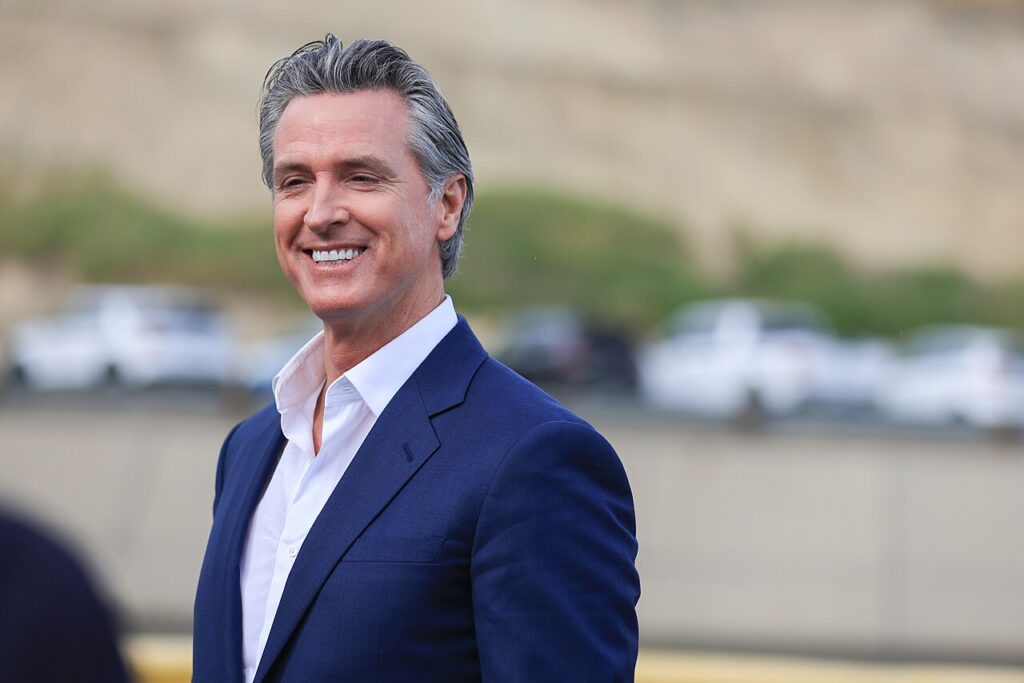
California Governor Gavin Newsom announced on Thursday that he is commuting the death sentences of all 548 people on the state’s death row, replacing them with life in prison without the possibility of parole. It is the largest mass commutation in American history — and it effectively empties the biggest death row in the Western Hemisphere.
The 548 people covered by the order include 529 men and 19 women. California’s death row was the largest in the United States by a wide margin, and Newsom’s single decision cuts the national death-row population by nearly 30 percent. About 1,388 people now remain under sentence of death across the country, the lowest figure since 1984. The previous record for a mass commutation belonged to Illinois Governor George Ryan, who cleared 167 death sentences in 2003.
Not all of the commutations are final yet. Under California’s constitution, a governor cannot grant clemency to someone convicted of more than one felony without the agreement of the state Supreme Court, backed by at least four of its seven justices. That applies to 382 of the 548 cases — roughly 70 percent. Newsom submitted those cases to the court on Thursday. The remaining third will take effect on his own authority, after a 10-day notice period for victims’ families and prosecutors.
In a three-page open letter to Californians, Newsom said the decision followed nearly three decades of opposing executions in public office. “I take this action because I firmly believe that state-sanctioned killing is incompatible with California’s values, undermines the foundations of our legal system, and diminishes all of us.” He called life without parole the most severe punishment he can impose through clemency, and wrote that the people affected would die in prison, but not by the state’s hand. He also acknowledged the decision would be painful for victims’ families, calling it among the hardest of his career.
Newsom halted executions two months into his first term, in March 2019, calling the death penalty a failure. California has not executed anyone in more than 20 years — the last was Clarence Ray Allen, 76, put to death by lethal injection at San Quentin in 2006 — yet the state has spent an estimated $6 billion on the system since capital punishment was reinstated in 1978, carrying out just 13 executions in that time. Voters twice refused to abolish it, in 2012 and 2016, and a 2016 measure meant to speed up executions has produced none. Two-thirds of the condemned were sentenced more than 20 years ago, and about 70 percent are still waiting for lawyers to be appointed for their appeals.
The commutations cover some of California’s most notorious killers, including Randy Kraft, known as the “Southern California Strangler”; Charles Ng, convicted of killing 11 people in the 1980s; and Richard Allen Davis, who kidnapped and murdered 12-year-old Polly Klaas in 1993. But the reaction was not only anger. Jess Nichol, Klaas’s sister, backed the decision, saying she had come to believe that whether Davis is executed “has absolutely nothing to do with my recovery or with real public safety.” Amnesty International praised the move and called for the death penalty to be abolished everywhere.
The announcement landed on a day that showed how divided America remains on the issue: Indiana executed Jeffrey Weisheit, 50, in the early hours of Thursday, with further executions scheduled in Alabama and Florida, and it came weeks after Tennessee’s attempt to execute Christa Pike failed, leaving the state to decide what happens next. Newsom leaves office in January after eight years as governor, and he is widely expected to seek the Democratic presidential nomination in 2028 — a contest in which this decision will be argued over endlessly.
But the immediate effect is simpler, and bigger than any one politician’s ambitions. The death penalty survives in California law — prosecutors can still seek it in new cases — yet the state with the largest death row in the Western Hemisphere has decided it will not execute any of the people on it. That is a turning point the rest of the world will be watching, including in countries moving the other way: Burkina Faso restored the death penalty only last month, eight years after abolishing it. California has just shown that the traffic on this question can run in both directions — and that a single signature can empty a death row built over nearly half a century.