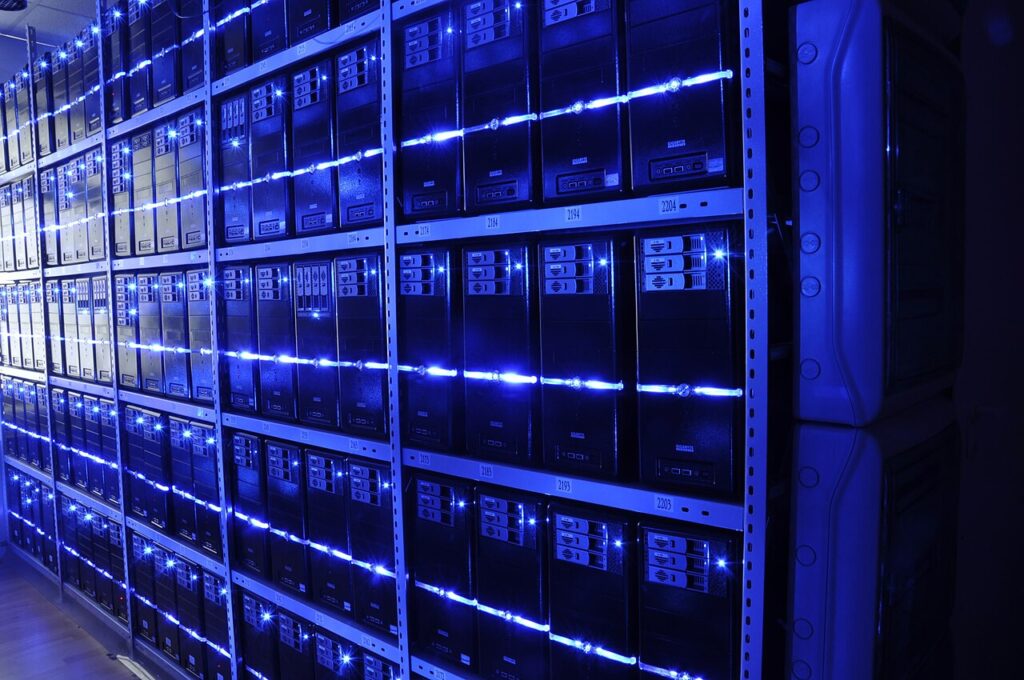
President Donald Trump has a new front in his campaign to keep the artificial intelligence industry inside the United States: the buildings that house it.
Speaking at a White House news conference on Friday, a day after his three-way summit with China’s Xi Jinping and Russia’s Vladimir Putin in Shenzhen, Trump said American companies that build data centers overseas will face a “tremendous tax.”
“We’re not going to allow our companies to build data centers outside of our country,” Trump said. “We’re not going to allow that to happen.”
Then came the admission that has defined the announcement: he had not told anyone in his own administration about the plan before saying it out loud. “I haven’t even said that to my people,” he said. “But I’m telling them now — they’re here.”
What Trump actually proposed
What did he say, exactly? That US firms building data centers abroad “can” do it — “but we’re going to put a tremendous tax on them.” He framed it as a ban backed by a penalty, and gave no details of how either would work, what the rate would be, or what legal authority the government would use.
Why does he want this? Because, in Trump’s telling, data centers are the physical heart of the AI race, and letting them go abroad means handing China the advantage. “We’re not allowing data centers to go into other countries, because China will take all of them,” he said. He singled out a proposed facility in Finland and warned that if companies are allowed to build overseas, “they all will build in China.”
Which companies are affected? All of the big builders. Alphabet announced earlier this month that it plans to invest $15 billion in data-center infrastructure in Malaysia in 2027 and 2028. Microsoft plans to invest more than $10 billion in Kuwait, Qatar, Saudi Arabia and the United Arab Emirates through 2030. Amazon, Google and Microsoft all run data-center operations across the world.
Can a president actually do this? Not on his own, at least not through a tax — imposing taxes is Congress’s job, and Trump offered no mechanism. The threat also landed the same week the Commerce Department issued a rule requiring a licence for data centers anywhere that rent large amounts of computing power on US chips to Chinese companies, and a day after the Senate approved legislation easing data-center permitting, which now heads to the House.
The politics underneath
Trump’s announcement sits on top of a genuine political problem. Data centers are unpopular in many of the American towns where they are built: residents complain about noise, water use and electricity demand, and local opposition has become a live political issue across the country. Trump addressed that directly on Friday, urging communities to welcome the facilities and extract something in return. “You ought to take advantage of the data centers,” he said. “Make them pay you, make them pay your community, but don’t shut them off.”
His pitch to the companies was a mix of threat and promise: build in America — “if they won’t go in Texas or they won’t go in California, they’re going to go in West Virginia” — and, he claimed, they will make so much money they won’t know what to do with it, pay lower taxes, and even build their own electricity.
Why this matters
The timing is awkward for everyone involved. The AI industry is in the middle of the largest infrastructure buildout in history, and the companies doing the building have planned their capacity globally, close to customers and cheap power. A threat to tax overseas construction — however vague, however legally uncertain — lands in the same week those same companies’ shares were collapsing: the Nasdaq had its worst week since March 2020, with Nvidia down 14% on Friday alone.
There is also a tension at the heart of the policy. Trump wants the United States to win the AI race against China, and he wants the computing power that race requires to sit on American soil. But the race is global by nature: Google launched its Gemini 4 Neon model this week at $3 per million tokens, and startups like Superhuman are shipping AI agents to users everywhere. The models are built in America; the users, the data and the demand are everywhere else.
For now, the announcement is a sentence spoken at a podium, not a policy. No executive order, no bill, no rate. But it is a sentence that tells the world’s biggest technology companies something they have heard before from this president: the rules of the AI buildout can change in a single press conference. And as China’s own apps block its AI assistants, the global AI map is being redrawn by politics as much as by engineering.