The Women’s World Cup is about to get bigger, wider and more crowded than it has ever been. On Monday, FIFA confirmed that the 2031 tournament will be hosted jointly by the United States, Mexico, Costa Rica and Jamaica — four nations, twenty cities, and 48 teams for the first time. Four years later, the 2035 edition goes to the United Kingdom, led by England.
Both bids were unopposed and were approved by acclamation at an extraordinary congress of FIFA’s 211 member associations, held online. FIFA president Gianni Infantino said the objective was “making women’s football truly global” — and the map now says so: the 2031 tournament will be the first Women’s World Cup co-hosted by four nations, and the third staged in North America, after the United States hosted in 1999 and 2003 and Canada in 2015.
The numbers explain why this is a different kind of tournament. The U.S.-led bid offers FIFA a choice of stadiums in 20 cities: 14 in the United States, four in Mexico, plus San José in Costa Rica and Kingston in Jamaica. With 48 teams, the 2031 edition will feature 104 matches — the same expanded format as the men’s World Cup. The United Kingdom bid, joining England with Northern Ireland, Scotland and Wales, offers 19 venues, including Wembley Stadium in London.
For England, the wait has been a long one. The country has not hosted a World Cup final tournament of any kind since the men’s World Cup in 1966 — sixty years before the women’s tournament arrives in 2035. That the 2035 edition will be the first Women’s World Cup staged in the United Kingdom at all is a measure of how slowly the women’s game has been given the sport’s biggest stages, and how quickly that is now changing.
The winning candidates promised commercially successful tournaments and pledged to reinvest all profits in women’s football. The next edition, in Brazil in 2027, runs from June 24 to July 25 and will be the last 32-team Women’s World Cup.
Why this matters beyond the fixture list
Two things are happening at once here. The first is scale: 48 teams means more countries at the table — including, for the first time as a host, Jamaica, a nation whose women’s team has repeatedly fought its own federation for basic funding and support. Hosting is not the same as investment, but it is hard to host a World Cup and ignore the team wearing your colours.
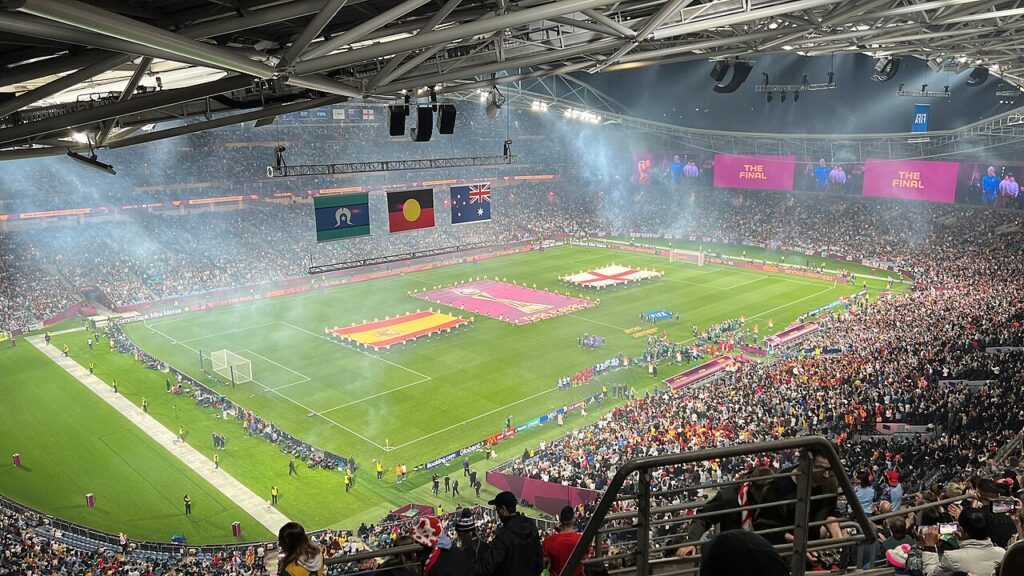
The second is geography. A four-nation tournament spread across North America and the Caribbean, followed by one across the four nations of the United Kingdom, is FIFA betting that the women’s game no longer needs to be concentrated in one country to fill stadiums. The 2023 final in Sydney, played in front of a packed Stadium Australia, suggested the bet is a safe one.
There is a risk, of course, and it is the same one the men’s game now carries: tournaments spread across continents and time zones become harder to follow and easier to dilute. But the counter-argument is the one FIFA is making with its wallet — more teams, more hosts, more matches, and every cent of profit fed back into the women’s game. For a sport that spent most of its history being told to be grateful for scraps, that is a sentence worth reading twice.
And for the hosts, the calendar is already moving: Brazil 2027, then the long road to 2031, when the women’s game arrives in four countries at once — a scale no edition has attempted before. Football, as Infantino might say, is going global. This time, the women’s version is leading the way.
Read FIFA’s announcement: 2031 and 2035 FIFA Women’s World Cup hosts appointed.