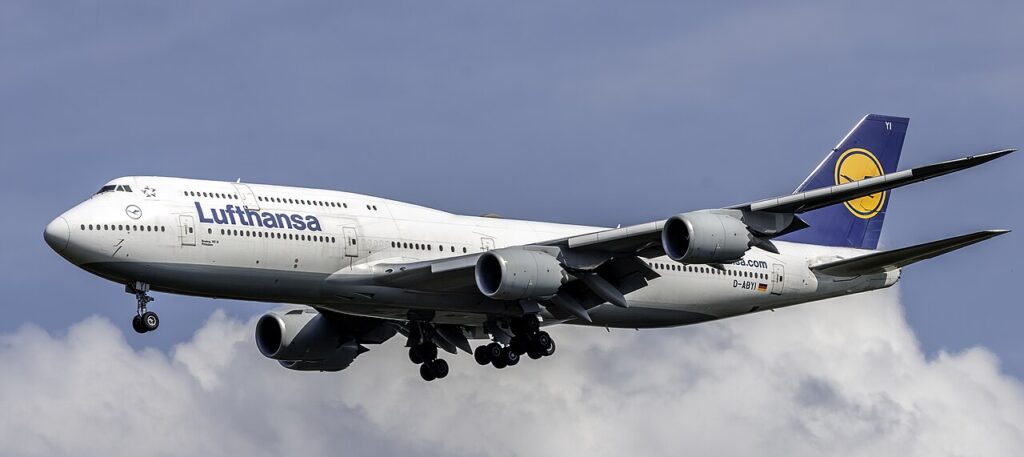
Informopedia Explains: stand on the observation deck at any big airport and watch a fully loaded Boeing 747 leave the ground, and the sight never quite stops being absurd. Four hundred tonnes of metal, fuel, luggage and people — heavier than two blue whales — rising into the sky on nothing but air. No ropes, no magnets, no trick. Just air, moving fast, over a curved piece of metal.
It works. It has worked, millions of times a day, for more than a century. And the reason it works is one of the most satisfying pieces of physics you can learn: a tug-of-war between four forces, won by a wing.
The four forces
Every airplane in flight is caught between four forces, and the pilot’s whole job is keeping them in balance.
Weight pulls the plane down — gravity, acting on every kilogram of it. Lift pulls it up. Thrust pushes it forward — from the engines. And drag holds it back — the air’s resistance to being shoved aside. In level flight, lift equals weight and thrust equals drag. Change any one of the four and the plane climbs, descends, speeds up or slows down. That is, in essence, all of flying.
The interesting force is lift, because it is the one that seems to cheat. It comes from the wing, and from a simple fact: a wing is shaped and tilted so that the air flowing over it ends up moving downward. And when a wing pushes air down, the air pushes the wing up. That is Newton’s third law — every action has an equal and opposite reaction — doing the heavy lifting, literally.
What the wing actually does
A wing’s cross-section is called an airfoil: curved on top, flatter underneath. Air meeting the wing splits, and the air travelling over the top has further to go and arrives moving faster. Faster-moving air presses less hard on the surface beneath it — a relationship described by Bernoulli’s principle — so the pressure above the wing drops below the pressure underneath it. The difference pushes the wing upward.
There is a popular version of this story that says the two streams of air must meet up again at the back of the wing at the same time — the “equal transit time” idea. It is wrong, and NASA’s own teaching materials say so plainly: the air above the wing actually arrives at the trailing edge first. The real explanation is the combination of the two effects — the pressure difference above and below, and the downward deflection of air, which engineers call downwash. Both come from the same cause: the wing’s shape and its angle to the oncoming air, the angle of attack.
That angle is why a plane can fly upside down, and why a flat board held out of a car window at speed will lift if you tilt it. The curve of the wing makes lift efficient; the tilt makes it possible at all. Too much tilt, though, and the smooth airflow over the wing breaks apart into turbulence — a stall — and lift collapses. That is why pilots watch their angle of attack the way drivers watch their speed.
Why speed matters so much
Lift grows with the square of speed: double the airspeed and you get four times the lift. That is why takeoff is a race down a runway rather than a gentle hop, and why a plane that is too slow falls out of the sky while a fast one can glide on a dead engine for miles. Flaps and slats — the panels that extend from a wing’s trailing and leading edges on approach — temporarily reshape the wing to make more lift at low speed, which is what lets a 400-tonne aircraft land at around 270 kilometres per hour instead of well over 300.
A Boeing 747-8 at maximum takeoff weight is about 447 tonnes. Its wings span nearly 69 metres. At cruising altitude, around 35,000 feet, it moves at roughly 900 kilometres per hour through air so thin that each breath of it holds a third as much oxygen as at sea level. The engines provide the thrust; the wings do the rest. Nothing else holds it up.
Why this matters
Understanding lift matters because it is the foundation of everything that flies — including the machines now pushing past it. Hypersonic missiles work by riding the same aerodynamic rules at five times the speed of sound, where the air itself starts to behave differently. Drones, air taxis and the next generation of electric aircraft all live or die by the same four forces.
And there is a quieter point. The next time you look out of a plane window at the wing — that thin, curved slab of metal flexing gently in the wind — you are looking at the whole trick. It is not magic, and it is not brute force. It is a shape, moving fast, persuading the air to push down so that the air pushes back up. Four hundred tonnes of it, held aloft by nothing more solid than a difference in pressure.
The speed of light is a harder limit — why nothing can go faster than light is a different story entirely. But the speed of a wing through air is a limit humans learned to exploit, and the sky has been crowded ever since.
Further reading: NASA Glenn Research Center’s Beginner’s Guide to Aeronautics.