Informopedia Explains: a jar of honey is a small miracle of logistics. Inside it is the work of thousands of insects, tens of thousands of miles of flying, and a chemical transformation that turns thin flower water into a food that never spoils. Archaeologists found honey in Egyptian tombs, 3,000 years old, still edible. No other food humans eat can say that. And the whole process starts with a dance.
The flower: a map written in ultraviolet
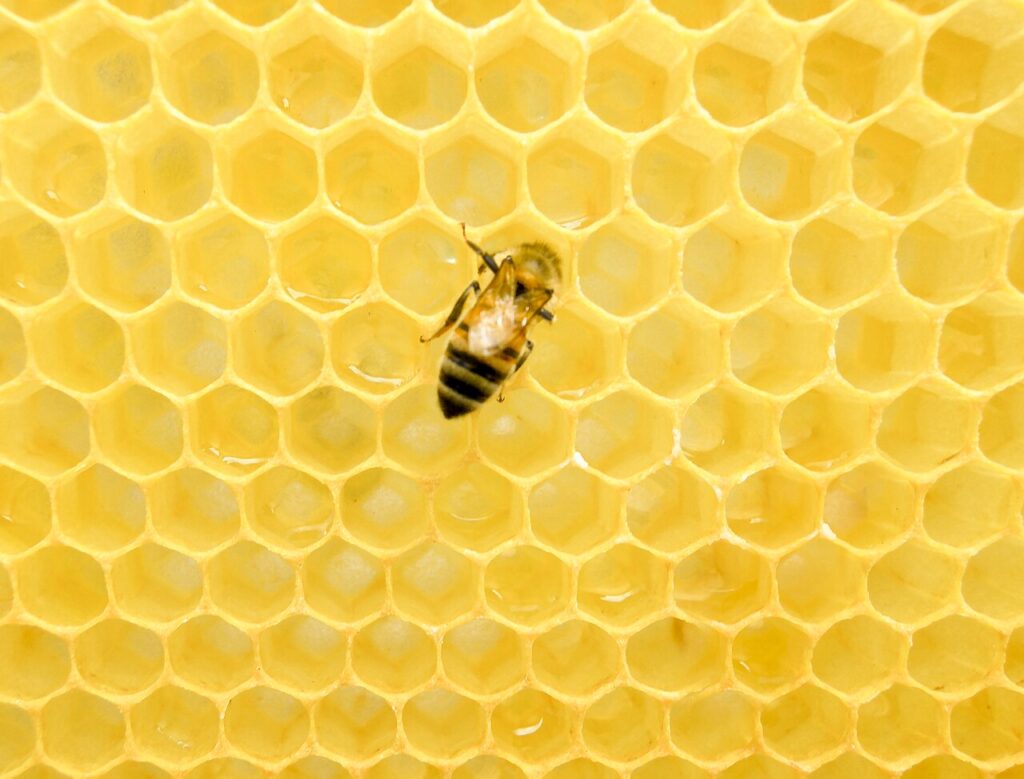
Everything begins with nectar, the sugary liquid flowers produce to bribe pollinators into carrying their pollen. Nectar is mostly water — 70 to 80% — with dissolved sugars, mainly sucrose. A forager bee lands on a flower, unrolls her long tongue, and drinks. She does not swallow the nectar into her digestive stomach. It goes into a separate pouch called the honey stomach, or crop, which she uses purely for transport. She may visit a hundred flowers or more on a single trip, carrying home about forty milligrams of nectar — roughly half her own body weight.
Bees see a world humans cannot. They detect ultraviolet light, and many flowers carry hidden ultraviolet patterns — landing strips pointing straight to the nectar. A forager usually works within two or three kilometres of the hive, though she will fly much farther for a good patch. When she finds one worth sharing, she flies home and tells her sisters about it. The telling is the famous part.
The dance: directions in a dark hive
Back on the comb, in the darkness of the hive, the returning forager performs the waggle dance. She runs in a straight line, shaking her abdomen side to side, then loops back and repeats it. The angle of her run, measured against straight up, shows the direction of the flowers relative to the Sun. The length of the waggle run shows how far away they are: the longer the waggle, the greater the distance. Other foragers crowd around, follow the dance with their antennae, and fly out to the same spot.
For flowers close to home — under about 50 to 100 metres — bees use a simpler round dance instead. The waggle dance is for the long hauls, and it is astonishingly precise. Karl von Frisch worked out what the dance meant, and shared the Nobel Prize for it in 1973. He spent decades watching bees in glass hives, painting tiny marks on their backs, and moving their food sources to see how the dance changed. The result is one of the most remarkable findings in animal behaviour: an insect giving directions with a symbolic code — angle for direction, duration for distance — inside a dark box, to an audience that cannot see the sky.
The kitchen: enzymes, fanning, and wax
Making honey takes four steps, and the dance is only the first.
Step one, collection: foragers bring nectar home in their honey stomachs, where enzymes already begin breaking down the sugars.
Step two, the handover: back at the hive, the forager passes her nectar mouth-to-mouth to a younger house bee, in a process called trophallaxis. As the nectar is passed along from bee to bee, more enzymes are added. The most important is invertase, which splits sucrose into two simpler sugars, glucose and fructose — honey is mostly made of these two. A second enzyme, glucose oxidase, turns a little glucose into gluconic acid and hydrogen peroxide, which gives honey its antibacterial bite.
Step three, the drying: the partially processed nectar is spread into wax cells, and the bees fan it with their wings — hundreds of beats a second — to blow the water away. Nectar starts at 70 to 80% water; honey finishes at about 17 to 18%. The hive holds a steady 33 to 36°C while this happens, which speeds evaporation without destroying the enzymes. The whole transformation takes one to three days.
Step four, the seal: when a cell is full of ripe honey, the bees cap it with a lid of beeswax. Sealed, the honey will keep until the colony needs it — which can be months later, through a winter when no flowers bloom.
Why honey never goes off
Honey’s immortality is chemistry, not magic. At 17% water, there is too little free moisture for bacteria or yeast to grow — the sugar binds the water so tightly that microbes effectively die of thirst. The gluconic acid makes honey acidic, around pH 3.9. And the hydrogen peroxide from glucose oxidase is a mild antiseptic. Three defences, all produced by the bees themselves, and the result is a food that outlasts civilisations. The honey in Tutankhamun’s tomb was still good when archaeologists opened it in 1922, three thousand years after it was sealed.
The scale is hard to grasp. To make a single pound of honey, a colony’s foragers must visit around two million flowers and fly roughly 55,000 miles between them. A single jar on a supermarket shelf represents the lifetime work of hundreds of bees. And only a few of the 20,000-plus kinds of bees on Earth make honey at all — most are solitary, and the honeybee’s industrial-scale operation is the exception, not the rule.
Why it matters
Honey is the by-product. The real business is pollination. As bees move from flower to flower collecting nectar, they carry pollen with them, and that is how most of the world’s flowering plants reproduce — including a large share of the food humans eat. Roughly one in every three bites of food exists because a pollinator did its job. Chocolate is one example: the cacao tree depends on tiny midges and other pollinators, and the crop is already under pressure. Even moths, the night shift of the pollinator world, do work that bees cannot.
That is why falling bee numbers are more than a beekeepers’ problem. Pesticides, habitat loss, parasites and disease have cut into colonies worldwide. A hive is a small factory that runs on information — the dance, the enzymes, the fanning, the wax — and when the factory closes, the fields around it notice. The honey will keep for 3,000 years. The bees that make it need looking after now.