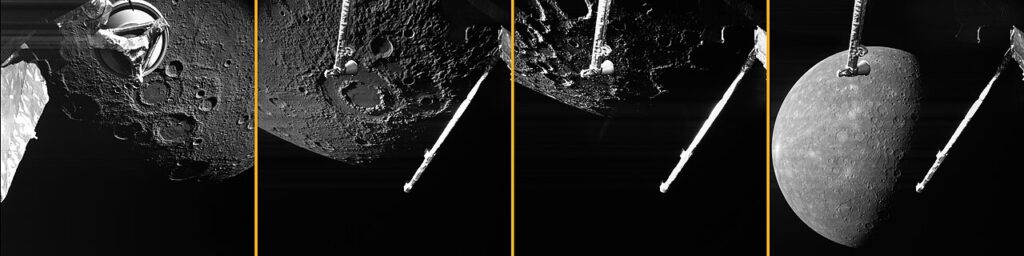
Eight years after it left Earth, Europe and Japan’s spacecraft has finally arrived at the smallest, strangest planet in the Solar System. On 21 November, the European Space Agency announced that BepiColombo had slipped into orbit around Mercury — only the second mission in history to do so, after NASA’s MESSENGER, which circled the planet from 2011 to 2015.
The spacecraft did not arrive in one piece. BepiColombo is really three machines travelling together: a European-built orbiter that will map the surface, a Japanese-built orbiter that will study the magnetic field, and a transfer module that pushed them across the inner Solar System. The transfer module separated in September. Now the two science probes, still joined together, have begun a months-long sequence of 16 engine burns that will slowly lower their orbit. They separate on 9–10 December, and science operations begin in April 2027.
It took this long for a reason. Mercury is the hardest planet in the Solar System to reach — harder, in some ways, than going to Jupiter. Falling towards the Sun gives a spacecraft enormous speed, and shedding that speed to settle into orbit takes years of careful braking. BepiColombo did it with nine gravity-assist flybys — one past Earth, two past Venus, six past Mercury itself — each one stealing a little energy from the planet it passed and handing it back as a change of course.
Why bother with Mercury at all
Mercury is an oddball, and oddballs are where theories get tested. It is barely bigger than the Moon, yet it has a magnetic field — something a small, supposedly cooling planet should not have. Its iron core takes up about 85% of its radius, far more than any other planet’s. And despite sitting closer to the Sun than anywhere else, its polar craters hold water ice in permanent shadow, never touched by sunlight.
Nobody fully understands how a planet like that forms. One idea is that the young Mercury was much bigger and lost most of its rocky outer layers in a giant collision. Another is that the Sun’s heat simply boiled the lighter material away. BepiColombo’s two orbiters are designed to settle the argument: the European probe, flying as low as 400 kilometres, will map the surface and measure the composition; the Japanese probe, swinging out to 11,000 kilometres, will watch how the magnetic field interacts with the solar wind.
What happens next
The schedule from here is precise. The Japanese orbiter, Mio, reaches its science orbit on 9 December and begins tracing ellipses between 500 and 11,000 kilometres up. The European orbiter keeps descending until March 2027, when it reaches its own orbit, 400 to 1,500 kilometres above the surface. Both start full science operations on 6 April 2027 — more than eight years after launch, and a year into a mission that was supposed to be the easy part.
ESA is holding a media briefing on the arrival on 27 November at the Science Museum in London. But the real test comes later, in the data. Mercury has been visited by only two spacecraft in half a century of spaceflight — NASA’s Mariner 10, which flew past three times in the 1970s, and MESSENGER. BepiColombo is the first mission to orbit the planet with two spacecraft at once, watching the surface and the magnetic field simultaneously.
There is a reason the innermost planet stayed mysterious for so long. It is small, scorched, and almost impossible to get to — which is precisely why going there matters. The planets that break the rules are the ones that tell us how the rules were made.
For a sense of how little we knew about planets beyond our own until very recently, consider the “phoenix planet” found orbiting a dead star — a world that should not exist, around a star that should not have one. Mercury is closer to home and just as strange. And like the light-speed limit that governs every journey in space, the physics that made BepiColombo’s trip so slow is the same physics that will govern every mission that follows it.