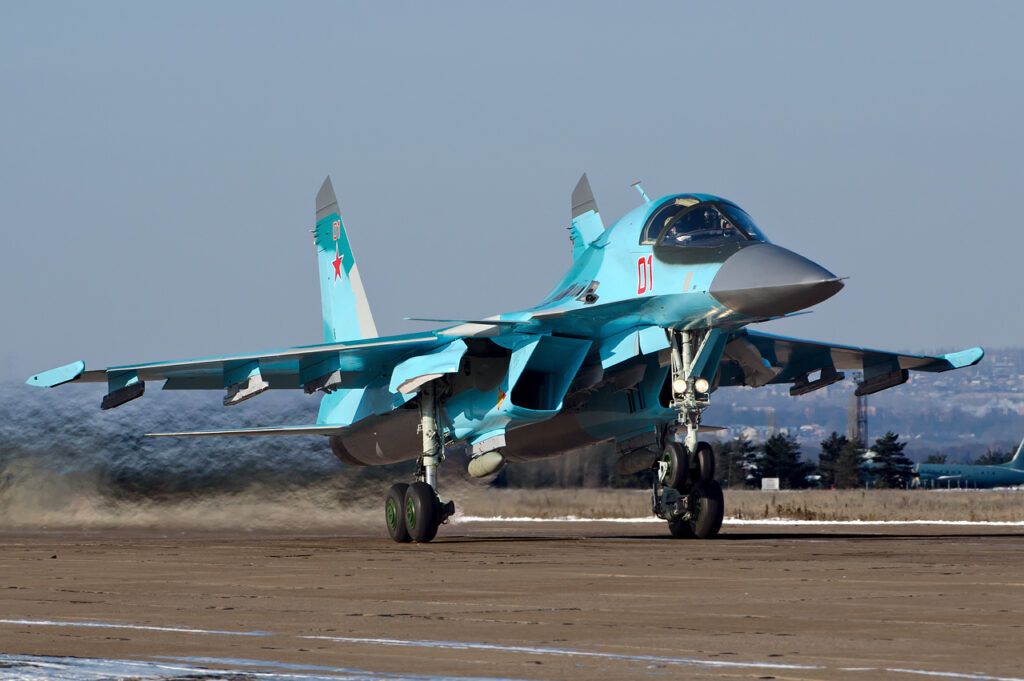
Ukraine’s navy said on Thursday it had destroyed six Russian Su-34M fighter-bombers in an overnight strike on the Borisoglebsk airfield in Russia’s Voronezh region — using Neptune, the domestically built cruise missile that famously sank the Moskva, the flagship of Russia’s Black Sea Fleet, in 2022.
In a statement, the navy said the strike was carried out on the night of October 15 with the Neptune coastal missile system. Six Su-34M bombers were destroyed, it said, along with specialized equipment used to service aircraft on the ground. Secondary detonations of stored ordnance and widespread fires followed the impact. “The destruction of enemy Su-34Ms significantly weakens the enemy’s aviation potential and reduces the intensity of tactical aviation use in the relevant areas of the front,” the navy said, adding that details were still being clarified.
Ukraine’s general staff later said it had confirmed damage “of varying degrees” to all six aircraft, according to Reuters, which cautioned that it could not independently verify the battlefield reports. Russia has not confirmed any losses at Borisoglebsk.
The Su-34M matters because it is the workhorse of Russia’s air campaign. The deeply modernized, all-weather supersonic fighter-bomber — each worth tens of millions of US dollars — is Moscow’s premier platform for dropping KAB guided glide bombs on Ukrainian defensive positions and frontline cities. Those munitions can be released far from their targets, letting the aircraft strike without flying into the range of some Ukrainian air defenses. Six fewer of them, if the claim holds, means fewer glide bombs falling on places like Zaporizhzhia and Kramatorsk.
The Neptune matters, too. Unlike the Western-supplied Storm Shadow or ATACMS missiles, the Neptune is Ukrainian-designed and Ukrainian-built — originally an anti-ship weapon, repurposed for land attack. A successful deep strike with a domestic weapon carries a message Kyiv is keen to send: its long-range strike capability does not depend entirely on Western permission or supply.
Borisoglebsk has been hit before. Ukrainian drones attacked the base in October 2024 and again in July 2025, and a fuel storage facility there was destroyed in another strike in July 2026. The airfield also hosts a Russian training aviation center. Independent monitoring channels reported missile alerts in the Borisoglebsk area on the evening of October 14, hours before Ukraine’s claim surfaced.
The strike claim lands in the middle of a fast-moving week for the war. Volodymyr Zelensky has said Ukraine is resuming attacks on Russian oil refineries after Donald Trump declared an energy ceasefire on Sunday — a truce that lasted barely a day before Zelensky was mocking it. The Ryazan oil refinery was set ablaze in a drone attack, and Zelensky said the strikes were Ukraine’s answer to more than 850 Russian Shahed drone attacks in a single day.
It also comes as Kyiv’s relationship with Washington frays. Zelensky accused the United States of “helping Russia” earlier this week, after reports that American officials threatened to cut off intelligence sharing if Ukraine kept hitting Russian energy sites. A big, domestically executed strike deep inside Russia reads as Kyiv’s reply to that pressure: we can do this on our own.
If the claim is confirmed, it would rank among the heaviest single blows to Russia’s tactical air fleet this year — and a direct hit on the aircraft type doing the most damage to Ukrainian cities. For now, though, it remains a claim: dramatic, plausible, and unverified. The next 48 hours — satellite images, Russian silence or denial, Ukrainian follow-up — will tell whether six of Russia’s most feared bombers really burned at Borisoglebsk.