Informopedia Explains: the small rumble on your lap at 5 a.m. is not one message — it is a whole language, and scientists are still learning to read it.
It was the early hours when Karen McComb’s cat Pepo started. The animal behaviourist, who had spent years studying the calls of elephants and red deer, was being woken before dawn by a low, insistent rumble on her chest — her own cat, wanting breakfast. It was not loud. It was not a meow. McComb did what a scientist does: she started recording. That small domestic irritation became one of the most revealing studies ever done on animal communication.
Most of us hear a purr and translate it in one word: happy. Often it is. But cats also purr in the veterinary waiting room, in the middle of giving birth, while recovering from a broken leg, and sometimes in their final hours. A sound that shows up in moments of pleasure and moments of pain cannot mean just one thing.
The engine in the throat
For decades, the mechanics of purring puzzled researchers. A dog barks by pushing air out; a human sings the same way. A purr runs in both directions — a cat keeps it going while breathing in and breathing out, a trick almost no other mammal manages. The accepted explanation, built on work by Remmers and Gautier in 1972, is that the sound starts in the brain: a rhythmic neural oscillator deep in the brainstem fires signals to the small muscles of the larynx. Those muscles twitch roughly 20 to 30 times a second, opening and closing the glottis, and air passing over the fluttering vocal folds on each breath makes the rumble.
Then, in 2023, researchers at the University of Vienna added a twist. Working with eight excised cat larynges, Christian Herbst and colleagues found that the larynx could produce purr-like oscillations on its own, with no nerve signal and no muscle contraction at all, simply by blowing air through it. The reason appears to be small pads of connective tissue, about four millimetres across, embedded in the cats’ vocal folds. Those pads vibrate passively at purring frequencies, around 25 to 30 hertz. No other domestic mammal has them. The current picture is a hybrid: the tissue does the physics, and the brain shapes the result.
A kitten’s first language
Purring does not start with happiness. It starts with survival. Kittens are born blind and deaf, and they begin purring when they are only a few days old. A nursing mother purrs while her kittens feed, and the kittens purr back. Researchers believe the vibration works as a beacon: a blind newborn can feel its mother’s rumble through the nest and follow it to milk. It is the first conversation a cat ever has, conducted entirely by touch and tremor.
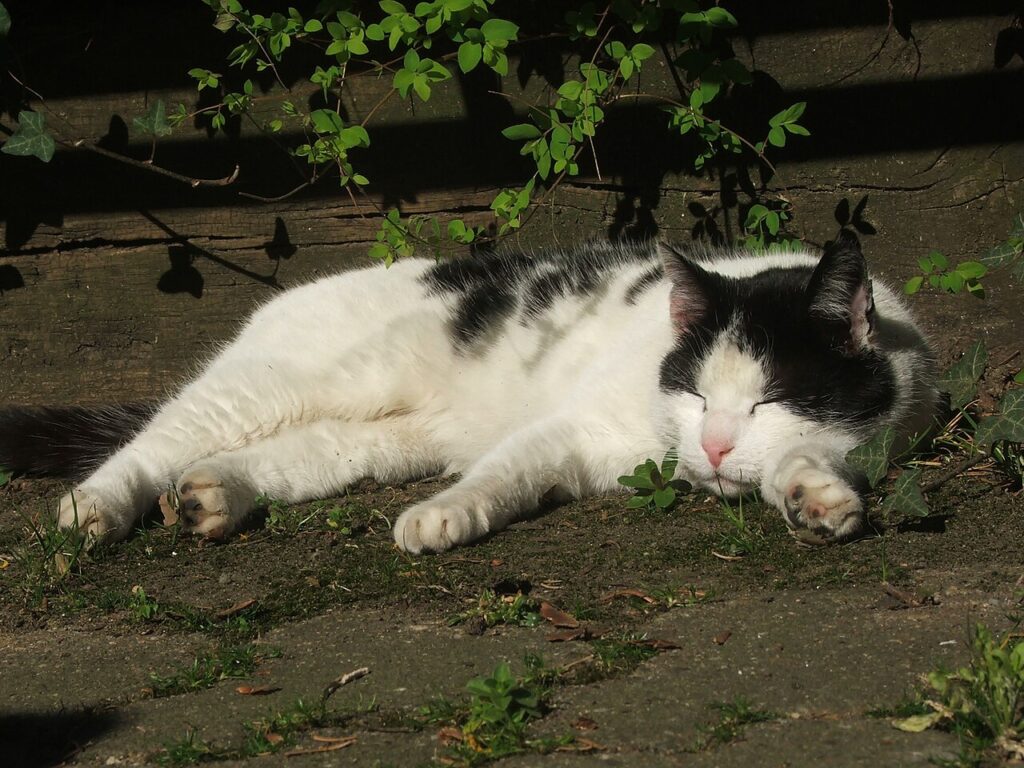
That early use is a strong clue that purring is not, at root, a happiness signal. It is a contact signal — a way of saying “I’m here, I’m close, I’m not a threat.” Adult cats keep using it that way: a nervous cat at the vet may purr at the cat in the next cage, and a subordinate cat may purr at a dominant one. Behaviourists compare it to a human smile — we smile when delighted, but also when nervous or trying to calm a tense room. Owners can read it by watching the whole cat: a contented purr comes with soft eyes, slow blinks and kneading paws, while a stressed purr often comes with a tense body, flattened ears or a tucked tail.
The purr that isn’t happiness
Veterinarians have long records of cats purring in circumstances no one would call pleasant: during labour, after surgery, with serious injuries, in the last stages of illness. One veterinary account describes cats in hospital wards purring continuously, for hours, while plainly anxious or in pain. Researchers now describe purring as a self-soothing signal — something closer to a person humming under stress than to a laugh.
Can a purr heal?
Here is the claim you will meet everywhere online: cats purr at frequencies that heal bones, so purring helps injured cats recover — and might even help the humans they sit on. In 2001, the bioacoustician Elizabeth von Muggenthaler recorded 44 felids — domestic cats, cheetahs, ocelots, pumas and servals — and reported that every one produced strong frequencies between 25 and 150 hertz, with peaks at exactly 25 and 50 hertz. Those are frequencies medicine uses in vibration therapy for bone growth and fracture healing. She proposed that purring might be a built-in, low-energy way for a cat to keep its bones and muscles strong during its long hours of rest — an idea echoed by Leslie Lyons, a feline geneticist at the University of California, Davis.
But honesty requires saying what the evidence is not. Von Muggenthaler’s finding was published as a one-paragraph conference abstract, not a full peer-reviewed paper, and no study has ever shown that a purring cat heals its own fracture faster, or that sitting with a purring cat measurably repairs a human bone. The frequency overlap is genuine, and vibration therapy is a genuine field of medicine, but the leap from “the numbers match” to “the purr heals” has never been tested directly. The coincidence is real. It is not proof.
So where does that leave the claim? Purring probably does help a cat in some physical way — injured and frightened cats do it too consistently for it to be meaningless — but the strongest version of the story, that a purr is a healing machine, runs ahead of the data. A low-frequency vibration that calms the animal and sits in a range known to stimulate bone and tissue is a plausible piece of self-care. It is not a prescription.
The cry hidden inside the purr
The most surprising thing about purring is not what it does to the cat. It is what it does to us. In 2009, McComb and her colleagues at the University of Sussex recorded ten cats purring while actively soliciting food, and while purring in ordinary, non-food contexts. They played both kinds of purr to 50 people at equal volume and asked them to rate how urgent and how pleasant each sounded. Even people who had never owned a cat judged the food-seeking purrs more urgent and less pleasant — and when offered a choice between two purrs from the same cat, they picked the food-seeking one as the more urgent almost every time.
The reason was buried inside the sound. The team found a high-frequency peak, around 380 hertz, embedded in the low rumble of the solicitation purrs — a voiced component, like a cry or a meow, woven into the purr. That frequency is close to the pitch of a human baby’s cry, roughly 300 to 600 hertz. When the researchers digitally removed just that high-pitched element, the urgency ratings fell sharply. The cat, in other words, had learned to slip a baby-like cry into its purr — a sound humans are wired to answer. The purr that drags you out of bed is not quite the purr you hear on a quiet evening, and your cat knows it. Our earlier explainer on why humans cry looked at how tears evolved as a social signal; the solicitation purr is the feline version of the same trick.
Why lions can’t purr
If purring is so useful, why don’t lions do it? The old textbook answer points to a small bone in the throat called the hyoid. In domestic cats and other small cats, the hyoid apparatus is fully bony and rigid, which supports continuous purring on both the in-breath and the out-breath. In lions, tigers, leopards and jaguars, part of the hyoid is flexible cartilage instead of bone — a structure that allows the deep resonance of a roar, which can carry for kilometres and hold a territory together, at the cost of a true purr. Big cats can make purr-like sounds, but only while exhaling, and no cat can both roar and purr. The Vienna larynx research complicates the old picture, but the division holds. Cheetahs and pumas purr; lions and tigers roar. The snow leopard, oddly, does neither.
What it means for the person on the sofa
So what should an owner do with all this? Mostly, what good owners already do: listen to the purr, but watch the cat. A purr with a relaxed body, slow blinks and kneading paws is contentment — and, in a small way, a compliment. A purr that appears alongside hiding, loss of appetite, a sudden change in the sound itself, or a cat that will not move, deserves a vet visit, not reassurance. A purr is a signal, not a diagnosis.
There is also something quietly remarkable in the relationship itself. Cats were never bred the way dogs were; they domesticated themselves, drifting into human settlements for the mice and staying for the warmth. The purr is one of the few sounds they kept from kittenhood into adult life, and they kept it, it seems, because it works on us. Like the grief and attachment behaviours seen across the animal kingdom, it is a reminder that the emotional lives of animals are not simple.
Why this matters
Purring matters because it is a case study in how much we get wrong when we translate animal behaviour into one human word. “Happy” is too small a box for a sound that a cat uses to find its mother in the dark, to calm itself in pain, to keep the peace with a rival, and to get breakfast out of a sleeping human. The 2023 discovery of the passive vibrating pads means researchers can now study purring mechanics without a living cat in the loop. One prediction is safe: the more we learn, the less the purr will sound like a single word. It is closer to a sentence, and cats have been speaking it to us for thousands of years.