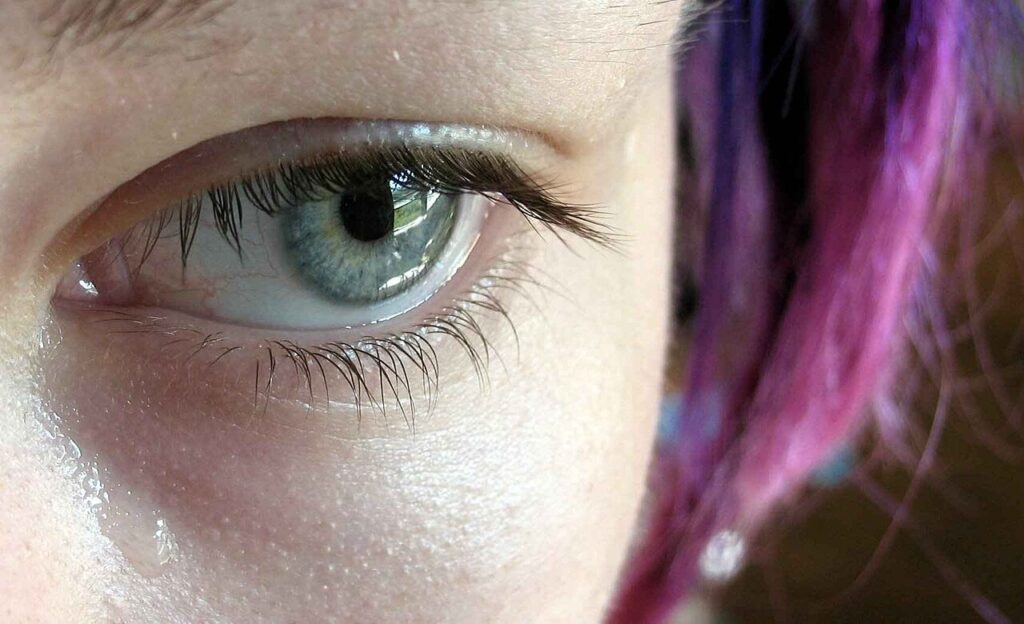
Informopedia Explains: every land mammal makes tears. Only one species cries because it is sad, or moved, or overwhelmed — and it is us. Dogs whimper. Elephants trumpet their grief. But no other animal sheds tears over a feeling. The reason is wired into the human brain, and it is stranger than the usual explanation you have heard.
Three kinds of tears
Your eyes make three different kinds of tears, from the same small almond-shaped glands that sit just above the outer corner of each eye. Basal tears flow all the time, about 0.5 to 2.2 microlitres a minute, keeping the cornea wet and nourished. They are a three-layer film — oil on top to stop evaporation, water in the middle, mucus underneath to help it stick — and you never notice them until they stop working. Reflex tears are the emergency flush: chop an onion, walk into smoke, get dust in your eye, and the flow can rise a hundredfold, to around 300 microlitres a minute, washing the irritant away with water and antibodies.
Emotional tears are the odd ones out. They are not triggered by anything touching the eye. They start in the brain’s limbic system — the emotional core that includes the amygdala, which weighs how much a feeling matters — and travel down through the brainstem to the facial nerve, which tells the lacrimal glands to open up. The signal is the same machinery that makes you blush or your heart race; the tears are just its most visible product.
They are also chemically different. Emotional tears carry more protein than reflex tears, and higher levels of stress hormones — including adrenocorticotropic hormone and leucine enkephalin, a natural painkiller. That finding comes from a small study by the biochemist William Frey in the 1980s, and it has been wildly overstated since: the popular claim that crying “flushes toxins” out of the body rests on that one unreplicated study, and the amounts involved are far too small to detoxify anything. What the chemistry does show is that emotional tears are a different product from the ones that wash out dust — made by a different command, for a different purpose.
Why would evolution invent this?
The leading explanation is surprisingly practical, and it has little to do with flushing anything out. Tears blur your vision and mark your face as distressed. A crying person looks less threatening, and more in need of help. In a social species, that is a powerful signal: it softens aggression from others and invites caregiving, often before a word is spoken. Babies cry to signal that something is wrong; adults, the theory goes, kept the same channel and aimed it at feelings.
That also explains why crying is so social. Studies find that roughly a third of crying episodes actually leave people feeling worse — and the deciding factor is usually whether someone else was there to comfort them. Cry alone in a room and you may feel no better. Cry in front of someone who puts an arm around you, and the same tears seem to help. The relief, if it comes, comes from the response, not from the salt water.
There are differences, too. Testosterone appears to inhibit crying, while the hormone prolactin — higher in women — stimulates it, and studies consistently find that women cry more often than men, on average. Crying also changes with age: in newborns it is a reflex, a pure alarm; in adults it is almost entirely emotional, triggered by grief, joy, frustration, empathy — and by music, films and weddings, the moments when feelings outrun words.
What crying does not do
It is worth clearing up the myths, because crying attracts them. Tears do not wash stress hormones out of your body in meaningful amounts. Crying does not mean you are weak — the same limbic system that triggers it also drives the focus and determination that gets people through hard things. And holding tears back is not obviously healthier: the research on suppression is mixed, but the social cost of never signalling distress is real. People who never cry are harder to read, and harder to help.
That is, in the end, what makes human crying unique. It is not a plumbing system. It is a language — one that predates words, that babies use before they can speak, and that adults never quite give up. Like why déjà vu feels so real, or why we dream, it is a reminder that the brain’s strangest behaviours usually turn out to be communication. The tears are the message. The comfort they summon is the point.